

Canonsburg to test new parking pattern
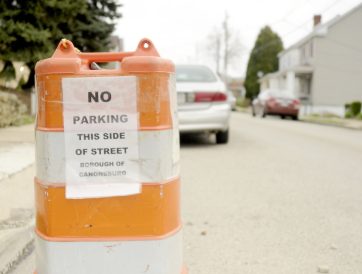
CANONSBURG – By week’s end, residents of Chartiers Street and Duquesne and Franklin avenues in Canonsburg must restrict their parking to one side only.
Council members voted Monday night to change parking to only the south side of the 400 and 500 blocks of those streets for a 90-day trial in an ongoing effort to reconfigure parking throughout the congested borough.
This is the second phase of about 13 streets officials determined could benefit from parking restrictions.
About 35 residents, mostly those affected by the change, attended the meeting to voice concerns about limited parking options after being informed via letter of the upcoming alteration.
“I am totally opposed. That road was a two-way road and we didn’t have issues,” said Ron Krusienski, a Franklin Avenue property owner. “There was no problem for 65 years.”
Mayor Dave Rhome said the changes were being implemented for the safety of the entire community.
“I applaud council for moving forward to make this happen,” Rhome said.
Council Vice President Rich Russo, who conducted the meeting in President John Bevec’s absence, offered alternatives such as using available driveways, garages and back-alley access for parking.
Many residents complained about the condition of borough alleys and the cost of putting in parking pads, another suggestion of council members.
As an incentive to construct parking pads, the borough offered to waive permit fees, which cost between $50 and $100, and secured agreements with vendors to provide materials like slag and sand to property owners at the borough’s reduced cost.
Effective Tuesday, parking in the 400 and 500 blocks of Giffin Avenue was moved from the northside to the southside after officials found the change would allow for more parking spaces.
The first wave of restrictions are considered a success, according to Rhome, with one-side parking implemented on South Jefferson Avenue and the 900 and 1000 blocks of Second Street.
“Be patient,” Rhome advised.
In other business, council voted to conduct a second audit of the now-defunct Main Street program after the first audit revealed the borough could owe the state as much as $26,000.
The Main Street program, also called Our Town Cooperative, was funded mostly by state money and created to bolster downtown business, including facade renovations and community events. It was shut down in the beginning of 2013, after the resignation of manager Nadeen Steffey.
“We didn’t have a good candidate to proceed, and we didn’t have the (financial) support locally,” said Russo.
Council members discovered the program was never officially closed through the state. In order to close it, the audit was done, which revealed a discrepancy in funds.
Russo said he believes a second, more in-depth audit will reveal problems with bookkeeping.
One facet of the Main Street program was a matching grant program in which business owners could apply for funds to improve building facades. Russo said in at least one case, that money was never matched by the state. Another possible cause of the inconsistency, he said, is local businesses pledged to make donations to the program that were never collected.
“It’s a grand leap to say money is missing,” Russo said. “We do know if our audit is successful and completed, and we find out we do owe money, we need to pay it.”