

State Senate committee hears testimony in Carroll Township on blight
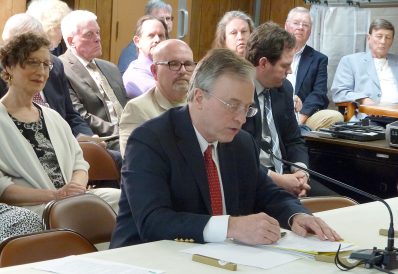
Blight can be described in different ways and the problem is inconsistent among the 66 municipalities in Washington County, a county commissioner said Wednesday.
For example, there are eight unsightly properties scheduled for demolition in Chartiers Township, a community with 1,500 property owners, Washington County Commissioner Harlan Shober said at a state Senate hearing in Carroll Township on blight and revitalization.
“To the other extreme, the Mon Valley communities such as Donora, Charleroi and East Bethlehem Township and the city of Washington and other more urban municipalities experience a much more obvious problem,” Shober said at the hearing in the Carroll Township building hosted by state Sen. Camera Bartolotta.
“The number of properties that need attention is much higher and the need for a plan and strategy for their use, going forward, is of upmost priority,” Shober said.
The Senate Urban Affairs and Housing committee hearing chaired by state Sen. Scott Wagner, R-York, gathered testimony suggesting municipalities need to collect data on blight and use it to levy expensive fines against owners of blight properties or find one judge to oversee a blight court in order to better identify offenders. It was also suggested to the committee that people who have been cited for blight should be excluded from bidding on properties when they come up at auction.
“Problems can become opportunities when the right people come together,” said Bartolotta, R-Carroll.
She said blight costs Pennsylvania municipalities a collective $27 million a year and also lowers other property values and places a higher real estate tax burden on those who properly care for their buildings.
Shober suggested Washington County create land banks, where a board is established to work with local municipalities to purchase property and decide how it would be reused.
Joe Kirk, executive director of Mon Valley Progress Council, said his organization recently formed a “fight blight roundtable” to develop cooperative approaches to address the problem.
Among the roundtable’s recommendations is to dedicate an attorney to expedite the legal process of acquiring blight.
“There is simply not enough money available nor is it an effective strategy to just demolish any and all properties defined as blighted,” Kirk said.
Bill McGowen, executive director of Washington County Redevelopment Authority, said it takes money and hard work to eliminate blight. One federal source of money that can be used to address community blight has been reduced by 40 percent in the past five years, he said.