

Mechanical tin toys always in demand
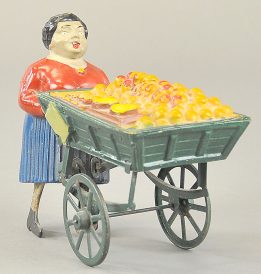
Tin toys, especially those that picture everyday life, are popular with today’s collectors. Political, social, women’s work, and other themes inspired toy makers. Many early toys were made of very thin tin that was painted in bright colors. Some of the toys moved when wound and had either a clockwork or a key wind mechanism. Toy collectors are careful to use the proper word – “clockwork” or “windup.” Clockwork toys have gears and parts like those used on a clock. In 1862, a cheaper type of power for moving toys was developed that used a spring, which was wound with a key or crank. Some still were being made as late as 1920. By the end of World War II, plastic parts were used for toys and the earlier metal wind-up was out of production. Battery-operated toys were made in Japan after 1946 and today there are electronic toys. All of these toys are popular with collectors and price is determined by condition, rarity and the appeal of the design. Toys that move or make noise always attract buyers.
Q. I have a gold ring that belonged to my grandfather and perhaps his father. It’s engraved with initials on a flat section on the front. The sides of the ring band are decorated with a geometric pattern. Inside is a small mark, the capital letters “OB” in a rectangle with clipped corners. Can you tell me who made it?
A. OB stands for Ostby & Barton Co. a jewelry firm that worked from 1880 to the 1950s. Englehart C. Ostby was born in Norway, moved to the United States, and by 1879, had joined with Nathan B. Barton to form a jewelry company. The firm was so successful they became the country’s largest jewelry manufacturer and the largest ring makers in the world. In 1912, Ostbys, Barton and his 22-year-old daughter Helen went on a trip to Europe to vacation and to buy precious stones for the company. They changed their vacation plans, deciding to return on the RMS Titanic with friends. When the Titanic hit the iceberg, the Ostbys both went from their staterooms to the lifeboats and waited to leave. Barton went back for a coat and missed a lifeboat; he drowned and his body was later found, identified, and buried near his home. Barton’s daughter, who had to leave the Titanic without him, was rescued, and she continued working with her brother at Ostby & Barton. Collectors search for pieces of O & B jewelry partly because of Nathan’s newsworthy death and partly because of the quality of the jewelry. Price depends on the value of the stones, the gold and the design. Most jewelry offered online is priced from $125 to $350, with some prices as high as $3,500.
Q. I have the chance to buy an old Sligh dresser from a family member. It’s made of walnut, 54 inches wide, has columns on the sides, a burled oval on the front, and 2 large and 2 small drawers. Can you tell me if it is an antique? What would be a fair price to offer?
A. Charles R. Sligh founded the Sligh Furniture in 1880 in Grand Rapids, Michigan, after working for Berkey & Gay as a furniture finisher and travelling salesman. By the 1920s, Sligh advertised itself as “the largest manufacturer of furniture exclusively for the bedroom in the world.” From 1910 through the 1920s, the company offered more than 80 bedroom suites and 11 dining room suites in a wide range of styles, including Sheraton, Louis XVI, Jacobean, Italian Renaissance, and more. Some had a painted finish or painted decoration. Sligh closed in 1932. Your dresser probably is a retro piece made in an older style. A fair price to offer would be $150 to $200.
Q. I would like to know the value of a Rowenta Snip lighter with case.
A. Robert Weintraud founded Weintraud & Co. GmbH in Frankfurt, Germany, in 1884. The name Rowenta, a combination of his first and last names, was adopted in 1909. Rowenta began making lighters in the 1940s. Rowenta Snip lighters were first made in 1952. Rowenta is now part of Groupe SEB. Value of your lighter, $30 to $40.
Tip: Don’t hang an oil painting above a fireplace that is used frequently. Smoke will damage the paint.
Current prices are recorded from antiques shows, flea markets, sales and auctions throughout the United States. Prices vary in different locations because of local economic conditions.
• Silver, asparagus tongs, Feather Edge Shell pattern, Goldsmiths & Silversmiths Co., 1901, 3 inches, $95.
• Toy, sulky, red cart, seated jockey, embossed seating, spoke wheels, iron, gold trim, Pratt & Letchworth, 8 inches, $235.
• Rug, black bear, full head, claws, felt pad, Crosby Fur Co., 69 x 72 inches, $320.
• Fairy Soap sign, girl sitting on soap, slogan, cardboard, die cut, easel back, countertop, 18 x 12 3/4 inches, $400.
• Decoy, Hooded Merganser, wood, painted, ringlet neck, tack eyes, lead weight on base, 6 x 18 inches, $530.
• Papier-mache doll, shoulder head, painted face, hair, inset eyes, stitch jointed, Germany, c. 1840, 29 inches, $950.
• Commode, Louis XV style, black lacquer, gilt, marble, two drawers, Japanese scenes, c. 1950, 33 x 39 inches, $1,125.
• Wristwatch, Rolex, Datejust, 18k yellow gold, diamonds, presidential-style bracelet, c. 1974, woman’s $8,610.
Write to Kovels, Observer-Reporter, King Features Syndicate, 300 W. 57th St., New York, NY 10019.