

USC panel talks ethics in emergency care, assisted suicide
When Hurricane Katrina leveled New Orleans in 2005, it left hospitals in disarray. Flood waters swallowed power generators and thousands of people poured into the buildings seeking life-saving care. As resources waned and evacuation of patients had to be prioritized, Memorial Hospital Chief Physician Ana Pou told doctors to administer lethal doses of drugs to patients in palliative care and faced criminal homicide charges.
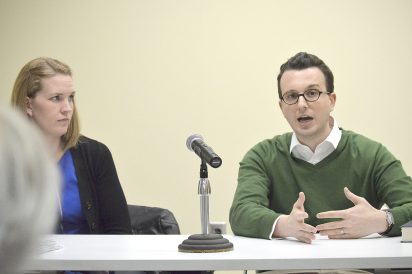
A grand jury that investigated Pou dismissed the charges, but in the wake of the controversy, Pou drew attention to ethical considerations doctors use in disaster situations. The topic was discussed at Upper St. Clair Library March 26 as part of Allegheny County Library Association’s annual “One Community One Book” selection of “Five Days at Memorial,” which two local biomedical ethicists commented on and used as a springboard for understanding doctors’ roles in end-of-life health care decisions.
“So, what happens in a situation like Katrina is triage care, or assigning importance of care to patients: those who need it immediately, those who need evacuated immediately, and those who should be evacuated last,” said Jason Byron, manager of medical ethics at UPMC-Presbyterian hospital in Pittsburgh.
Babies were first for treatment and evacuation, leaving those in palliative care or that elected “do not resuscitate” status in their medical directions to be left last. According to Byron, because palliative care is treating symptoms of illness, like pain, those patients’ elective status was similar to DNR patients in that maintaining comfort, not sustaining life, was a priority.
Pou said informed consent is impossible during disasters, and used as protocol those who were in the best health should be evacuated first. Yet this, bioethicists agree, is unique to disaster or triage scenarios and not in ideal care situations.
The parallel problem, according to Sarah Stockey, a clinical ethics supervisor at Duquesne University, is a breakdown in communication.
“We put as much authority in the hands of the patient as possible … but if those (directions for care) aren’t communicated to family or to a medical attorney whom you assign power of attorney for that purpose, your autonomy near end of life and through health care during it are diminished,” she said, “and the best starting point is to have candid conversation with family about fears and anxieties about illness and death, and your expectations for quality of life in certain circumstances.”
A living will is a way to provide instruction to doctors when a person’s ability to make rational decisions is taken away by loss of consciousness or severe mental degradation, such as late-stage dementia. But even with these tools, ethicists still take both the wishes of the patient and the patient’s family into consideration.
“Ethicists and doctors in hospitals will weigh those concerns of the family and make sure they’re heard … we try to reach an agreement where everyone is comfortable while honoring the patient’s wishes,” Stockey said.
Despite these approaches, resident Matt McClaughlin was skeptical, and told the two bioethicists they and others shouldn’t use utilitarian ethics – like the practice of triage care – in general care situations.
McClaughlin, who identified himself as Catholic, said the presumption of any medical decision should be preservation of life.
“Utilitarianism as a practice leads to evil. I don’t think the philosophy is inherently evil when it’s approached with care, but it can’t be your underlying philosophy as a medical practitioner,” he said.
Stockey and Byron never said they were utilitarians, nor that they use that lens as a starting point, but they said ethical decisions should be filtered through three principles: beneficence, or to provide care that provides actual benefits; mitigation, or preventing further harm; and justice, or treating patients fairly, particularly in regards to patients in similar situations.
The principle of “do no harm” is what prevents euthanasia as a legal practice in the United States. Stockey said the idea of doctor-assisted suicide may gain traction over euthanasia in the coming decades because it places responsibility and autonomy solely in the hands of the patient.
“With euthanasia, the doctor is administering lethal drugs to end suffering or prevent further suffering, whereas doctor-assisted suicide would have a doctor providing the materials to a patient and instructing them how to administer the drugs,” she said. Canada’s Supreme Court in February to overturned a 1993 ban on doctor-assisted suicide. The country’s government has until next February to rewrite its laws on the procedure. The practice is currently legal in Oregon, Vermont and Washington, and is being debated in New Jersey.