

Washington County has two people in place to aid veterans with VA inquiries
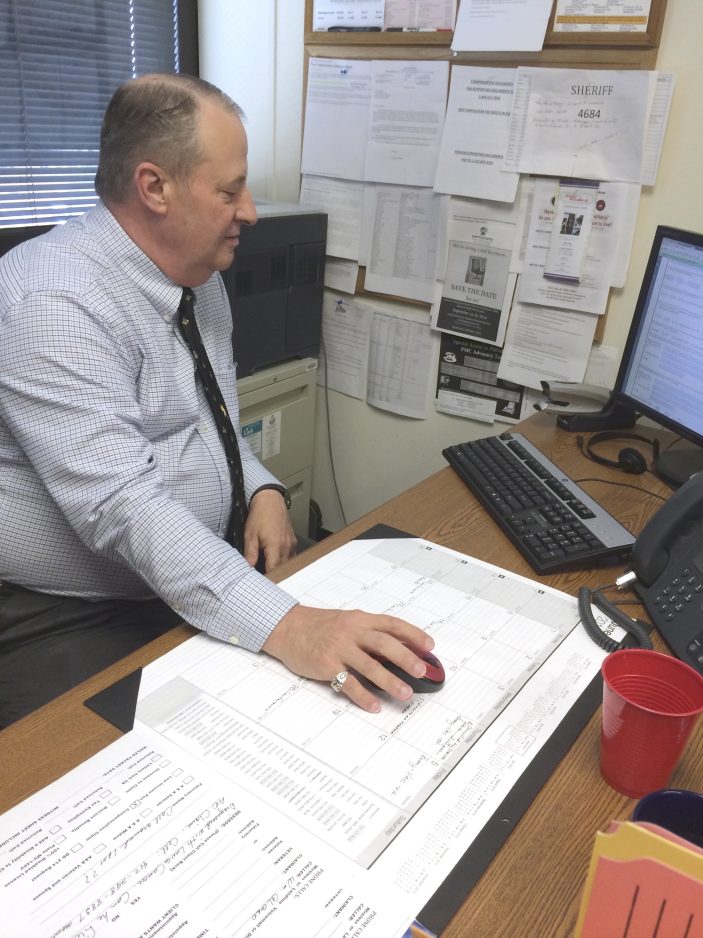
Barry Grimm, director of the Washington County Veterans Affairs office
Trying to find out about veterans’ benefits can be a bewildering experience, but each county government in Pennsylvania has people in place to aid those who are trying to secure them.
Anyone who spends any amount of time in the hallways of the seventh floor in Washington County’s Courthouse Square office building is going to encounter people stepping off the elevator with one question in mind: “Which way to the veterans office?”
A steady stream of pedestrian traffic makes its way to the office of Barry Grimm, a U.S. Navy veteran who survived the USS Forrestal’s disastrous fire in the Gulf of Tonkin during the Vietnam War. As the director of the Washington County Veterans Affairs office, Grimm, along with his assistant, Susan Meighen, are both nationally accredited to handle veterans’ claims.
He recently discussed some basic information.
First, he doesn’t differentiate between “wars” and “conflicts.”
“The VA considers them wars,” he said of the federal department.
The second is the definition of the term, “claim.”
“A claim is not medical treatment,” Grimm said. “A claim is compensation. I have nothing to do with that health care system, except for minor things like helping them fill out a form to get in.”
The Department of Veterans Affairs operates Community-Based Outpatient Clinics known as “C-BOCs.” There are about three dozen clinics in Pennsylvania, including one in Washington Crown Center, 1500 W. Chestnut St., so it’s not just for Washington County residents.
Once a veteran completes the form for health care, Grimm recommends that, because it’s only two miles from his office, that he or she drop it off in person.
“They have an enrollment person here at the clinic,” Grimm said. “I always recommend that you hand-carry it so it doesn’t get lost in the mail.”
It’s his experience that veterans are notified within a few weeks if they’re eligible to be an outpatient at a clinic.
For his clients, Grimm routinely checks a box that says, “Please notify me of my first appointment.”
If a veteran is accepted as patient, Grimm said, “That gets your foot in the door. You have to go at least once a year. If you stop going there, you may get tossed out of the system.”
Because Washington is so close to VA hospitals in Pittsburgh, Grimm said he rarely gets requests for veterans to receive health care at the closest “regular” hospital.
If someone happens to have an old paper form lying around, Grimm’s advice is to discard it.
A health care form to determine eligibility for clinic treatment is now called the “10-10-EZ.” It is two pages long and it has two pages of instructions. It replaced a much longer form.
Grimm said in late April, the majority of people he’s dealing with are “Vietnam veterans because of the agent orange factor, but we still get a lot of World War II and Korea. We just had one in here, a 96-year-old Merchant Marine who transferred over to the Coast Guard. He wanted to get into the health care system.”
He invites people to make an appointment to see him or Meighen so they can work on the forms together rather than people trying to fill out forms themselves and bringing them in for him to check.
“We’re going to get on the computer, bring that form up, and most of them are fillable now. We know where to send it, and we know how to send it.”
A third area he addressed are caregiver benefits.
“You can’t be a caregiver unless you’re being paid by that veteran to perform activities of daily living for him or her,” Grimm said. “If you went into a personal care home, for example, that personal care home would have to be performing at least two activities of daily living.” Those activities might include assistance in getting a person in or out of bed, administering medications on time, bathing or daily exercise, if required. The caregiver’s role is also related to the veteran’s income, and spouses of war-time veterans may be eligible, but Grimm has the details.
After filing a claim, Grimm’s clients may call him to check on its status, which he can do. Or, a veteran or family member can track it by signing into a program and going through “e-benefits.”
“It’s so complicated,” Grimm said, and the VA system is constantly changing. “That’s why we have to go to training courses.”
The Greene County Veterans Affairs office on High Street in Waynesburg also serves as a place for local veterans to receive answers. For processing claims, Director Dalen Watson also uses other organizations such as the Veterans of Foreign Wars.
“Anything that you can think of that someone might need, we do,” Watson said.
Watson said that she has had every request in the book, including a few peculiar ones.
“One time, I had a woman asking me to put her husband in jail,” Watson said. “We do a lot, but I can’t do that.”
Another resource for veterans is available at California University of Pennsylvania.
The Greater McKeesport Vet Center sends a licensed professional counselor to Cal U. every week during the academic year to meet with veterans, who don’t need to need to be a student to qualify for the service, said Robert Prah, director of Veterans Affairs at the university.
“I know people come,” Prah said.
He said the counselor finds a quiet space to meet people in Louis L. Manderino Library from 10 a.m to 2 p.m. every Tuesday during the academic year. The day may be changed this fall to Thursday.
Vet Centers are a community-based arm of the U.S. Department of Veterans Affairs. For more information 724-938-4076 or email vetcenter@calu.edu.
Staff writers Scott Beveridge and Chelsea Dicks contributed to this story.