

Maker movement coming to local school districts
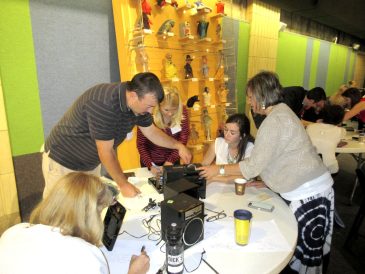
PITTSBURGH – The sound of hammering permeated the theater of Children’s Museum of Pittsburgh as area educators gathered to complete a task. Divided into small groups, their goal was … well, not exactly clear.
Deconstructing a waffle iron, electric razor, ’90s-era boom box, plastic toddler toy and a computer keyboard with all available tools seemed to be the most pressing issue.
“It put us into the position of learner, with no set criterion for what they wanted us to do,” said participant Mandi Figlioli. “We took notes, because we didn’t know if we had to put it back together.”
Figlioli, Burgettstown Area School District assistant to the superintendent, was one of 65 area educators who participated in “maker learning” training June 29 at the museum. Burgettstown Area Elementary Center and Cecil Intermediate School have been selected to participate in the pilot stage of a program that will explore ways schools can integrate the philosophy into their curriculums.
Maker learning is a movement characterized by hands-on tinkering, learning by doing and building with old materials and new technologies.
“It’s trying to bring back innovation and inquiry,” said Figlioli. “Students are much more actively engaged.”
Through a partnership between the museum and Kickstarter, an online funding platform, the schools will raise money for their projects. Educators will plan and execute their chosen projects during the 2015-16 school year, using topics like applied math, literacy and energy.
“We are exploring some challenging questions, hoping to learn a lot to take to schools across the country,” said Teresa DeFlitch, Kickstarting Making project manager.
DeFlitch said the benefits of tinkering in informal spaces, like libraries and museums, have been proven by studies that found making develops creativity and allows participants to think like innovators and entrepreneurs. This partnership will allow the museum to evaluate making in schools and create a curriculum based on what was learned in the pilot program.
Burgettstown’s project includes students in kindergarten through eighth grade having access to makeshops – also called STEAM labs and makestations – at both the elementary and middle school. Teachers will take their students into the makeshops regularly and complete one project every nine weeks.
The museum will help the schools develop their spaces and will provide continual support for educators.
“So much time has been spent on testing. The maker movement is trying to get learning hands-on and open-ended,” said Figlioli. “This lets (students) struggle a little bit. It’s a really exciting strategy.”
Educators at Cecil Intermediate also will implement a maker room in the school. But their project will focus only on students in fifth and sixth grades, using engineering processes to solve real-life situations.
Grace Lani, Canon-McMillan School District director of curriculum and instruction, said the goal will be to eventually expose all students to maker learning.
“We will work on trying to embed this philosophy into our curriculum,” said Lani.
Each school will create a campaign video through Kickstarter in an effort to raise funds, to run from September to October.
Burgettstown will use most of the money raised on materials with which students can work, like fabric, circuitry and robotics.
Every school selected will also be able to present their projects at Maker Faire Pittsburgh, advertised as “part county fair, part science fair and part something entirely new.” During the event, to be held October 10 and 11 on the city’s North Side, makers will exhibit a variety of mediums, from robotics to 3D printers to vintage crafts.
“This is a really exciting opportunity for us,” Figlioli said. “At a rural school, getting funding is limited. This gives us the opportunity to extend our partnership with the community to improve culture and learning all together.”