

Neighbors of Budd Baer dealership angered by expansion
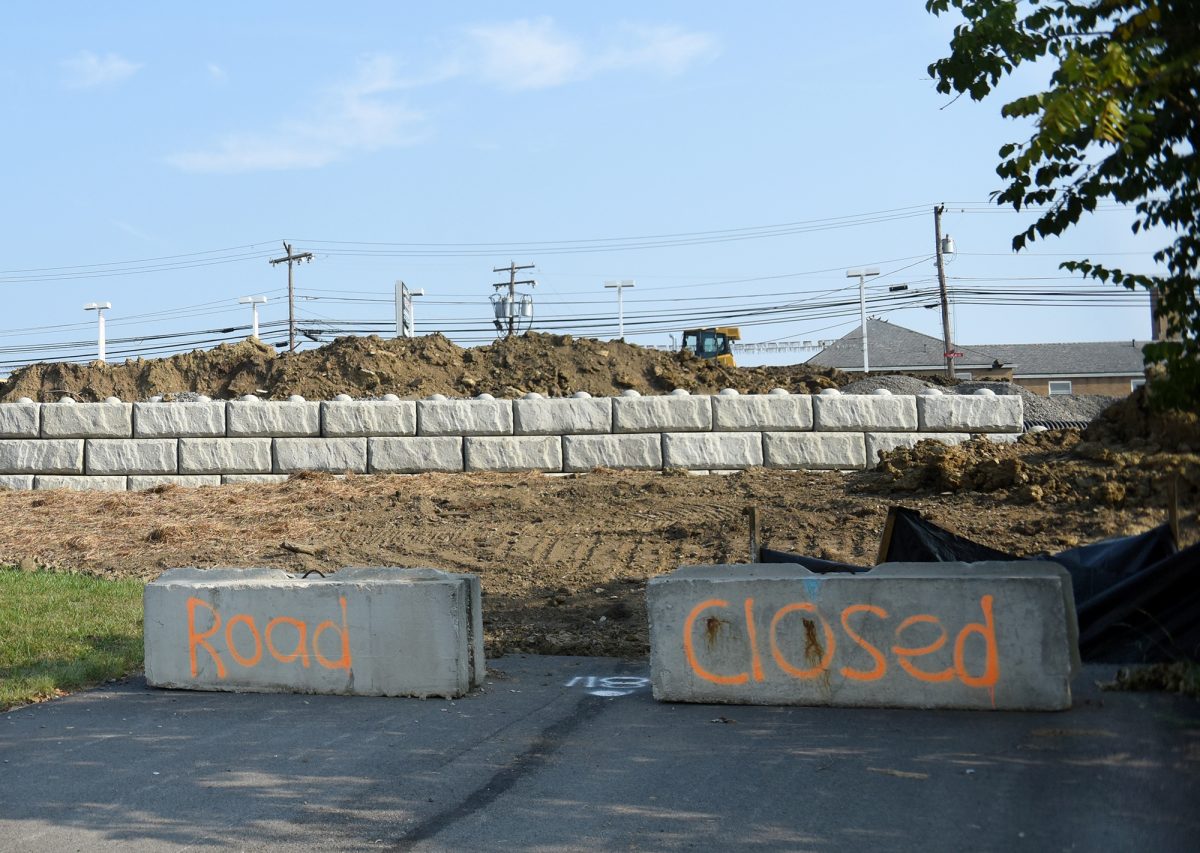
A portion of Poplar Street in Washington is closed and now belongs to the Budd Baer car dealership.
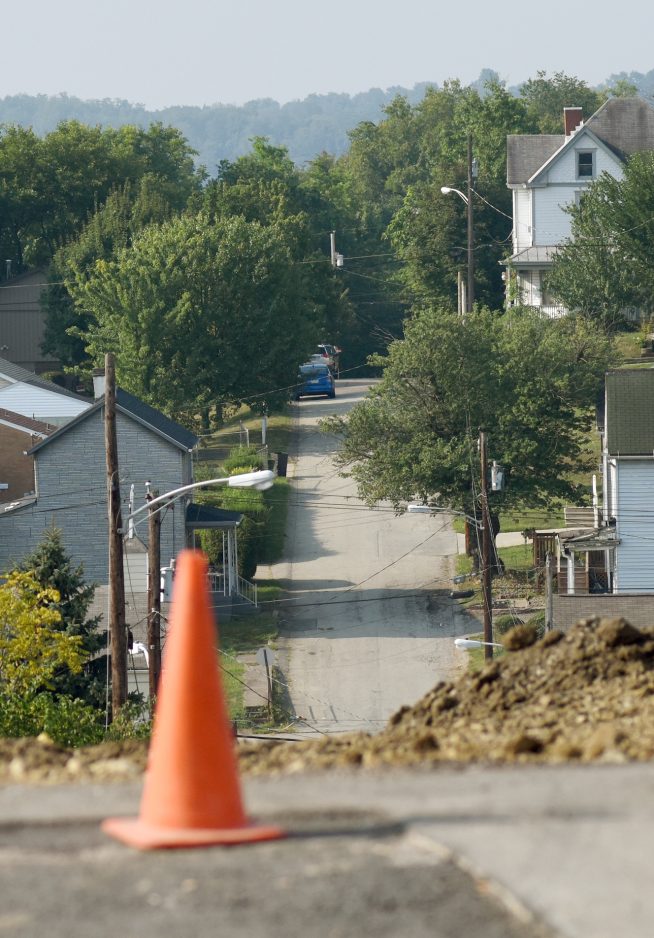
An orange cone sits where the entrance of Poplar Street used to be. The property now belongs to Budd Baer.
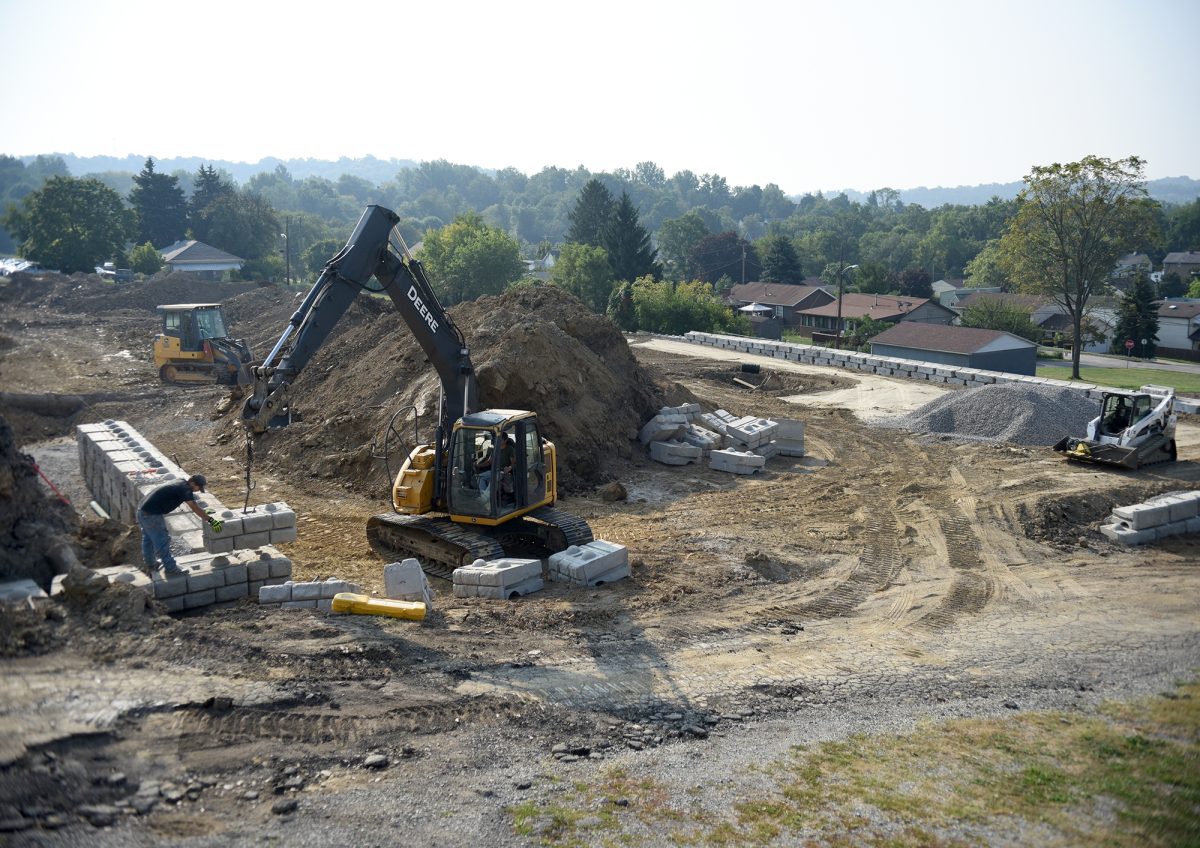
Construction workers build a wall Tuesday around the Budd Baer car dealership on property that used to be Poplar Street in Washington.
In 1998, Highland Ridge residents wanted a change.
Drug deals took place on the streets in open view near dilapidated, vandalized houses and vacant lots. Crumbling sidewalks were strewn with litter.
Fueled by the city’s commitment to capitalize on state Department of Transportation plans to improve traffic between Washington & Jefferson College and Interstates 70 and 79, about 80 residents gathered and offered ideas for community development. Five key actions were identified: redevelop the Highland corridor, help existing homeowners improve their properties, eliminate vacant and blighted buildings and lots, foster youth development and activities, and create an effective organization to revitalize the neighborhood.
Eventually named the “Highland Ridge Neighborhood Plan,” the initiative involved residents, the City of Washington, Washington County Council on Economic Development and Washington County Redevelopment Authority.
A Pittsburgh architect was hired and plans were underway to raze dilapidated structures and build new properties. With funding from federal, state and private sources, the plan allowed interested parties to purchase new homes for less money than it would cost to rent.
“When completed, the plan will transform the Highland Ridge neighborhood into a showcase along the Highland Ridge corridor,” said a fact sheet from the project.
With some of those objectives met, the neighborhood was on the right track. Crime dropped. Fifteen new houses were built and 52 blighted structures were acquired.
Phyllis Waller, Erie Street resident and Washington NAACP president, was one of the homeowners who used the plan. She said she was happy to buy a home in the close-knit community she grew up in and never wanted to leave.
But Waller said the progress was negated by a new challenge: a business she and others said is encroaching on their properties and creating an inhospitable environment.
The expansion of Budd Baer car dealership on Murtland Avenue has residents claiming owner Mark Baer is not being a good neighbor.
“I should be able to open my windows and not listen to all that noise,” said Linn Avenue resident Tonna Parker of the current construction of a parking lot.
In addition to noise, Waller, Parker and many other residents told City Council Monday during a nonvoting meeting about dirt from the work, the number of tractor-trailers on community streets and flooding from Budd Baer runoff.
When they brought the issues to council in June, residents didn’t know council unanimously voted in February to vacate a portion of Poplar Street, essentially turning it over to Baer, who owns property on both sides of the road.
Baer since closed that portion of Poplar, cutting off access to Murtland Avenue. Residents are angry they weren’t informed before the well-used road was closed.
“You guys allowed this to happen,” said Parker. “Shame on you.”
City solicitor Jack Cambest said the city acted in accordance with the law by posting a notice in the Observer-Reporter on Jan. 12. But residents contend they should have been notified personally and said closing Poplar Street created additional traffic on Linn Avenue, including an increase in speeding motorists.
“Would you want it in your neighborhood? If you don’t want it in your neighborhood, don’t put it in ours,” Waller told council members. “When you omit something and don’t tell, it’s a lie.”
Tuesday, after hearing about the meeting, Baer said residents should be happy once construction is complete. He said a fence will be constructed atop an existing wall to shield the neighborhood from the lot and that greenery will be planted along the wall.
“It’s better than it was,” he said. “I tore down things that were an eyesore.”
Baer estimated that if the weather cooperates, construction should be done by the end of October and residents will see improvements in the next three to four weeks.
Baer said he’s willing to meet with residents after construction is complete to discuss lingering concerns. He said he’s already met with a resident’s attorney concerning flooding, an issue he said was resolved.
“I have a very open-door policy,” he said, noting Parker was the only resident to discuss concerns with him. “I’m sorry they’re upset. Once again, I haven’t done anything I’m not allowed to do. This is not a fight between me and my neighbors. It’s between the city and them.”
Residents expressed their frustration to council Monday, taking issue with the zoning of the neighborhood.
Waller said no one was able to pinpoint exactly when a portion of the neighborhood was changed from residential to commercial. But Councilman Ken Westcott said the only zoning change he could find occurred in 1997, when the area was changed from commercial to general business. Many residents said the area was always residential.
“It’s a residential area. It’s been a residential area since I’ve been a little boy, and I’m 64 years old,” said Robert Gatling, a resident who was involved with the redevelopment plan.
Fred Fleet, president of Highland Ridge Community Development Corp., advised city council to make sure city zoning is in order for the sake of future endeavors.
“If the lines start getting a little shaky, our donors are not going to be happy,” Fleet said.
Councilmen Joe Manning and Terry Faust expressed remorse for voting to vacate Poplar Street.
Manning said that, after meeting with residents, he would like to see a compromise, with Poplar Street possibly being reopened.
“I voted to abandon that alley,” he said. “I thought it would be good for the economy and good for the city. I’ll be the first to apologize. I can admit to you I made a mistake.”
Council members discussed changing the way they notify residents of neighborhood plans in the future.
In other business, Mayor Brenda Davis said the city will look into providing street lights in the 600 and 700 blocks of Fayette Street after residents said there are many people who use the street to get to work in the early morning. Fayette Street was the site of several shootings over the past few months.