

Notice: Undefined variable: paywall_console_msg in /usr/web/cs-washington.ogdennews.com/wp-content/themes/News_Core_2023_WashCluster/includes/single/single_post_meta_query.php on line 71
Notice: Undefined offset: 0 in /usr/web/cs-washington.ogdennews.com/wp-content/themes/News_Core_2023_WashCluster/single.php on line 18
Notice: Trying to get property 'cat_ID' of non-object in /usr/web/cs-washington.ogdennews.com/wp-content/themes/News_Core_2023_WashCluster/single.php on line 18
Virtual Reality in the Operating Room
Notice: Undefined offset: 0 in /usr/web/cs-washington.ogdennews.com/wp-content/themes/News_Core_2023_WashCluster/includes/single/strategically_placed_photos_article.php on line 412
Notice: Trying to get property 'term_id' of non-object in /usr/web/cs-washington.ogdennews.com/wp-content/themes/News_Core_2023_WashCluster/includes/single/strategically_placed_photos_article.php on line 412
Virtual reality (VR) technology is no longer restricted to the arcade. More and more virtual reality technologies are making their way into healthcare education and practice, revolutionizing the way medical students and professionals train and prepare for life-altering procedures.
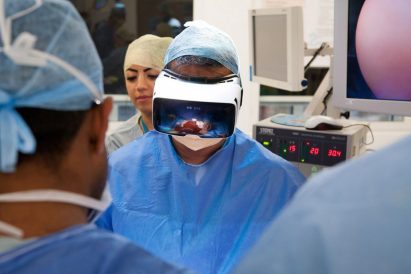
VR technologies offer unprecedented new advantages in medical education and training. Wearable virtual reality technologies like the Occulus Rift and Google Cardboard allow surgeons to record procedures for students to watch and learn from later.
This allows students, physicians, nurses and physicians’ assistants to feel more comfortable with the process of certain procedures. It also offers them a much more immersive and interactive learning experience than paper, photo or video.
The VR technology market is evolving to address healthcare’s usage of its devices. The recently formed company Medical Realities solely focuses on developing VR and augmented reality technologies for medical training use.
Medical Realities released its Virtual Surgeon product earlier this year. The Virtual Surgeon allows doctors to record surgical procedures for students to later watch in virtual reality. The company’s founders hope that technologies like The Virtual Surgeon will make healthcare training more accessible and easily distributed.
The use of VR in medical preparation cuts down on training and materials costs. The average human cadaver costs a medical school nearly $3,000, compared with the average cost of VR technologies ranging from $10-$250.
While VR technologies don’t entirely eliminate human cadaver use, medical schools could invest in fewer cadavers and more VR technology for a fraction of their current training costs. VR technologies also allow more flexibility in training than human cadavers.
VR technologies also allow for the widespread distribution of medical training materials. Professionals can easily upload videos recorded using The Virtual Surgeon to YouTube or another video hosting site for open public viewing. Students can access these materials from anywhere on demand.
These new technologies cut down on medical training costs and also maximize the optimal retention rate for students. Edgar Dale’s Cone of Learning indicates that after two weeks, the brain tends to retain 10 percent of what it reads, 20 percent of what it hears and 90 percent of what it does, including simulated experience. VR technologies allow medical students to get “hands-on” experience in a cost-effective and contained environment.
VR technologies allow for an immersive learning experience for medical students, but also provide ways for physicians themselves to adapt new techniques and perform procedures more efficiently.
Technologies like the Surgical Navigation Advanced Platform (SNAP) allow surgeons to “see what they can’t see” using flight simulation technology. This is particularly useful for neurosurgeons, who usually operate in close proximity to regions in the brain that control speech or movement. SNAP technology allows neurosurgeons to orient themselves to the brain prior to operating and to also use the headset during surgery to ensure they are not damaging any other areas of the brain during the procedure.
3D Systems recently released 3D soft-printed tissue model technology that allows for 3D prints of patients’ anatomical features and areas in which physicians will perform procedures. This allows for more effective practice and familiarity for surgeons.
Professionals can even use VR technologies to simulate emergency situations in the operating room. Researchers have looked into the best way to use VR to simulate surgical smoke and bleeding during procedures. Though there are industry standards for dealing with these situations, simulations allow for more preparedness and possible standards revisions.
VR technologies are greatly influencing the future of medical training and precision, expert and student alike. With new educational tools and models will come new insights and approaches.