

In West Virginia, dog racing could be on its last legs
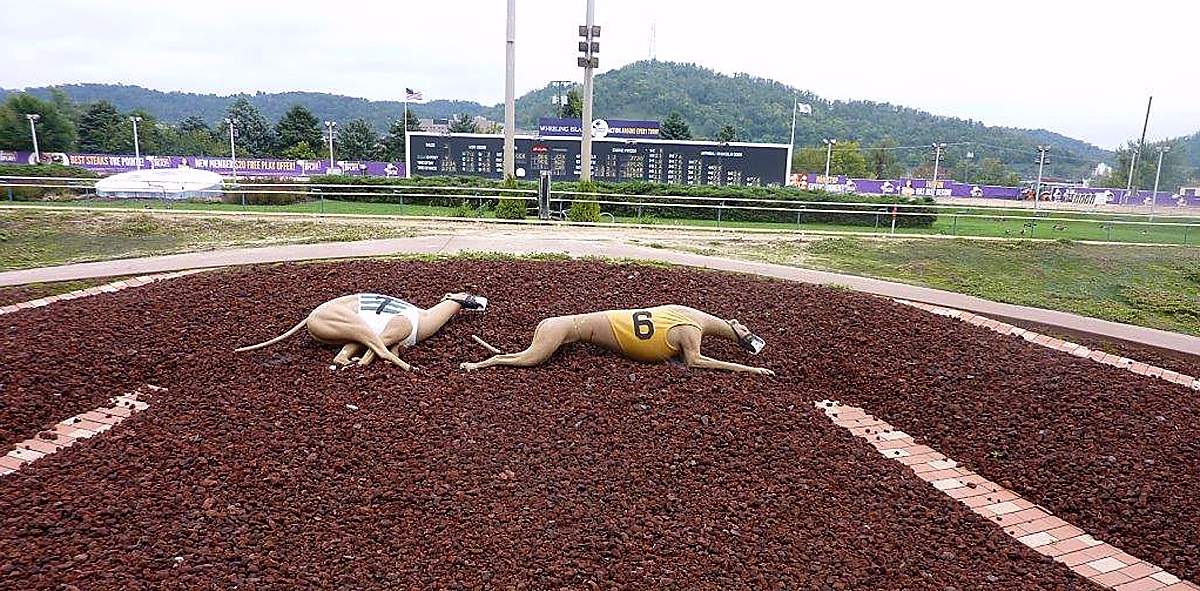
Two plastic greyhounds are perched alongside the track at Wheeling Island Hotel, Racetrack and Casino.
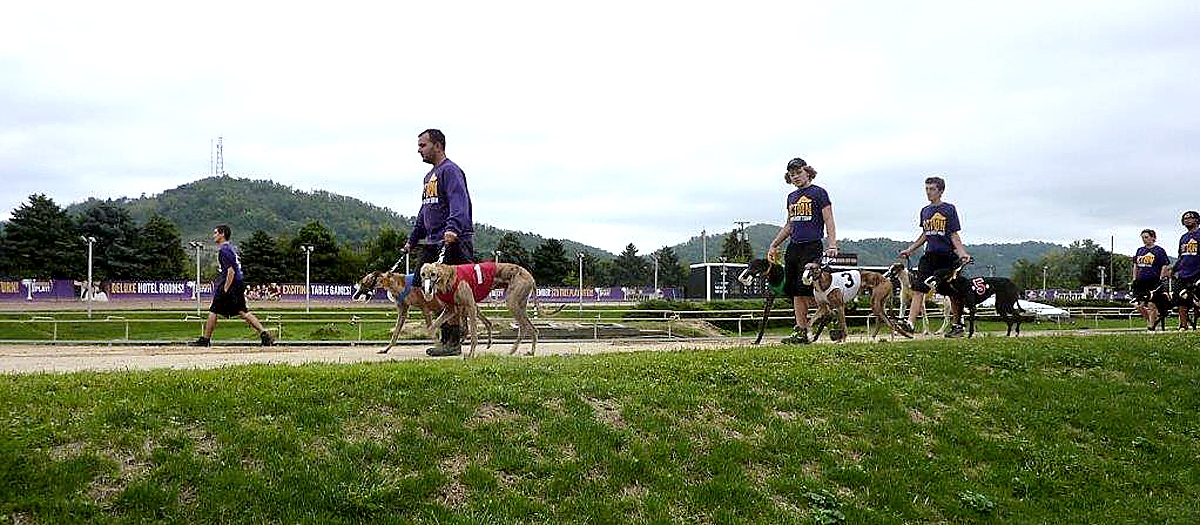
Employees at the racetrack on Wheeling Island walk greyhounds onto the track before a recent afternoon race.
WHEELING, W.Va. – The quiet and gloom of an overcast early afternoon at the Wheeling Island Hotel, Casino and Racetrack in West Virginia is pierced by the recorded fanfare of a trumpet.
There are just a few spectators lingering along the track as eight greyhounds are brought out by Wheeling Island employees and led toward a box.
An announcement rings out: “Greyhounds in the box!”
Then, rather than a traditional mechanical rabbit, a white tuft of what looks like fur starts rocketing around the track on a device that looks to the untrained eye like a jerry-rigged lawn mower. Once it completes its first orbit, another announcement is made.
“And they’re off!”
The lean greyounds are released from the box and start to instinctively, furiously chase after the tuft of fur they think is prey. It takes only about 15 seconds for them to round the track before the race is over and the process starts anew.
Along with a few spectators outside, there are some who appear to be retirees in a glassed-in area above the track, glancing at the races unfolding before them, talking to friends and nibbling on concession-stand fare. Some also watch and place bets on other races at other tracks that are being simulcast on television screens.
Bob McCue of nearby Martins Ferry, Ohio, is outside sipping a drink, and says he doesn’t place many bets, but likes to meet up with friends at the track and see the greyhounds in action.
“I just like to watch it,” he said.
His days of being able to watch the races in West Virginia could well be numbered. Where dog racing was once legal in 19 states, from Vermont and New Hampshire in the east to Idaho and Nevada in the west, it is allowed now in just seven. And in those states, the revenue generated by dog racing has been wilting like an aged canine on a blistering August afternoon. In fact, in some of the places where dog racing remains legal, the industry is only staying afloat on the strength of state subsidies.
Like harness racing, which has seen a similar drop-off in interest, many gamblers are being lured away from the racetracks by the slot machines and table games that are casino staples. In fact, the slot machines that so enchant those gamblers were only initially allowed at Wheeling Island if they were tied to the racetrack. Now, there is an effort afoot to “decouple” the dog tracks from the casinos.
A bill was introduced earlier this year in West Virginia’s legislature that would ban greyhound racing in the Mountain State while also offering $36.5 million in compensation to greyhound breeders and owners over a three-year span. State Sen. Ron Stollings, a Democrat from Boone County, was one of two lawmakers who introduced the measure, and he explained it was “by request” of greyhound breeders and owners “to try to get the ball rolling” on a decoupling effort.
“A lot more study is being done as we speak,” Stollings said. “Certainly, there is a push to decouple the dog racing from the casinos.”
One study that has already been done on dog racing in West Virginia paints a relentlessly bleak picture of the industry. Released earlier this year by Spectrum Gaming Group, it reports attendance at dog races at Wheeling Island declined by 99 percent from 1983 to 2013. In 1983, it said, almost 1 million people came to watch the dog races; 30 years later, only 13,000 did. Wagering on the races dipped from $35 million in 2004 to $15 million in 2013.
Even more striking, the report states subsidies from the casinos and the state might be outweighing any perceived economic benefits from dog racing, and that West Virginia “is moving perilously close to not covering its expenses related to regulating the industry.”
Greyhound racing also has been in the crosshairs of animal-rights organizations that say dogs are exploited and treated cruelly by owners and breeders.
Repeated attempts to contact Sam Burdette, the Elkview, W.Va.-based president of West Virginia Greyhound Owners and Breeders Association, were not successful. However, in a commentary piece he wrote for the Charleston Gazette-Mail in 2011, he decried critics of dog racing and said banning it would be “the first step down a very slippery slope.”
“The greyhound racing and breeding industry is a source of jobs and economic support in West Virginia,” Burdette wrote. “Greyhound racing is an added attraction and part of the overall package of the resort casinos.”
In West Virginia, greyhound racing happens at both the Wheeling Island complex and the Mardi Gras Casino & Resort in Charleston. The management of Wheeling Island is cautious about where dog racing fits in its future. In a statement provided to the Observer-Reporter, Osi Imomoh, the president and general manager at Wheeling Island, described greyhound racing as “a key component of our business. It makes us unique and different from our competition.”
He added, “While casino gaming is a larger share of our revenues, greyhound racing continues to be an important part of our revenues… We will continue to work with the West Virginia legislature and West Virginia racing commission as they decide the future of West Virginia greyhound racing.”
The origins of dog racing date to England in the 1870s. The first professional American track opened in California in 1919 and reached its height after World War II, drawing hordes of spectators who were mostly working class. Aside from seven states in the United States, greyhound racing is also legal in New Zealand, Australia, South Africa and Britain.
One person who would unambiguously welcome the end of West Virginia greyhound racing is Carey Theil, the executive director of Massachusetts-based Grey2K USA. Billing itself as “the largest greyhound protection organization in the United States,” it spearheaded a ballot initiative in Massachusetts in 2008 to outlaw dog racing there and believes the remaining states where it is allowed should follow suit.
“It’s a relic of the early 20th century,” Theil said. “The complete end of greyhound racing will take time. Casinos give money to subsidize a product they don’t want, they lose money on and that people aren’t interested in.”