

Painting ceramics was once a hobby
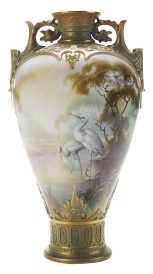
China painting was an important artistic talent in past centuries. Although single color transfer designs were developed and used by the late 1700s, they lacked the color and graceful lines that were possible if the ceramic was decorated by hand. Today, the work of exceptional painters brings much higher prices than other pieces by the same factory.
Shirayamadani (1865-1948) was a Japanese artist at Rookwood Pottery in Cincinnati. Rudolph T. Lux (1815-1868) decorated white porcelain with portraits ordered by important politicians and businessmen in New Orleans, and William Powell (working 1900 to 1950) was famous for painting English birds on porcelains made by Royal Worcester. In the first part of the 1900s, painting ceramics was a hobby and sometimes a job of talented housewives.
There were magazines like Keramic Studio, published by Adelaide Alsop Robineau that featured pictures and instructions and even furnished patterns. Large makers of dinnerware and decorative porcelains often had a team of young women who put patterns on plates or sometimes, painted original landscapes or floral designs.
A Royal Worcester vase from the early 1900s was decorated with a picture of wetlands and two egrets in soft colors and gilded trim. It is marked with the green “Royal Worcester England” mark and the initials “WHB.” It also is signed “W. Powell” by the painter. The 12 1/2-inch-tall vase sold in 2015 for $1,180.
Q. Is a scrapbook filled with valentines from the 1920s worth anything? It’s so old the pages are crumbling.
A. Most old valentines sell for $1 to $10 depending on design, rarity and condition. If the valentines are glued to the pages, they are worth even less. Those with moving parts sell for more.
Q. I have a small wash table with a metal tag on it that reads “The Ross Table Wash-Stand, Patented, Manufactured by Forest City Furniture Co., Rockford, Ill.” It has a hinged lid with a mirror on the inside of the lid and compartments to hold things. There is a shelf below. When was this made and what it might be worth?
A. Forest City Furniture Co. was in business in Rockford from 1869 to 1919. L.P. Ross was granted a patent for a “combined wash stand and table” in 1886. The compartments in the washstand are meant to hold the bowl and pitcher, and there is a removable compartment for waste water. The shelf holds soap and towels. Your washstand is worth about $400.
Q. Are printed paper bags from closed stores really collectible, and are they popular? I saw a D. H. Holmes bag on eBay for $40.
A. Collectors like shopping bags with interesting graphics or from particular stores. Some collectors hang them on the wall like paintings. Paper shopping bags with handles were first made in 1912. Some shopping bags are considered works of art. Over 100 bags were exhibited at the Smithsonian’s Cooper-Hewitt Museum in New York City in 1978. The museum now owns over 1,000 bags. Bloomingdale’s won awards for its series of shopping bags designed by well-known artists, designers and architects in the 1980s. You can find vintage shopping bags online and at house sales.
Q. I have a National cash register in British currency. There is a tag on it with the numbers 2490973 and below that 745. It has wooden case, a marble slab above the drawer and is in very nice condition. What is its approximate value?
A. National Cash Register was founded in Dayton, Ohio, in 1884. Brass cash registers were made from the 1890s to about 1918. Flat metal cases stamped and painted to look like wood were made beginning about 1918. The larger number on your cash register is the serial number. It indicates the cash register was made in early 1926, so it’s not actually wood but metal painted to look like wood. National Cash Register had a factory in England and registers with amounts listed in British pounds were made there. The company became NCR Corporation in 1974 and moved to Duluth, Georgia, in 2009. It is still in business. Collectors pay the highest prices for the old, ornately decorated brass cash registers in good condition. Metal with simulated wood grain cash registers sell for about $200 or less. British currency numbers will lower the value.
Q. We inherited a large collection of toothbrush holders, about 250 pieces. We’d like to sell them. How can we contact possible collectors?
A. If you have figural toothbrush holders, not the kind with just holes for toothbrushes made for a modern bathroom, you can sell them. Dealers must find and buy the things they sell, so go online to see who is selling toothbrush holders. People who sell toothbrush holders first have to buy them. If they are uncommon and priced right, porcelain toothbrush holders also sell at auctions.
Tip: Phillips screws were introduced in the 1920s, a good clue to dating furniture. But remember, sometimes old screws have been replaced with newer ones.
Current prices are recorded from antiques shows, flea markets, sales and auctions throughout the United States. Prices vary in different locations because of local economic conditions.
• Bank, elephant, gray paint, red and gold highlights, Hubley, 4 3/4 inches, $90.
• Advertising, dispenser, Malted Grape Nuts, chocolate drink, yellow, glass lid, c. 1926, 7 x 15 inches, $180.
• Toy, ambulance van, tin lithograph, red cross emblems, driver, crank, white, Lindstrom, 1920s, 8 inches, $355.
• Bicycle, velocipede, tricycle, wood frame, handlebars, iron fittings, seat, spokes, red paint, c. 1890, 41 x 17 inches, $420.
• Animal trophy, bear, brown grizzly, head, wall mount, 1970s, 23 x 17 inches, $570.
• Cologne bottle, Myers-Neffe, cylindrical, enamel, gilt, flashed cranberry, stopper, c. 1890, 7 inches, $650.
• Armoire, Classical, walnut, stepped cornice, 2 doors, drawers, c. 1840, 101 x 85 inches, $2,690.
• Pottery, vase, iridescent green, 4 applied starfish, Paul Daschel, c. 1900, 14 5/8 inches, $6,130.
Write to Kovels, Observer-Reporter, King Features Syndicate, 300 W. 57th St., New York, NY 10019.