

Grant’s local connection displayed on Trinity wall
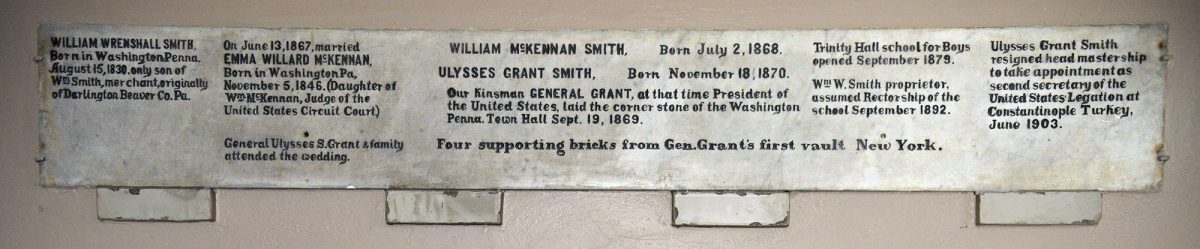
A tribute to President Ulysses S. Grant hangs on the wall at Trinty High School.
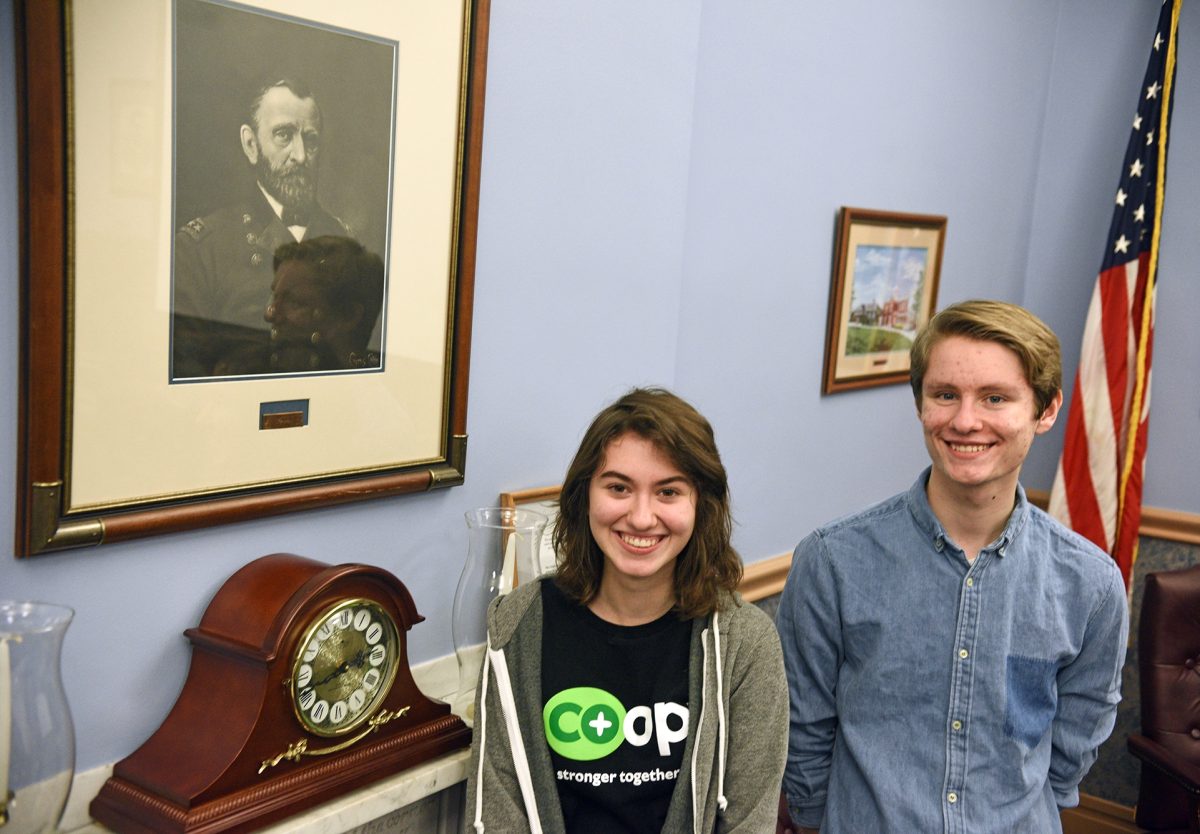
Students Taylor Mals, left, and Casey Shaw stand next to a portrait of General Ulysses S. Grant at Trinty High School.
Groucho Marx’s legendary query to quiz show guests about who’s buried in Grant’s Tomb has endured for decades, but there’s a local noteworthy tribute to Grant and some relics of his first burial place that predate the comedic “You Bet Your Life.”
In the vestibule of the former Trinity Military Academy – now a wing of Trinity High School in North Franklin Township – hangs a timeline that illustrates the connection between the 18th president of the United States and, not Washington, D.C., but Washington, Pa.
“I knew he had been here before. I didn’t know he slept here,” said Trinity junior Casey Shaw Jr., who was enrolled in an Advanced Placement American history course last year.
“We actually have the history of Trinity Hall built into the curriculum at the middle school,” explained Larry Myers, head of Trinity’s social studies department. Trinity students learn that William Wrenshall Smith was the cousin of Ulysses S. Grant’s wife, Julia Dent Grant. He was Grant’s aide-de-camp during the Civil War and was present at Appomattox, Va., when Confederate Gen. Robert E. Lee surrendered in April 1865.
After his military service, Smith returned to Washington County.
An article in Harriet Branton’s “Focus on Washington County” history series published 30 years ago notes that Smith and his wife, Emma Willard McKennan Smith, purchased a mansion and surrounding property known as Spring Hill. There they founded Trinity Hall Military Academy in 1879, and it “very quickly grew into one of the best preparatory schools for boys in the East.”
Inscriptions on the fireplace mantel in the large, second-floor room where Trinity Area School Board now meets note that “Gen. Ulysses Grant, president of the United States, and Mrs. Grant occupied this room from September 15 to September 21, 1869;” and “Grant laid the cornerstone of the Town Hall September, 18, 1869.”
Washington Borough wanted a town hall before the Civil War, but those plans had to be placed on hold because of the conflict. The same building was to house Citizens Library, founded with a gift of $10,000 from Dr. Francis J. LeMoyne, said Chuck Edgar, research librarian for Washington County Historical Society, now housed in what was the physician-benefactor’s home at 49 E. Maiden St. in Washington.
In the book,”The Man Who Saved the Union: Ulysses Grant in War and Peace,” biographer H.W. Brands tells of national events coinciding with the cornerstone-laying visit.
Financiers Jay Gould and James Fisk wanted to corner the gold market and then drive up its value by persuading Grant to halt the sale of the nation’s gold supply to those who were willing to purchase gold-backed paper money. Grant instead ordered the sale of $4 million in government gold, according to a PBS article on “Black Friday, Sept. 24, 1869.” Due to the increased supply, a panic ensued as the price of gold sank.
“Gould’s partner Fisk arranged for a messenger, William Chapin of the Erie Railroad, to carry the letter to Pennsylvania. Chapin took a train to Pittsburgh and hired horses and a driver and rode through the night to the village of Washington, Pennsylvania.
“‘We started, lost our way once on the trip, but finally got there,’ Chapin told the congressional committee” that later investigated what came to be known as the Black Friday crisis, one that has nothing at all to do with the post-Thanksgiving shopping ritual.
The messenger went to the house where Grant was staying – presumably, Trinity Hall – but he was told Grant had gone elsewhere. The president was found playing croquet. He read parts of the letter twice, left to see his wife, and returned about 15 minutes later, declining to reply to the message.
The image of the president with a currency scandal during his administration was, interestingly enough, placed on the $50 bill in 1929 in two forms. One was a gold certificate, meaning it could be redeemed for the precious metal, and it bore a golden seal. (The other bill had a green seal.) The 1934 Series $50 bill removed the “redeemable in gold” clause from the bill because the United States had withdrawn from the gold standard, according to the website fiftydollarbill.info.
The Smiths of Trinity Hall, Grant’s hosts, were parents of two sons, William McKennan and U. Grant-Smith, born in 1870 and named for the general who had been elected president of the United States two years earlier.
The president likely met his namesake during another visit, because the third panel of the boardroom mantel inscription states, “The General and Mrs. Grant occupied this room from September 15 to September 18, 1871.”
There were more visits than those written in stone.
“Grant came here at least six different times,” said Edgar. “Most people come in and they can’t even believe Grant was here. It’s not common knowledge, I guess you could say. People who are actually Civil War buffs are amazed,” especially that the society’s Civil War room has a display that includes Gen. Grant’s field binoculars.
Grant served as president until 1877 and, before his death, penned the two-volume “Personal Memoirs of Ulysses S. Grant.” Edgar called it “the most famous autobiography written in America” as he pulled from the shelves of the society library a first edition. Grant’s publisher was Samuel Clemens, better known as Mark Twain.
“The man who saved the union” died in 1885, and the tribute also features four bricks from “Gen. Grant’s first vault, New York.” The brick vault was a temporary structure where the war hero was laid to rest until his tomb could be constructed.
Edgar speculated that the Smith family “probably bought the bricks,” but exactly how they were acquired isn’t documented.
The General Grant National Memorial Historical Resource Study, prepared by David M. Kahn, curator, describes Grant’s two tombs and efforts related to their construction over the course of 220 typed pages.
Grant’s arched “temporary tomb” was built lined with white enameled bricks. Completed by noon Aug. 7 1885, for Grant’s lavish funeral, this brick vault served as a tomb for almost 12 years.
A larger mausoleum was dedicated April 27, 1897, the 75th anniversary of Grant’s birth.
The temporary vault was torn down April 26 after Grant’s coffin was moved to its new resting place. The bricks were to be distributed to public schools, Grand Army of the Republic posts and veteran organizations in the greater New York area.
“They were each to be given a label with a facsimile of his signature on it. At least two of the unlabeled bricks found their way into the hands of the Grant family. On March 26, 1903, they deposited them with the Smithsonian Institution, and in 1979 the Smithsonian transferred the bricks to the collection of the General Grant National Memorial,” the formal name of Grant’s tomb.
“After Julia Dent Grant’s death in 1902, she was laid to rest beside her husband. Trinity Hall Military Academy closed in June 1907, but its connections to Ulysses S. Grant survive and it was purchased from one of the Smith sons to again be used as a school in 1925.
“Gen. Grant was the most famous individual who came through,” Myers said.