

Advocates for those with disabilities praise new savings accounts
“A penny saved is a penny earned,” goes an old American adage. But if you’re a person with a disability who receives some form of public benefits, things aren’t as simple as Benjamin Franklin made them out to be.
Instead, limits on assets as low as a few thousand dollars for public benefits programs pose a challenge for people with disabilities because too much money in the bank could affect their eligibility for programs.
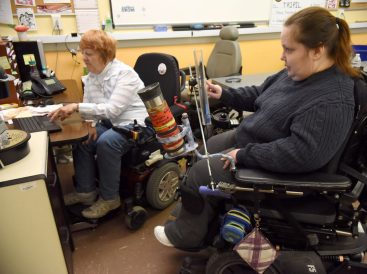
“It’s a game they play. They have to spend money because losing access to the benefits is critical,” said Kathleen Kleinmann, executive director of Tri-County Patriots for Independent Living, or TRIPIL, an advocacy group based in Washington.
Kleinmann was among the advocates across the state who welcomed the passage of a state law last week that makes some people with physical and intellectual disabilities eligible for tax-free savings accounts that allow them to put aside money to cover expenses related to their disability – including assistive technology, personal assistance services and health care – without losing their eligibility for public assistance.
Kate Blaker, volunteer coordinator for TRIPIL, said that when they’re available, the new accounts also could be used to cover education and transportation.
“This isn’t about helping people save for luxury vacations,” said Brenda Dare, independent living supervisor for TRIPIL. “It’s about helping people save for their basic needs.”
Sara Weir, president of the National Down Syndrome Society, said the law makes Pennsylvania one of 40 states to pass measures establishing ABLE programs, named for the 2014 federal Achieving a Better Life Experience Act.
Signed by Gov. Tom Wolf April 18, the law allows people with disabilities and their families to put aside money for qualified expenses that won’t factor into asset calculations that social service agencies use to evaluate users’ eligibility.
For Supplemental Security Income and Medicaid, two major benefits programs, that cap is $2,000 for most people.
“For our participants, it’s huge, because now individuals can accumulate more than $2,000 in assets without losing their SSI benefits,” said Tricia Reesman, manager of youth services for the Spina Bifida Association of Western Pennsylvania.
People with disabilities whose onset is before age 26 will be eligible for the accounts, according to Department of Human Services spokeswoman Diana Fishlock. Those with accounts will be able to contribute as much as $14,000 a year, or a total of $100,000 over their lifetime.
Kleinmann, who uses a wheelchair, said she received SSI for about four years, but stopped about 30 years ago when she started working full time. She hasn’t been enrolled in the program since. She said the difficulty of getting back on public benefits keeps many people from doing the same.
“I’ve talked to people like that,” Kleinmann said. “If they had a little bit of a nest egg behind them, they’d take that full-time job.”
Under the plan, the state Treasury Department will administer 529A accounts similar to the ones already used for college savings.
Fishlock said there 103,839 people under 26 in Pennsylvania on SSI and Medicaid, though she called these numbers a “proxy” that “doesn’t necessarily show the total number of people who could benefit from this legislation.”
Weir said the ABLE Act doesn’t address limits on income in public assistance programs that also deter people with disabilities from working full time.
The National Down Syndrome Society, which led efforts to get the ABLE Act passed, is looking to tackle those limits on income, too.
“We’re having discussions on Capitol Hill as to how we address that particular issue and solve the problem,” Weir said.