

GE’s Immelt: Company’s new advanced manufacturing center just the beginning
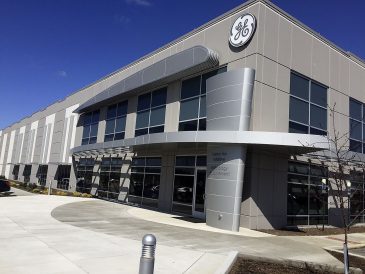
IMPERIAL – They’re calling it the factory of the future.
Its official name is the GE Center for Additive Technology Advancement, but during an open house Tuesday for the new 125,000-square-foot site in Findlay Township, GE officials said their new center, the first of its kind anywhere, will help them improve ways to make things better, cheaper and faster using technologies such as 3-D printing and robotics.
The event, held for media as well as public and academic officials, showed a variety of machines and processes the manufacturing giant is already using to make some parts in its various production divisions.
But GE Chief Executive Officer Jeff Immelt noted what people were seeing Tuesday – GE invested $39 million in the project – is simply the beginning of what the company expects will be the way all manufacturing will operate.
“The whole world of manufacturing is going to be transformed,” Immelt said.
“You’re right in the very beginning,” he added. “The first 15 minutes of this industry is being formed.”
“Formed” is the operative word, as the center employs 3-D printing, which uses powdered metals or plastic stock to make a variety of parts and shapes that are produced with little waste of the raw material and are stronger and lighter than those produced by traditional means.
During a tour of the plant, which will employ 50 manufacturing and software engineers and technicians, reporters were shown a fuel nozzle used in GE’s jet engines that once required the assembly of 20 different metal components, but through the additive or 3-D printing process, is now produced in one piece, is 15 percent lighter than its predecessor and more fuel efficient, thanks to its unified shape.
Philippe Cochet, GE’s chief productivity officer, said the center will be used by all eight of GE’s manufacturing divisions to try new designs and ideas, a place he said reflects GE’s belief the intersection of technology and manufacturing, a marriage of hardware and software, will change the way people create, produce and service products.
“It’s a hub where people can meet and work together,” Cochet said. “It’s a hub to accelerate ingenuity and develop the factory of the future.”
That future is already partially here, according to data provided by GE, which noted advanced manufacturing’s impact on the economy is $3.1 trillion, or 19 percent, of U.S. gross domestic product.
That Pittsburgh was chosen by one of the world’s largest manufacturers bodes well for the entire region, several speakers said Tuesday.
GE is collaborating with Carnegie Mellon University on developing more advances in additive manufacturing, particularly with the use of metals in the 3-D printing process.
GE’s commitment is formidable, given it makes everything from jet engines to appliances and lighting, locomotives, medical equipment and products for the oil and gas industry. In November, it completed its acquisition of the power and transmission division of Alstom, which included two production plants in Charleroi.
According to Immelt, the Pittsburgh region is poised to become a leader in the new, digitally focused approach to manufacturing.
“We think Pittsburgh has the chance to be one of the four or five destinations for advanced manufacturing,” he said.
It was noted some of the 3-D equipment in the new center was provided by ExOne, a Wesmoreland County company.
Ralph Resnick, president of the National Center for Defense Manufacturing and Machining, said the various processes GE will engage at the new facility will represent the entry into a new era by an entire industry.
“Advanced manufacturing is and will be crucial for the future of GE and for the country,” he said.
U.S. Rep. Tim Murphy, R-18th District, noted that area schools, from grade school through colleges, are already teaching various aspects of advanced manufacturing.
“With this commitment from GE, we are advancing Pittsburgh’s capability to compete in the international marketplace and to make this state the epicenter of tomorrow’s manufacturing,” he said.
“This is a game-changer for us,” added Dennis Davin, Pennsylvania’s secretary for economic development.