

Modern visions often inspired by early designs
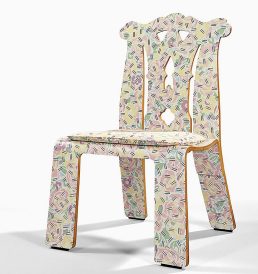
Furniture made by earlier workmen often inspire later designers who create a modern version.
The series of chairs by Robert Venturi (born 1938), first sold in 1985, represented the work of nine periods of furniture. Queen Anne, Chippendale, Sheraton, Empire, Biedermeier, Empire, Gothic Revival, Art Nouveau and Art Deco chairs made by Knoll all are made of plywood. Each is a cut-out form shaped like the 18th-, 19th- or 20th-century chair it represents.
The chairs were covered in a plastic laminate and some had fabric cushions. One version of the Chippendale chair is covered in the “Grandmother’s Tablecloth” pattern. The pastel flowers actually were inspired by a friend’s grandmother’s tablecloth. The chairs are seen in homes, shops and auctions today. In the 1980s, a chair could sell for up to $16,000. But many more of the chairs have been made and prices are lower.
A “Grandmother’s Tablecloth Chippendale Chair” sold by Skinner in 2015 brought $6,150.
Q. I have a picture frame that I treasure. It was given to me by my grandmother and I’d like to know more about it. It is white porcelain with painted flowers and gold trim. The mark on the back looks like an E over an S with 1811 in the bottom curve of the S and Prufsia (is it Prussia?) below. Do you know the history from the mark? And can you give me its value?
A. The mark on your frame was used by a company founded in 1861 by Leonard Schlegelmilch (1823-1898) in Suhl, Germany, and named in memory of his father, Erdmann Schlegelmilch (1782-1844). The Schlegelmilch names and factories confused collectors for years until extensive research was done in the mid-1980s, and the families and companies were sorted out. The Erdmann Schlegelmilch company made porcelain kitchenware, tableware, giftware, figurines, coffee and tea sets, and for a time, containers for perfume lamps. After Leonard died, his son Julius Martin ran the business, which reached its peak in 1913. Work declined between 1933 and 1935 and the company finally closed in 1937. Erdmann Schlegelmilch items are marked “ES Germany” or “ES Suhl.” Other pieces, like your frame, made at a factory in Saxony, Prussia, are marked “ES Prussia.” The mark on your frame has the date 1861, the founding date, not 1811. “Prufsia” is Prussia; the double “s” is in old German writing. The value of your frame is $75.
Q. I have a small salve container that belonged to my father. It’s made of tin and is about 2 inches high. The screw-off lid is embossed “Medicat 60, Trial Size, Resinol Shaving Stick.” On the bottom, it reads “under the Food & Drugs Act, June 30, 1906.” What is its antique value?
A. Resinol Chemical Company was started in Baltimore, Maryland, in 1895 by Dr. Merville Hamilton Carter, his brother Allan and a cousin. The company made soap and other products that contained Resinol ointment, supposed to clear up pimples, eczema and other problems. A 1916 ad for the shaving stick said it contained the “Resinol medication so that it soothes and refreshes the face.” The 1906 Food & Drug Act was replaced in 1938 by the Federal Food, Drug and Cosmetic Act. Resinol was listed as a soap manufacturer in business directories after 1956. Although one “for sale” ad online has priced a Resinol tin at $300, it had no bidders. The actual value is about $10.
Q. I have a marble and bronze bust signed “Schumacher.” I’d like to know something about the maker, how old this is, and how to clean it.
A. This mark was used by the Schumacher Foundry, which was founded by Henry Schumacher in Austria. The foundry made bronze and alabaster busts and full-length figures from about 1900 to the 1920s. Alabaster can be damaged by improper handling and cleaning. Don’t use water to clean it. Alabaster dissolves in water. Don’t wax alabaster, it will eventually cause discoloration. You can dust alabaster by brushing it with a soft bristle brush. Works made at the Schumacher foundry have sold at auction for a few hundred to over $2,000. Full-length figures usually bring higher prices than busts.
Tip: Specialized antiques and collectibles shows are becoming more popular. In 2012 there were shows devoted to garden antiques, political memorabilia, toys, clocks, advertising, Art Pottery, dolls, modern design, textiles, vintage clothing, bottles, glass, paper ephemera and jewelry. Makes sense, the serious collector can see more of interest at a one theme show.
Current prices are recorded from antiques shows, flea markets, sales and auctions throughout the United States. Prices vary in different locations because of local economic conditions.
• Tool, tobacco shredder, cast iron, wheel, wood handle, shaped apron, 14 inches, $60.
• Villeroy & Boch, lazy susan, blue onion, Saxony, black ink stamp, 1874-1909, 9 1/2 x 14 inches, $140.
• Advertising tin, Coburn & Co., allspice, red, eggshell blue, square, c. 1890, 6 1/2 x 9 1/2 inches, $240.
• Satin glass, bride’s bowl, Victorian, folded rim, crimped, ribbed, orange C-scrolls, 6 1/4 x 14 1/2 inches, $270.
• Toy, Mother Goose, walker, riding on goose with cat, tin litho, windup, Marx, 1930s, 9 inches, $335.
• Wood carving, Sphinx, reclining, stylized, spheres in hands, red and green paint trace, 1900s, 18 x 29 inches, $405.
• Writing table, Louis XV style, walnut, inset leather top, drawers, pull out slide, 1900s, 30 x 69 inches, $490.
• Yellowware, pitcher, green, black, brown roses, R. Web & Co., Salineville, Ohio, c. 1890, 10 1/2 inches, $575.
• Tramp art box, pedestal, triangular shapes, velvet interior, c. 1890, 7 x 10 inches, $680.
• Sterling-silver, sugar, lobed, flower band, scroll handles, lid, basket finial, stepped foot, c. 1850, 10 inches, $1,000.
Write to Kovels, Observer-Reporter, King Features Syndicate, 300 W. 57th St., New York, NY 10019.