

The play’s the thing at the Wooden ‘O,’ but the tour’s interesting, too
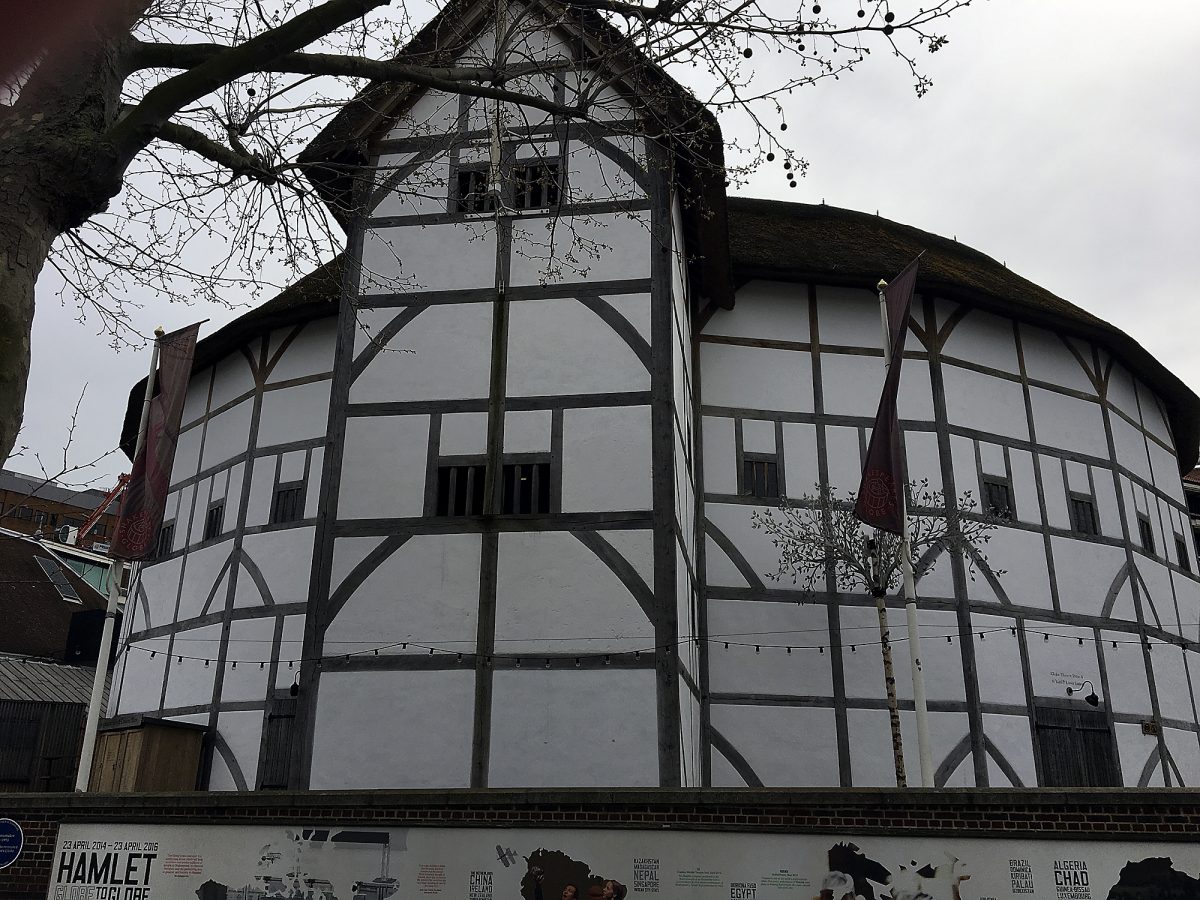
Next to the River Thames stands Shakespeare’s Globe Theater, the third to carry the name in London since 1599.
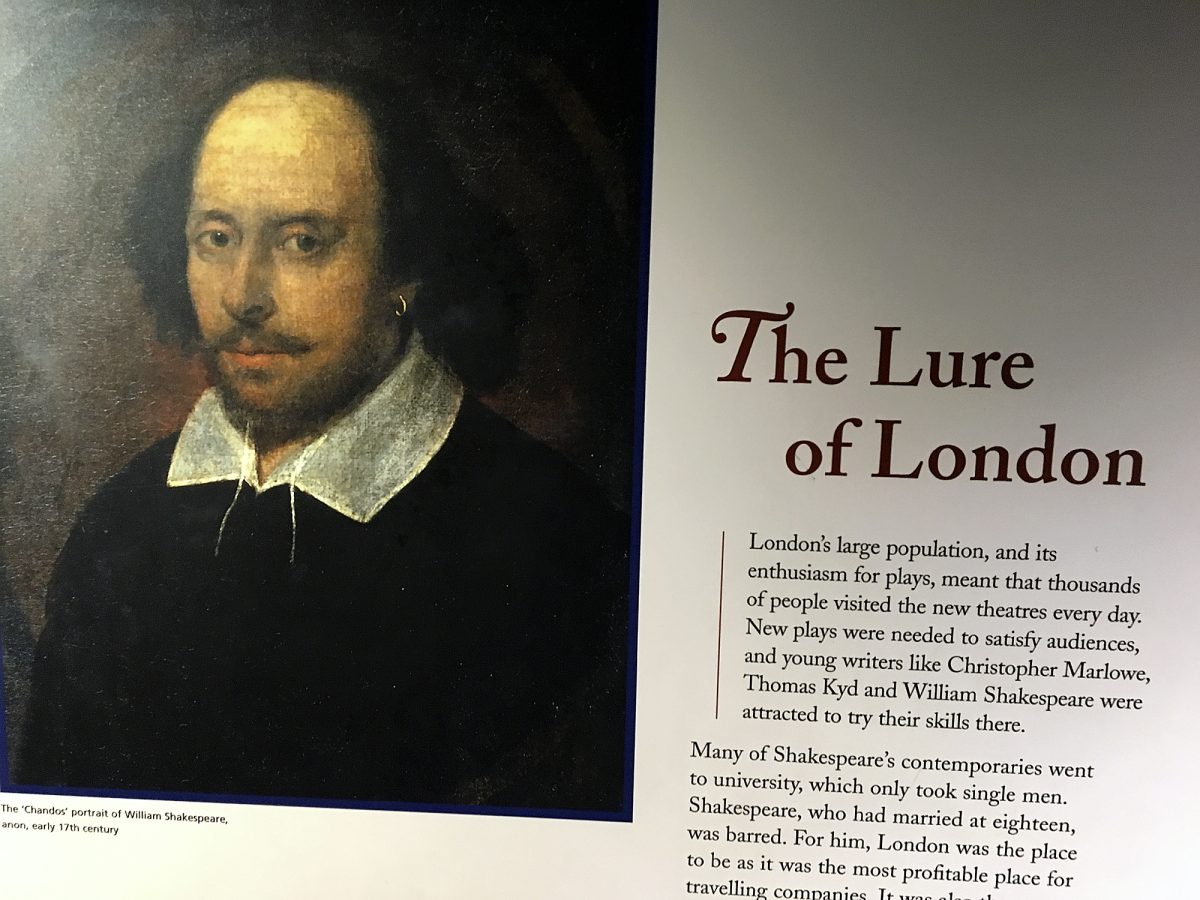
An artist named John Taylor may have painted this portrait of William Shakespeare from life. Known as the Chandos portrait after a previous owner, it was the first work acquired by Britain’s National Portrait Gallery, which was founded in 1856.
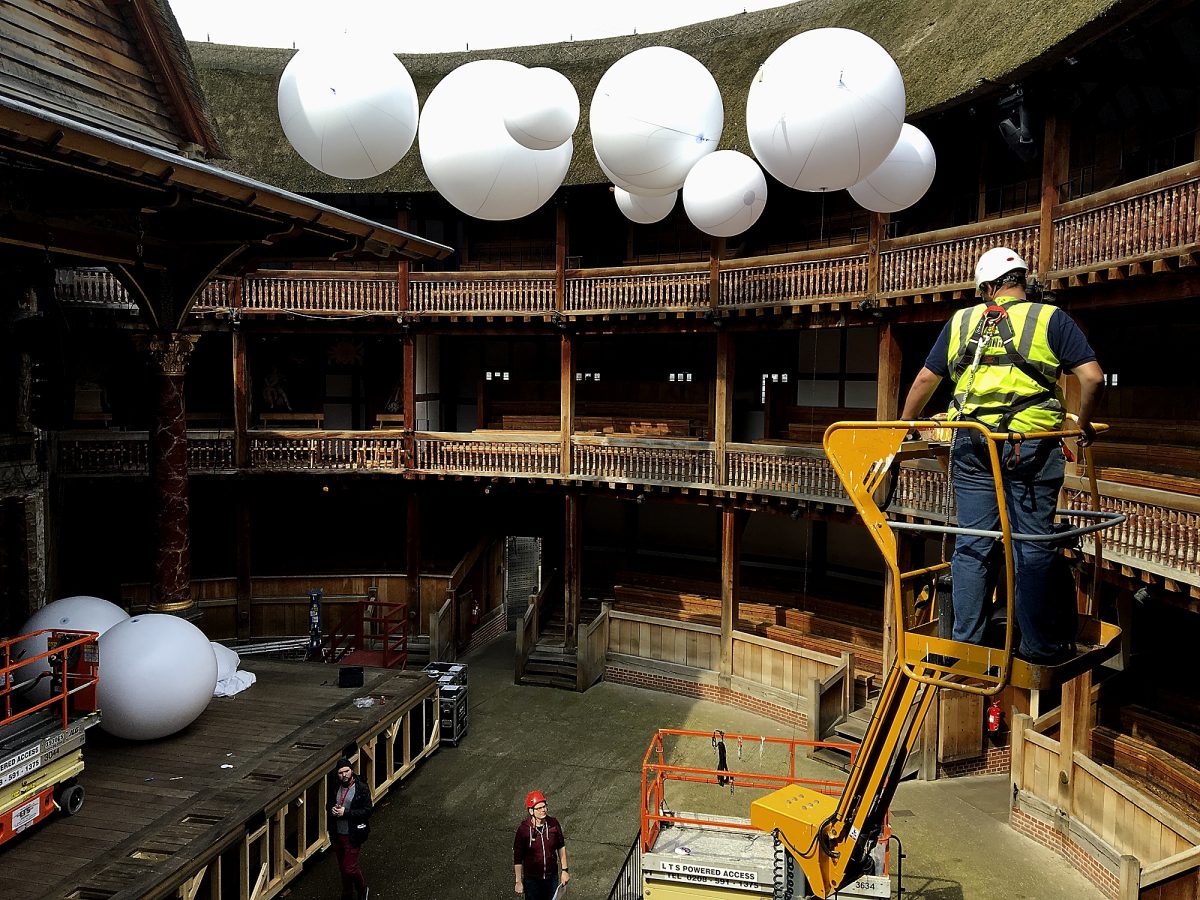
Technicians suspend balloons to be used in a production of “A Midsummer Night’s Dream” at Shakespeare’s Globe Theater in London.
LONDON – In the wildest of dreams, anyone who writes can only hope that someone will still be reading his or her words 400 years from now.
What if those sentences were not only read, but studied, recited, performed and analyzed?
Few scribes can claim this fame, but the plays and poetry written under the name of William Shakespeare are among them.
Stratford-upon-Avon had the Shakespeare market cornered for centuries, but the place where Shakespeare performed – London – until fairly recently had very little in the way of landmarks associated with The Bard. A marble statue was erected in Poet’s Corner of Westminster Abbey in 1741, more than a century after Shakespeare’s death and burial in Warwickshire. What is believed to have been the sole image of Shakespeare painted during his lifetime, a bearded man with a golden earring, hangs in Britain’s National Portrait Gallery.
This changed when an American actor-director, Sam Wanamaker, visited the United Kingdom’s capital 67 years ago.
According to “Shakespeare’s Globe Guide Book,” “When Sam arrived in England in 1949, he was amazed to find the only commemoration of Shakespeare’s life and work in London was a dirty bronze plaque on a brewery wall in Southwark,” a borough of London along the banks of the River Thames.
After years of fundraising and planning, Wanamaker, tragically, did not live to see his Shakespeare’s Globe Theater open in 1997. Four years before that, I had seen the project as a construction site, and I was eager to see the finished complex for the first time last month. Its website included information about plays being staged during our visit, but they had apparently sold out far in advance, and the information showed the venue as the Sam Wanamaker Theater.
There are two theaters in the Globe complex, one indoors, named after Wanamaker, and the other, THE Globe, “this wooden O,” as cited in the play, “Henry V.” It wasn’t until we arrived in London on April 10 that we learned that performances are staged in the open-air Globe later in April in conjunction with Shakespeare’s April birthday, which may have coincided with April 23, the date of his death. We were there about two weeks too early.
On one side of a courtyard are metal gates featuring likenesses of animals mentioned in Shakespeare. Had we been there on April 23, we would have seen that “passers-by adorn them with fresh flowers on the Bard’s birthday. It’s lovely,” said a woman at the Friends of the Globe desk. Rain or shine, performances in the only-partially-roofed Globe take place from the last week of April through October. “It’s unusual to have an open-air space in modern theater,” our guide, Tracy, said. There are somewhat prickly wooden benches and some individual seats sheltered from the weather along the circumference of the ring-shaped timbered bays covered by thatching atop the 20-sided, O-shaped Tudor-style frame.
Remember learning about the groundlings when studying English literature? You, too, can be a groundling today at the Globe, but don’t dare sit down. The price of a groundling’s admission, one penny in Shakespeare’s day, is 5 British pounds today (about $7.35), and it means you must stand for the entire performance in what’s known as “the yard.” There are hazards to being a modern groundling that explain why one cannot sit on said ground. Because, in the event of an emergency evacuation, “they would be trodden upon,” said Globe guide Tracy. The climate in southern England is mild, but summers can be on the warm side. Standing in the hot sun has caused as many as 40 people to faint. The Globe may not have ushers, but “stewards” can use their discretion in allowing those needing a break to sit indoors before returning to the theater during a performance.
The Globe has a “show-must-go-on” attitude, never stopping plays for weather, according to Tracy, who warns, “weather can have an impact on you.” In a country that has what weather buffs call a marine climate, it’s no wonder the theater sells plastic ponchos.
An actual seat in the structure that rings the Globe costs between $30 and $66.
Harvard professor Stephen Greenblat, in his 2004 book, “Will in the World,” noted, “The theater, which did not exist as a freestanding structure anywhere in England when Shakespeare was born,” described the rise of the venue. “Playacting in purpose-built playhouses (as opposed to candlelit private halls, innyards, and the backs of wagons) had only recently come to London.”
During Shakespeare’s time, the audience at the Globe numbered 3,000. Today, safety codes allow no more than 1,500 to attend. Shakespeare’s first Globe Theater had two exits. Now, there are seven. A special exception was made to the local ban on thatched roofs for the sake of authenticity. Thatched roofs, made of dried vegetation, contributed to the spread of the Great Fire of London in 1666, and this flammable material was also factor in the demise of the first Globe Theater.
This initial Globe Theater opened around 1599 and operated until June 29, 1613, when, during a play called “All Is True” about King Henry VIII and the birth of his daughter, Elizabeth, the audience had much more bang for their buck. A cannon firing a blank salute unexpectedly discharged a flaming wad that landed on the thatching and caused the theater to burn to the ground.
A second Globe Theater opened in 1614, apparently several years after Shakespeare retired to Stratford, and its roofing material was tile. Shakespeare died in Stratford exactly 400 years ago at age 52, and the second Globe Theater closed in 1642, the year that Civil War broke out. Puritans, who deposed and executed King Charles I, despised theater because it could potentially keep people from attending church services, and banned public performance. This second Globe Theater was demolished seven years later.
It would be another 348 years before the third Globe Theater opened on land beside the River Thames, near the site of the earlier playhouses in Southwark. Although contemporary works show the Globe’s exterior, none depict the interior. Planners relied on drawings of other theaters of the time when figuring out how to configure the inside of the Globe, where actors perform mostly in the daytime and some evenings. England, in a northerly latitude, has more hours of daylight in summer than Southwestern Pennsylvania. Nighttime performances, to mimic Elizabethan and Jacobean times, would have to be lighted by candles and all that flame around wood and thatching would be a fire hazard. The theater relies mostly on natural light.
So how to convey the dark forest of this season’s “A Midsummer Night’s Dream”? Audiences must listen closely to the actors’ lines, because their words will introducing important elements of the scenes regardless of the actual time of day.
“The actors will declare they are in the dark or a nighttime space,” Tracy said. “Today, we depend on the text to help us. If there is an evening performance, you can play with light a little.”
In keeping with theater in Shakespeare’s time, the Globe does not create sets for its productions. Most of the stage is decorated wood, although colorful pillars are painted to look like reddish marble with actual gold-leaf trim. Two support a roof so the actors are protected from the elements.
A museum forms part of the Globe complex, and the price of a tour ticket includes admission to its many exhibits on Tudor and Stuart-era life, costuming and music.
One display of the museum includes a few panels devoted to the Group Theory of Authorship, adherents of which believe the name William Shakespeare is a pseudonym for writers who could have been severely penalized for expressing unpopular opinions.
“There are a relatively small number of contemporary documents linking William Shakespeare to the plays generally ascribed to him. There have been claims either that they were written in collaboration with other playwrights, or even that Shakespeare didn’t write them at all,” the text of the display reads. “Is there any evidence to confirm that William Shakespeare was the author – or any to confirm he was not?
“The National Archives have most of the important papers relating to William Shakespeare’s life; he appears as a taxpayer, a property owner, a will-maker, a beneficiary in the wills of others, an actor under royal patronage, a shareholder in theatres, a dramatist and is involved in law suits. The only widely accepted examples of his handwriting are six signatures.” Although entire books have been written on this topic, presenting myriad potential authors, the Globe sheds some light on five possible authors: English spy Christopher Marlowe, who may have faked his own death to continue writing from sunny Italy; Edward de Vere, 17th Earl of Oxford, an aristocrat whose life had many parallels with those of the fictional Hamlet; Mary Sidney, Countess of Pembroke, who sponsored poets and an acting troupe; Francis Bacon, Viscount St. Alban, a great intellectual of his time who wrote prolifically; and a relatively new addition to this group, Sir Henry Neville, a member of Parliament who was, for a time, imprisoned in the Tower of London and who had access to confidential information about a shipwreck in Bermuda, considered by many to be source material for “The Tempest.”
I’ve seen the Globe Theater in two of three phases, construction and completion. The third will have to be the charm: an excuse to return to London and actually see a play performed there.