

‘Rough ride’ for Freddie Gray, prosecutor says
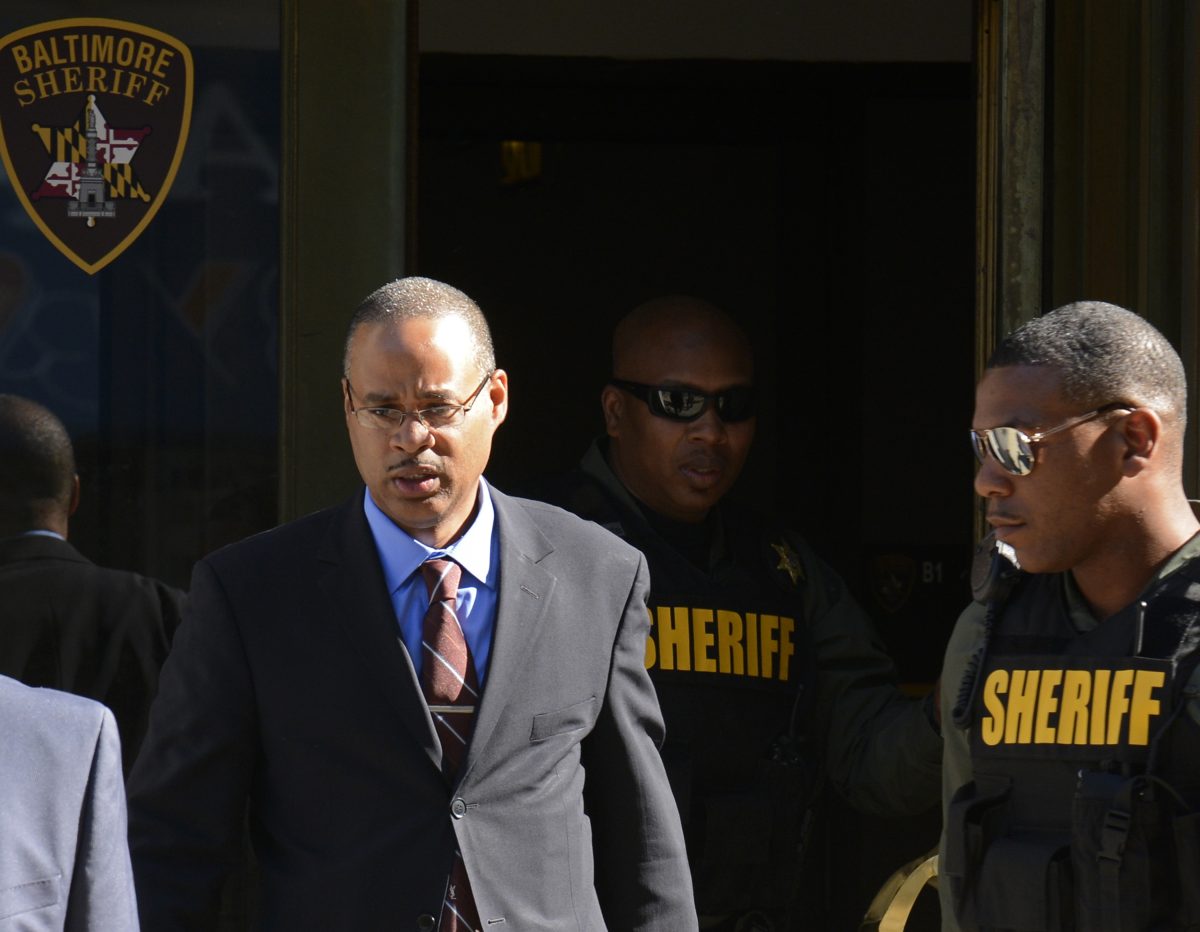
Officer Caesar Goodson, left, one of six Baltimore city police officers charged in connection to the death of Freddie Gray, leaves the courthouse after the first day of his trial Thursday in Baltimore.
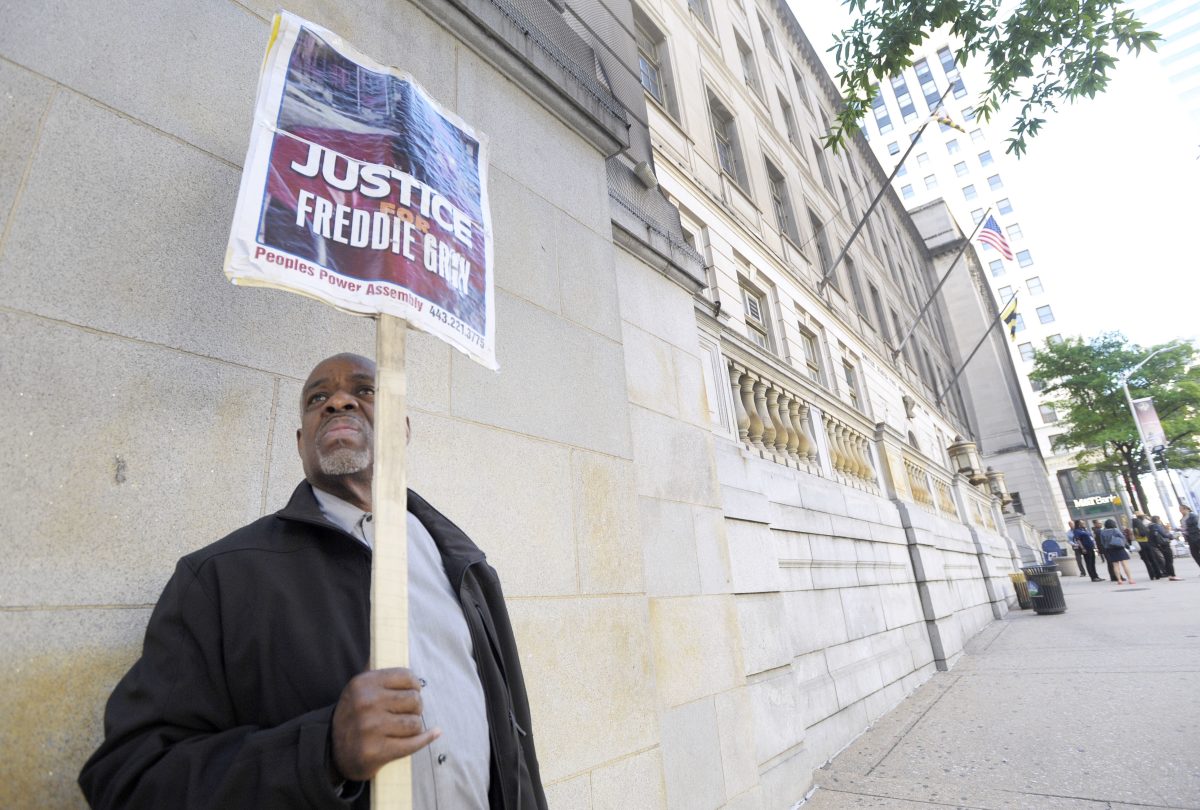
Arthur B. Johnson Jr., of Baltimore, demonstrates alone Thursday outside Baltimore’s Courthouse East on the first day of the trial of Officer Caesar Goodson, not pictured, one of six Baltimore city police officers charged in connection to the death of Freddie Gray, in Baltimore.
BALTIMORE – The officer at the wheel when Freddie Gray suffered a fatal spinal injury in the back of a police van caused the young black man’s death by deliberately giving him a “rough ride,” prosecutors said for the first time Thursday as the driver went on trial on murder and manslaughter charges.
A “rough ride” is police lingo for teaching someone a lesson by putting him in a police wagon without a seat belt and driving so erratically that he is thrown around.
Over the past year, prosecutors hinted Gray was subjected to such treatment. But the accusation during opening statements at Officer Caesar Goodson’s trial was the first time they said the driver meant to hurt Gray, whose death in April 2015 touched off the worst riots in Baltimore in decades.
Prosecutors said Goodson was grossly negligent when he failed to buckle Gray in or call for medical aid during the 45-minute ride.
“There was no good reason for the defendant not to belt him in, except to bounce him around,” Chief Deputy State’s Attorney Michael Schatzow said.
During the drive, Goodson ran a stop sign and made a sharp right turn at such high speed he crossed a double yellow line, Schatzow said, citing video surveillance footage. Gray – his hands cuffed and his legs shackled – was thrown helplessly against the rear compartment, the prosecutor said.
Goodson attorney Andrew Graham flatly disputed the notion Gray was deliberately bounced around, saying: “There was no rough ride. It simply didn’t happen.”
He also said officers “virtually never” belt prisoners in and Goodson is such a “slow and cautious” driver he sometimes lulls his prisoners to sleep.
Graham said Goodson – “a good officer, a gentle man, a nice guy” – didn’t belt Gray in because of his “violent and erratic behavior” that included screaming and kicking with such force the wagon shook. Gray continued to thrash around in the van for several stops, the attorney said.
Goodson, who is black, faces the most serious charges of the six officers arrested in the case. The 46-year-old Goodson could get 30 years in prison if convicted of second-degree murder, or “depraved-heart” murder. He waived his right to a jury trial and opted to let a judge decide his fate.
The trial is being closely watched, not just because Goodson is considered the most culpable of the officers but because prosecutors have yet to secure a conviction in the death that convulsed the city and led to the calling out of the National Guard.
The case against the first officer to go to trial ended in a hung jury in December. Last month, the second officer brought to trial was acquitted.
Gray was arrested after making eye contact with a bicycle officer in a high-crime neighborhood and running away. Once he was handcuffed and put in the van, Gray began to scream and kick so violently he shook the wagon, witnesses said.
Two blocks away, the wagon stopped again, and three officers took Gray out and put him in leg shackles. They then placed him on the floor of the van, head-first and on his belly. He was never buckled in, as required by department policy.
Schatzow said Goodson also failed in his duty when he stopped the van to pick up another prisoner, instead of taking Gray to a hospital.
Graham said Goodson’s supervisors never directed him to seek medical attention for Gray, and the man wasn’t exhibiting any symptoms of distress.
“He did his job, and he followed instructions,” Graham said. “Freddie Gray’s death was a tragedy, but convicting a good officer just to assign blame would make a tragic situation worse.”
Graham told the judge the assistant medical examiner who prepared Gray’s autopsy report and ruled his death a homicide initially told an investigator it was “a freakish accident” before meeting with prosecutors and changing her mind.
“It was the result of a pressurized investigation,” Graham said.
Rough rides, or “nickel rides,” so-called after rides at an amusement park, have been the subject of lawsuits in Baltimore and other cities.
Dondi Johnson died of a fractured spine in 2005 after Baltimore police arrested him for urinating in public. Police put him in a van without a seat belt, his hands cuffed behind his back. His family said he was thrown into the opposite wall. The family won a $7.4 million judgment, though a cap reduced that to $200,000.
In Philadelphia, police in 2001 barred transportation of prisoners without padding or belts after The Philadelphia Inquirer reported the city paid $2.3 million to settle lawsuits over rough rides that paralyzed two people.