

Brant Garda
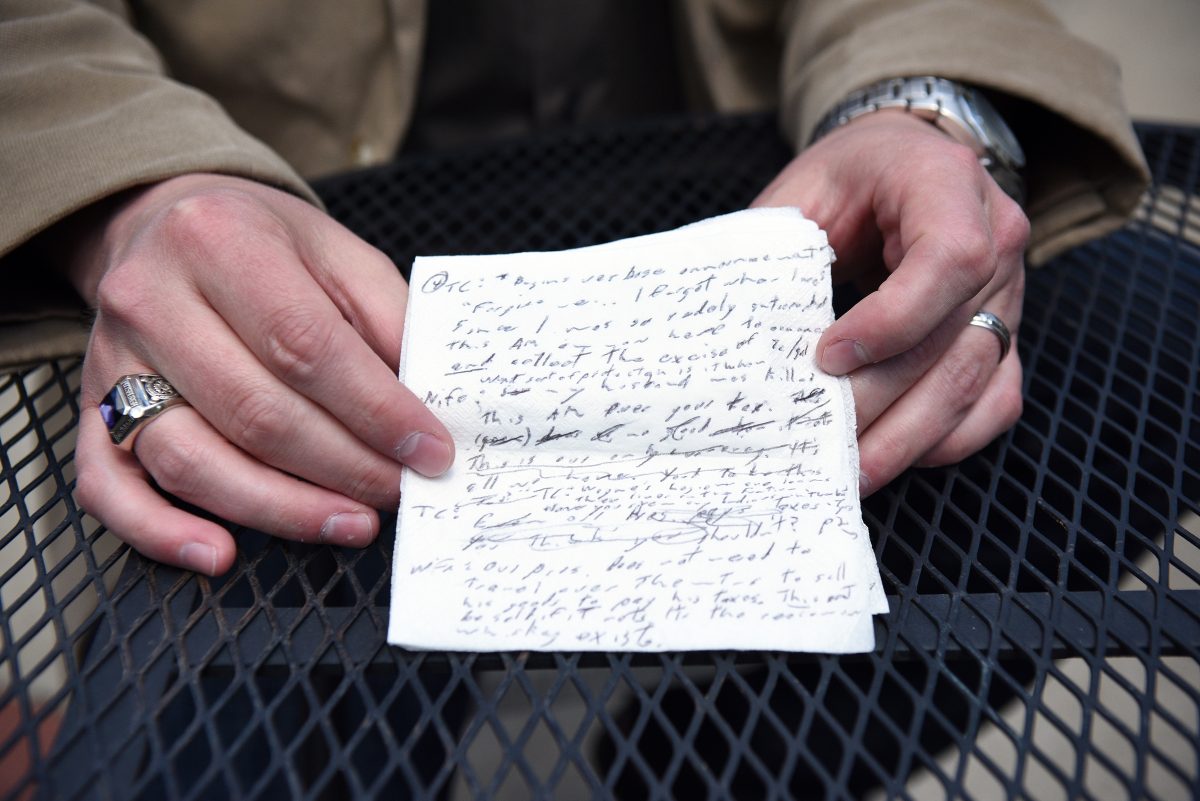
Celeste Van Kirk / O-R Brant Garda holds the script written on a cocktail napkin for re-enactors who will participate in the Whiskey Rebellion Festival.
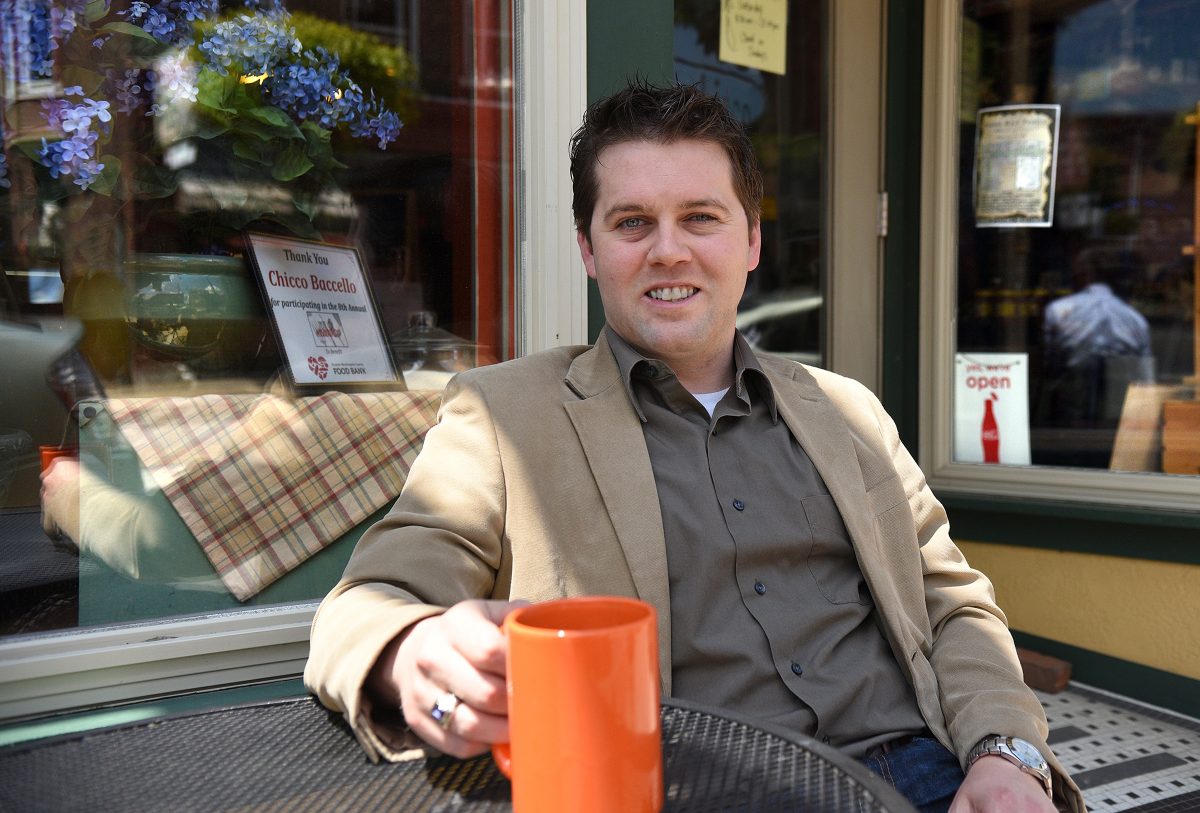
Celeste Van Kirk / O-R Brant Garda, a self-described American history buff, won’t appear in any of the Whiskey Rebellion Festival re-enactments but plays the important role of scriptwriter for re-enactors.
Brant Garda, a self-described American history buff, won’t appear in any of the Whiskey Rebellion Festival re-enactments. But his job is just as important as the roles the actors play. He gets started every January with Washington County Historical Society director and actor Clay Kilgore at the Union Grill, fleshing out first drafts of scripts for the actors to bring to life. For Garda, a martini gets the creative juices flowing, which Kilgore chides him for simply with his choice of – what else – whiskey and coke. And like many authors’ first drafts in a bar, their emerging scripts start off as scribbles on cocktail napkins. Since Garda started out five years ago moving chairs for the festival, the 30-year-old Trinity High School graduate and private capital consultant has moved from humble volunteer to scriptwriter and director for the realistic and often violent engagements that bring the Whiskey Rebellion to life on Washington’s Main Street every July.
Garda’s penchant for directing and writing stems from his experience as a stage and set designer through high school and his years at Allegheny College in Meadville. But it also has to do with his grandfather’s insistence to visit every Civil War battleground in the East as a teen. His soul was sewn to history, and it only took 20 years for him to find an outlet to help bring local American history to life. A sit-down with the man behind the scenes offers a look at how he and Kilgore make the Whiskey Rebellion an authentic retelling of history. Here is a conversation with Brant Garda.
Q. What’s different about the Whiskey Rebellion Festival this year?
A. In a name, Alexander Hamilton. Yes, the Broadway musical has made it a good promotional year for that and his popularity, but we had this idea early to develop not only this year, but next year as well, a two-part series of sorts: This year it’s 1786 and 1791, and next year will be 1793-1794. This year includes Hamilton finally showing in the area, and, after all, he was the lead influencer of the excise tax and pushing it to passage. But this year we’re doing a bit of a time-machine act. The kickoff of the festival will be a re-enactment in 1782, when Pennsylvania has its own initiative to enact a rum tax. Now this is going on when Benjamin Franklin was the sixth president of Pennsylvania – yes, president, the governor essentially, as it was more of its own territory and commonwealth than a state that was part of the federation. That scene in 1782, and the locals’ treatment of a tax officer, that will set the tone for the day before we flash forward to 1786 and 1791 and we’re in the throes of the uprising.
Q. How much is scripted?
A. Clay and I spend about 30 hours writing all the scripts, then doing rehearsals and day-of direction. And we’re keeping things as authentic as possible by incorporating journal entries and actual dialogues from the time period. But, yes, despite all that, some things can go off the rails – sometimes for worse, but most times for better. A lot of actors memorize a monologue or a toast, but others will take the script and give it some creative license depending on how the crowd is reacting. For instance last year it was supposed to be determined by the crowd who got tarred and feathered among two tax collectors. Well, overriding rule, both of them ended up with the treatment and in the stockades. One funny one was when Clay was playing John Holcroft, aka “Tom the Tinker,” an interim leader of the rebellion. Clay was trying to calm the crowd down after an insurrection, and another actor got them riled up again. He got visibly frustrated – in character! in character! – but eventually leaned on his musket and calmly but loudly said, “Joseph: Shut. Up.” So that’s our little joke now when we’re trying to move things along.
Q. Favorite scenes from past years?
A. This is again one of the unscripted moments that kept in line with what we were writing, but it got some unexpected and very audible authenticity. This was last year, when my sister was playing the widow of one of the farmers who was slain in an uprising. So one of the federal officers had interrupted the wake down in the Bradford House gardens and was reacting to her grief. She said, “My husband did not risk his life alongside the president to overthrow one tyrant only to have a hundred tyrants in Philadelphia!” to which the officer replied, “And your husband was buried today!” She responded meekly, “He was.” And he said, “I supposed your grain is not all that will rot!” There was an audible gasp from the crowd. Then she went up and full-on slapped him. She was supposed to just stage slap him, but she clobbered him and turned his head.
Q. What lessons do you want people to take away?
A. Not to put too fine a point on it, but I guess the media at the time. There will be a reading from the Philadelphia Gazette and its announcement of the excise tax. It actually was a fairly balanced write-up of the acts. But as the scene will show, what’s going on in Philly may not be what’s interpreted or expected to be received or understood in Western Pennsylvania. It’s kind of like how things play out with politics in Harrisburg today and the dissonance that goes with a message that may be received locally very well but just falls flat. It’s an examination of the bubble that those types of communications can, well, not communicate very well. There’s a lot to cram in for nearly a half-decade of forceful insurrection and pushback on the government. But this is a highlight for me, because it’s kind of the seed for this area to start planning what farmers and distillers were going to do before ultimately President George Washington came marching with his troops to quash the rebellion.