

Pipelines pushed at tri-state shale energy event
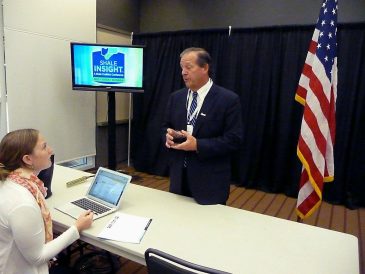
PITTSBURGH – The pipeline to efficient, cost-effective energy is – simply – the pipeline. And more of it.
Those were the overriding messages expressed Wednesday morning during the kickoff of the Shale Insight conference at the David L. Lawrence Convention Center. The annual event, which alternates between Pittsburgh and Philadelphia, is organized by the natural gas industry in the tri-state – specifically, the Marcellus Shale Coalition and its new partners, the Ohio Oil and Gas Association and the West Virginia Oil and Natural Gas Association.
Shale Insight will conclude today, highlighted by the keynote speaker, Republican presidential candidate Donald Trump. Democratic nominee Hillary Clinton was invited but declined, said David Spigelmyer, president of the Marcellus Shale Coalition.
“It is so important to connect production to distribution. Build the infrastructure and demand from markets will follow,” Gary Heminger said during the opening minutes of the opening keynote address.
Heminger is chairman, president and CEO of Marathon Petroleum Corp. He also is a major proponent of natural gas, particularly in the Marcellus and Utica shale plays.
“What we do in the Appalachian Basin continues to revolutionize the industry,” Heminger said. “We are at a critical moment in our industry’s history, but we are always at a critical moment because of what we do.”
He said, not surprisingly, the two major challenges facing that industry are lower commodity prices that have existed for more than two years and government regulations. He said the price situation “is difficult to overcome” and decried inconsistencies that occur in establishing regulations.
An increase in pipelines, of course, could lead to an increase in demand – and to higher prices.
Heminger also lamented that there is a lot of misinformation about oil and gas.
“Activists say, ‘Keep oil and gas in the ground.’ But without doing what we do, our energy sources will go down,” he said.
“Our industry groups need to be vocal and informed. When advocating for our industry, we are advocating for consumers, who are benefiting tremendously. Our industry is doing things cleaner and safer year after year.”
A group of energy-related executives followed Heminger to the stage. They included Owen Kean, senior director of energy for the American Chemistry Council.
“There has been increasing resistance to increasing the takeaway capacity of natural gas,” he said. “I think we need more people to support pipeline capacity in this part of the country.”
Richard Harshman, chairman, president and CEO of Allegheny Technologies Inc., also spoke in favor of natural gas.
His Pittsburgh-based firm has facilities in nine states, including the Allegheny Ludlum plate mill in Canton Township. It also plays significant roles in the aerospace and defense industries.
A little more than a year ago, ATI opened a hot-rolling and processing facility it built in Brackenridge in the Allegheny Valley. The cost was $1.2 billion, yet Harshman said it was a prudent investment.
“A natural gas furnace (there) is more cost-effective than anything else. It’s much more efficient than the 70-year-old facility we had. We are highly dependent on natural gas and will remain highly dependent.”
Donald Moul also touted natural gas. He is a senior vice president of fossil operations and environment for FirstEnergy Corp., which has shuttered several coal-fired power plants, including Mitchell Power Station in Union Township and Hatfield’s Ferry in Greene County in 2013.
“Cheap and abundant natural gas is making coal-fired and nuclear power plants less economically competitive,” Moul said. He added that natural gas is forecast to generate 34 percent of U.S. electricity in 2016, compared with 30 percent for coal – the longtime former primary source.
Spigelmyer was the master of ceremonies, accompanied on stage by his peers from across the state line: Shawn Bennett, executive vice president of the Ohio Oil and Gas Association, and Kevin Ellis, chairman of the West Virginia Oil and Natural Gas Association and vice president of government relations for Antero Resources.
Spigelmyer’s view of the nation’s energy landscape was sunny.
“We’re no longer relying on foreign sources for 65 percent of our energy needs,” he said. “That reliance has decreased to 40 percent because of what we’re doing at home.”
“At home” could have been referring to Pennsylvania, Ohio and West Virginia as well.