

Rare doorstop heralds ‘Open Door’ policy
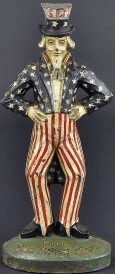
Iron doorstops became a hot collectible with rising prices about 1990. A 1985 book picturing doorstops and several auctions, which included rare doorstops, sent collectors searching for examples of the 1930s and ’40s collectible. They became so popular that thousands of copies were made, many from the original molds. Bright new paint identifies many recent doorstops, but some, with artificial wear and tear, are good enough to fool collectors today. It is almost impossible to break an iron figure, so many iron doorstops still are available with little damage. Top prices are paid for doorstops in great condition with almost all of the original paint. And, of course, rarity adds value.
This original Uncle Sam doorstop has the words “For the Open Door” on the base. The words “For the Open Door” had a political meaning, and it was not just a statement about how the doorstop was used. A complicated “Open Door” policy was promoted by the U.S. in 1899. It suggested that all countries should allow China and other countries to trade with no tariffs, no special harbor charges, and with no interference or attempts to divide China. There was another Open Door political discussion in 1922, and this discussion probably is the one mentioned on the doorstop. China opened special investment zones in 1928. There were more international discussions and changes in 1978 concerned with China’s industry, trade and foreign investment.
The Uncle Sam doorstop is rare and desirable, and this one, with great paint, sold recently at a Bertoia Auction for $21,240. The 1985 value was $250.
Q. I have a wooden table that is marked “Larkin Soap Company.” Does that mean it was used in the company office or was it made by a soap company? How old is it?
A. John D. Larkin (1845-1926) worked for a soap factory in Buffalo in the 1860s. He became a partner and moved with the company to Chicago. He met and married a girl from Buffalo and they moved back to their home town in 1875. There he started his own company, John D. Larkin, and sold “Sweet Home” soap. By 1881, he had a full line of related products and gave a free colored picture card with each bar of soap. Cards were not enough, so he started giving better premiums including, handkerchiefs, towels, dishes and even furniture. The desk was the gift with ten dollars’ worth of soap. Soap sales changed by the 1940s, premiums were no longer popular and the company closed in 1962, Your table was made from 1899 to 1904 when the company name matched the label on your table.
Q. We have a 10-inch antique plate and would like to know its value. It is by Sarreguemines, signed by L. Moux, and dated late 1800s.There are well dressed 19th century men and women in a room. Can you help?
A. Sarreguemines is the name of a French town that is used as part of a china mark. Utzschneider and Co., a porcelain factory, made ceramics in Sarreguemines, Lorraine, France, from about 1790. In the 19th century, the factory made majolica and transfer-printed wares picturing peasants. When a local innkeeper ordered a table service with local scenes, a local artist Henri Loux (1873-1907) designed a series of 56 illustrations that depicted the daily lives of the people of the Alsace region. Jugs, plates and other dishes were made using the designs starting in 1904. The dishes have come to be known as the Obernai series. Sarreguemines ceased production in 2007, and the factory no longer exists. A factory at Luneville-Saint-Clement still makes several of the designs that made Sarreguemines famous. The marks and scene on your plate suggest it was made about 1898. It probably pictures a scene from the 1898 comic play “D’er Herr Mayor” by painter, writer, and creator of the Alsatian theater, Gustave Stoskopf. It is worth about $50.
Tip: Apply your makeup, wash your hands, then put on your jewelry. This is especially important for pearls.
Current prices are recorded from antiques shows, flea markets, sales and auctions throughout the United States. Prices vary in different locations because of local economic conditions.
• Sandwich press, rectangular, square side handles and front top handle, flat plates, footed, 1930s, $10.
• Brass button, embossed, steam train, railroad, “Hollandsche Spoorweg-Maats Chappij,” c. 1890, 1 inch, $75.
• Ballot box, wooden, turned handle, 2 compartments, lift lids, scroll metal latches, sloped front, 3 1/2 x 9 x 5 inches, $150.
• Cranberry glass basket, enamel design, girl with flower, gilt wire twist upright handle, loop feet, 1800s, 6 x 4 inches, $235.
• Gunpowder flask, hammered goldtone metal, oval body, scalloped handles, beading, ivory panels and red cabochons, 1800s, 9 x 6 inches, $395.
• Photograph, United States Marine Corps, infantry men battle for Okinawa, black and white, 1945, 3 1/2 x 4 inches, $480.
• Vanity, mahogany, brass ormolu mounts, shaped top, three drawers, scroll apron, cabriole legs, Victorian, 30 x 36 inches, $795.
• Book, “The Tale of Mrs. Tiggy-Winkle,” Beatrix Potter, 1st edition, hardcover, F. Warne, 26 color illustrations, c. 1905, 5 1/2 inches, $1,300.
• Doll, Shirley Temple, composition, blonde mohair ringlets, leather cowgirl outfit, hat, smiling, dimples, 1930s, 27 inches, $2,495.
• Engagement ring, pink sapphires and diamonds, cluster, platinum and 14k gold, faceted oval center stone, c. 1925, size 8, $4,800.
Write to Kovels, Observer-Reporter, King Features Syndicate, 300 W. 57th St., New York, NY 10019.