

Leadership helps Steelers fight adversity
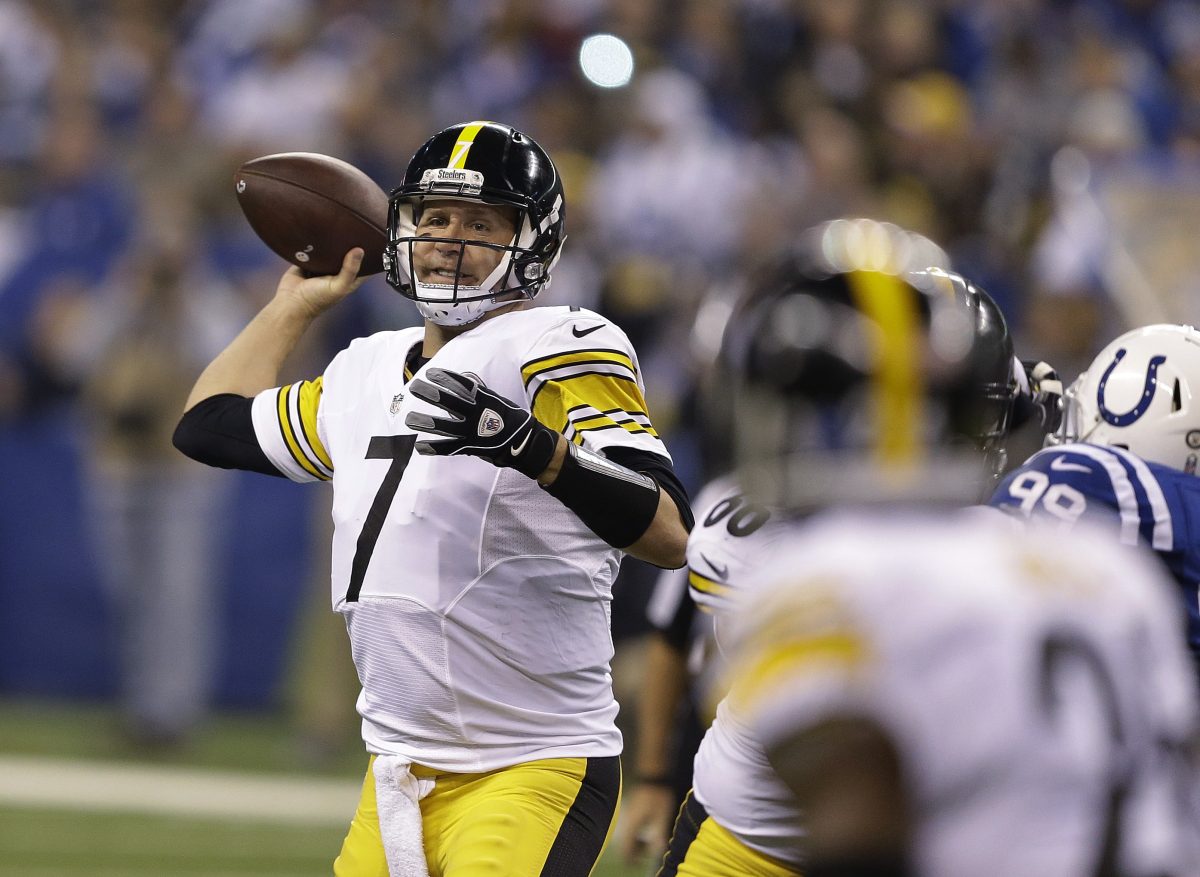
Steelers quarterback Ben Roethlisberger is one of the team’s leaders. “To me, leadership can be a lot of things,” he said. “It can be as subtle as a look. It can be words. It can be actions. Being able to lead people, lead men, is an awesome responsibility.”
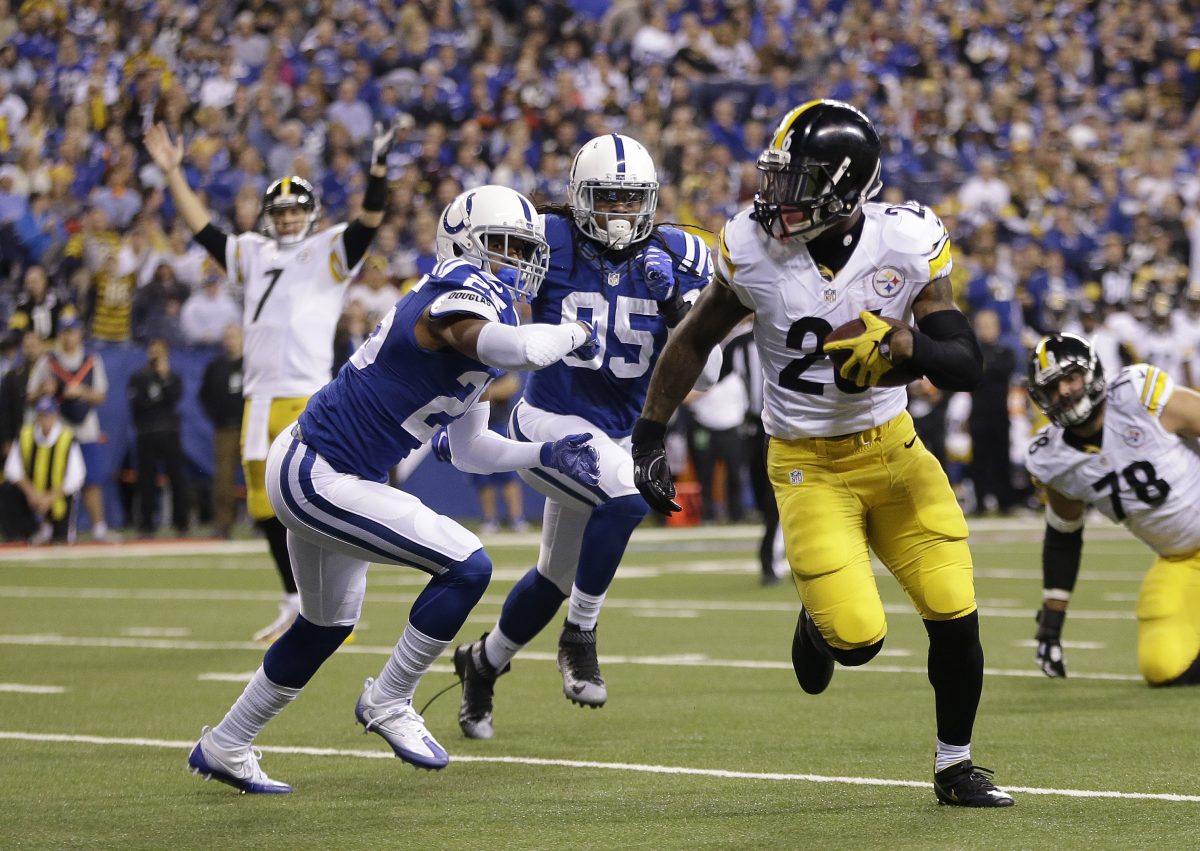
Steelers running back Le’Veon Bell runs past Indianapolis Colts’ Patrick Robinson for a 5-yard touchdown run during Thursday’s game against the Colts.
PITTSBURGH – The Steelers’ selection of defensive lineman Joe Greene in the first round of the 1969 draft is considered the move that changed the trajectory of the franchise.
A phenomenal player, Greene not only added Hall-of-Fame ability to the Steelers’ defense, he was the quintessential leader both on and off the field.
Every team has leaders. Often, that leadership is only revealed when adversity hits.
The Steelers, who improved to 6-5 with their 28-7 Thanksgiving Day victory at Indianapolis, went through a four-game losing streak that tested its leadership greatly.
The Steelers have won their past two games to not only pull out of their tailspin, but jump back into first place in the AFC North. Head coach Mike Tomlin leaned heavily on several players in his locker room to make sure Pittsburgh’s spiral didn’t continue.
“What I want guys to do is be themselves and be their best selves,” said Tomlin. “You have to acknowledge that different guys are blessed in different ways. Some guys’ talents lead them in terms of leading by example. Some guys are outgoing-personality types and have a way of capturing the moment with their words and bringing guys together. I want guys to be themselves and whatever that entails, just be their best selves. So if leadership is a skillset that they have, whether be it through actions or vocals, I expect them to do it.”
Tomlin has been blessed with a plethora of both types of leaders in his 10 seasons with the Steelers. And that leadership comes from a variety of different places.
When the Steelers lost, 35-30 to Dallas two weeks ago for their fourth consecutive loss, quarterback Ben Roethlisberger’s message to his teammates was a simple one.
“Follow me,” Roethlisberger said.
When the Steelers selected Roethlisberger in the first round of the 2004 draft, they had a veteran team with a plethora of leaders. But the young quarterback immediately became another leader on the field as befits the position.
And, as players such as Jerome Bettis, Alan Faneca, Hines Ward, Heath Miller and others have moved on, Roethlisberger has seen his role grow.
“To me, leadership can be a lot of things,” Roethlisberger said. “It can be as subtle as a look. It can be words. It can be actions. Being able to lead people, lead men, is an awesome responsibility.”
It’s one his teammates say Roethlisberger handles well.
They see him talk to young players when they need to be pulled aside. They see him take control of the huddle on the field. They see him take responsibility for his own errors.
“Accountability, it means everything. It’s a guy you can look to and know he’s going to be accountable every time,” said center Maurkice Pouncey, a leader his own right. “He’s going to keep his head high, win or loss. That’s the stuff you can appreciate. I think (Ben) does a great job of that. He keeps everybody grounded. Everybody knows when he’s serious and when he’s not. As a true leader, I appreciate that.”
When the Steelers took the field for the first time at training camp at Saint Vincent College in the summer, the defense gathered in a circle.
Defensive end Cam Heyward has been a leader of that unit for the past few seasons both vocally and in deed. But on this day, it was not Heyward who had gathered the troops together.
Outside linebacker James Harrison was the man in the middle of the group.
“We want to be the No. 1 defense,” Harrison yelled. “We’re going to be the No. 1 defense. We’re going to win a Super Bowl.”
It was a simple message but one that hit home with his teammates. Harrison is not a particularly vocal leader. He inspires his teammates more through his deeds rather than his words.
“I’m not trying to be a real vocal guy,” said Harrison, who broke the team’s all-time sack record against Cleveland. “I try to go out there and lead by example. I just do it. Hopefully, guys see that and try to follow suit.”
He does plenty of that. But when Harrison speaks, his teammates take notice.
“They watch everything he does on the field and off,” said Tomlin the day after Harrison broke the sack record against the Browns. “I went down this morning to get a cup of coffee at about 7:30 a.m., and I heard music on in the weight room. I went to see who it was. It was James Harrison less than 24 hours after becoming our all-time sacks leader. On a short week, he’s in there doing what he does. There’s a lot to learn from a guy who approaches his business in the manner he does. And I know our guys recognize that.”
Harrison is well known for his work ethic in the offseason, but that also carries over to the regular season. Even at 38, and maybe especially because he’s 38, he stays on a strict workout regime.
He’s also made a habit of working with other players on the team, showing them what it takes to become great.
“He’s an idol of mine. My first year, I didn’t do well. He took me under his wing the second year and showed me how he worked out, how he trained,” said veteran linebacker Lawrence Timmons of Harrison. “I woke up with him every morning and worked out and again in the afternoon. He’s the reason I am the person I am today as far as getting on the field and how I carry myself.”
With Heyward out for the remainder of the season with a pectoral injury, he also realized he had to take a more vocal leadership role moving forward.
With the Steelers mired in a 4-game losing streak prior to the game against the Browns. Harrison, as he did before the first play of training camp, gathered his teammates before they took the field in Cleveland.
“When we were about the go out on the field, he was the one bringing us out in the huddle, saying what he needs to say before we go onto the field,” said linebacker Arthur Moats. “We feed off of that. This is a guy whose track record speaks for itself, so anytime he says something, we listen.”
When Heyward was injured in a loss to the Dallas Cowboys Nov. 13, he finished that game, so teammates were surprised when they learned he wouldn’t play again this season.
Fellow defensive end Stephon Tuitt knew that with Heyward out, more would be placed on his plate. Already expected to be a disruptive force at the line of scrimmage, he now also would be relied on to provide a steadying factor, as well.
He responded with a career game against the Browns, recording six tackles, a career-high 2.5 sacks and four quarterback hits.
His teammates were just as impressed with some of his non-sack plays, such as when he completely blew up running back Duke Johnson and quarterback Josh McCown on plays down the field, proving age is not a factor when it comes to leadership.
“Everybody was being unselfish, doing whatever they could for the team,” said Timmons. “You saw it out there on the field. You had Tuitt running around, halfway across the field, tackling running backs, quarterbacks.”
When teammates see the 300-pound Tuitt making plays downfield, it becomes an inspiration. The hustle becomes contagious.
“If it takes that, that’s what I’ll do,” said Tuitt, who is in just his third season. “I’m not looking at any leader role, I’m just doing what I’m supposed to do, trying to be the best player I can be to help us make our playoff push.”
Yet he does recognize that with Heyward out, he does need to help set the tone for the defense.
He might not necessarily consider himself a leader, but the results of his actions show he clearly is being counted on to do more than just be a great player.
“To me right now, it’s leading by example,” Tuitt said. “It’s just going out there and giving it everything I have for the guys that I play with. Doing that alone is all that I can take care of and control.
“Cam’s able more to talk and get emotional with guys. I’m not a talker like that. Mine is more of an example. Just go out there and try to give it everything I can no matter what.”
Refusing to quit when things are going badly isn’t easy. But the Steelers haven’t had a losing season since 2003 and in each of the previous three seasons, they have gone 6-2 in the second half, showing no quit.
“The Steelers organization, past and present, has always had a will to win, never giving up,” said wide receiver Antonio Brown. “Since I’ve been here, we’ve always had that.
“I think it’s a hungry group. We’ve got a lot of young players. This isn’t the same Steelers team with the Brett Keisels and guys that have been around. We have a lot of young players.”
And those young players need leadership that starts at the top.
As Brown said, the Steelers have undergone a lot of change in the time he’s been here. Since 2010, Brown’s rookie season, the Steelers have lost players such as Keisel, Heath Miller, Troy Polamalu, James Farrior and others who were considered solid leaders both on and off the field.
But others always step into the role.
“That’s the evolution of this game, this sport and just this locker room in general,” said guard Ramon Foster, himself one of the team’s best leaders. “Guys step up, and when they do, guys follow. You don’t have to proclaim yourself as a leader. The ones that prove that he is or they are, they’re respected. That’s the beauty about this game, this sport.”