

Hathaway gave Division I football a shot and excelled
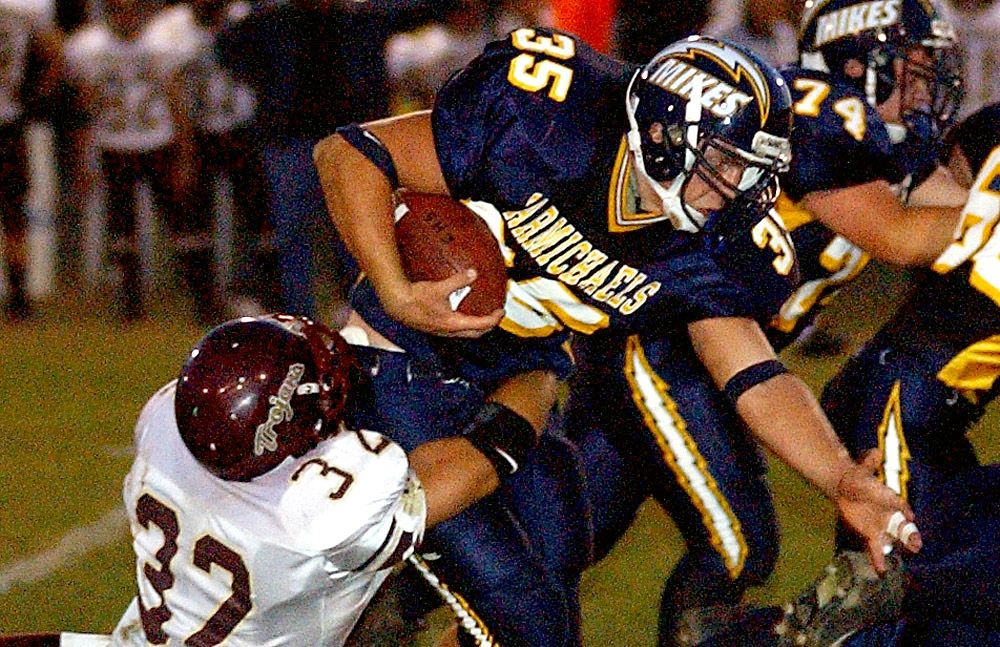
As a senior at Carmichaels, Bobby Hathaway rushed for 1,455 yards and scored 24 touchdowns. The Mikes won a school-record 11 games that year.
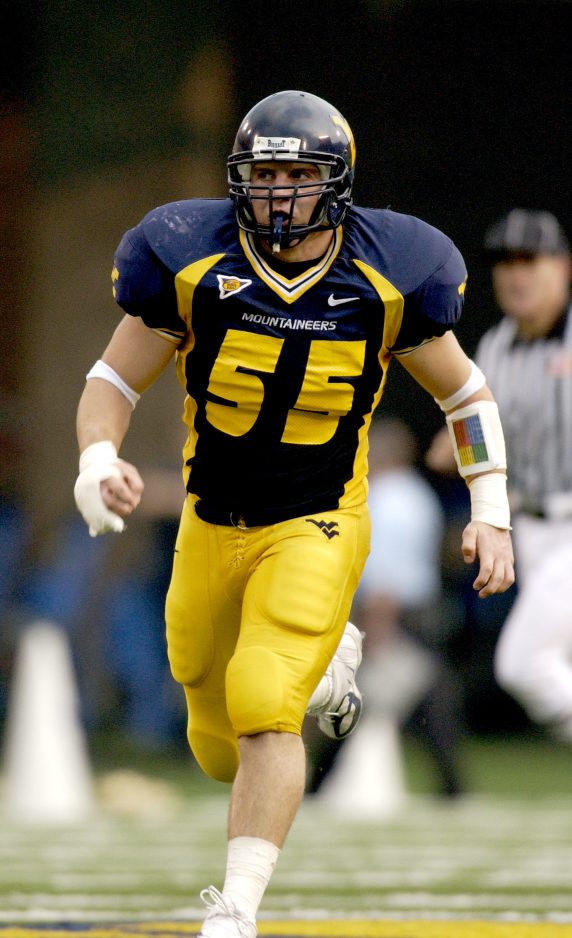
Bobby Hathaway played in 45 games while playing linebacker and special teams at West Virginia University from 2003-07.
Bobby Hathaway arrived on the West Virginia University campus in Morgantown, W.Va., in the summer of 2003 with a chip on his shoulder and things to prove.
Despite his standout multisport days at Carmichaels High School, Hathaway went largely unnoticed by major Division I football programs. The top student in his class at Carmichaels, several Ivy League schools coveted the bruising, two-way player. Division II schools were interested, too.
Hathaway appreciated the attention, but he had a goal – to play major college football. So, when then-WVU head coach Rich Rodriguez extended an invitation to Hathaway to become an invited walk-on, he jumped at the chance to join the team he grew up watching.
“My parents took me to camps everywhere while I was at Carmichaels. We were always running around,” Hathaway said. “I remember being at a camp at Ohio State and all these guys were talking about being on full scholarship. I remember saying, ‘I know I can do this. I’m going to do whatever to give it a shot.’ I had nothing against the smaller schools, but I wanted to give (WVU) a shot, at least for a year or two to see if it worked out. I knew I had to bust my butt.”
Hathaway dressed for games his first year but was redshirted. The following season, he earned a spot on special teams and even had a kickoff return against Central Florida. All the while, he was earning a reputation at practice.
“I felt like I had to go and lay people out,” Hathaway said. “Players were telling me, ‘Just chill out, relax.’ I was like, ‘You have a scholarship. It’s nothing personal.'”
Hathaway earned notice on special teams during the 2004 season. In the offseason, he further gained the respect of Rodriguez.
That’s when he and legendary WVU fullback Owen Schmitt, then a walk-on, worked a construction job in Grafton, W.Va. It required waking up at 5 a.m. and using a 90-pound jackhammer.
“After that, we’d get to the stadium to eat lunch with the team, then go through the team workout,” Hathaway said. “We were exhausted but I was in the best shape of my life.”
In July 2005, Hathaway and Schmitt were put on scholarship.
“It was just a great feeling. I wouldn’t go back and change it even if I could,” Hathaway said. “It was such a sense of satisfaction, and another perk was all the extra sets of socks and gloves you get when you’re on scholarship.”
It didn’t take long for Hathaway to earn considerable playing time at linebacker for the surging Mountaineers, who were among the nation’s best teams at the time. For those who followed him at Carmichaels, Hathaway’s rise up the WVU depth chart wasn’t a surprise.
“Recruiting is based on something I like to call objective subjectivity,” said John Menhart, Hathaway’s football coach at Carmichaels and the superintendent for that school district. “They predetermine if a kid can play on what can’t be measured. What can’t be measured is a kid’s intelligence, work ethic and love for the sport. Bobby had all of those and, on top of that, Bobby could’ve played anywhere. He was a really smart kid who really understood the game.”
At Carmichaels, Hathaway was a destructive force for one of the best football teams in school history. In 2002, the Mikes won a school-record 11 games, earned the program’s first playoff victories (Bishop Canevin, Fort Cherry) since 1980 and Hathaway led a talented group that included Jono Menhart, Colby Giles, Justin Zielensky and Josh Novotny with 1,455 rushing yards, 24 touchdowns and 100-plus tackles.
Hathaway shared the Observer-Reporter’s 2002 Offensive Player of the Year honors with Washington High School’s Travis Thomas, who played at Notre Dame.
As John Menhart said following the Mikes’ convincing playoff victory against Fort Cherry at Thomas Jefferson High School, “If Bobby Hathaway isn’t a Division I player, then we’ll never have one.”
Menhart was right, and it wouldn’t take long before Hathaway was calling defensive signals on the field for West Virginia.
“I still remember the 2006 Sugar Bowl,” Hathaway said. “It was January 2006 and (Hurricane) Katrina hits, so they moved the game to Atlanta and we played Georgia. It was so loud and I’m calling plays on defense. I had to scream so everyone could hear me. I still get goose bumps thinking about that game.”
West Virginia beat Georgia, 38-35, one of several signature victories during the golden era of Mountaineers football. From 2003-2007, West Virginia went 49-14 with four Big East Conference championships and victories in the Sugar, Gator and Fiesta bowls. He played in 45 games and had 114 tackles, including 10 tackles for loss during those years.
These days, Hathaway, 32, lives in Morgantown and is married with two children. He works for United Rentals as a branch manager in Washington and, on occasion, a die-hard WVU fan still recognizes the former linebacker.
“I’ve definitely had an awesome time,” Hathaway said. “College was a blast, but it was a lot of hard work, too. When I look back at high school, you realize how much fun you had. You never forget those times.”
Mike Kovak is assistant night editor for the Observer-Reporter. His email address is mkovak@observer-reporter.com.