

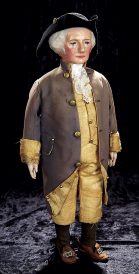
George Washington’s likeness captured in a portrait doll
While Valentine’s Day is always Feb. 14, President’s Day can be any one of seven dates, the third Monday in February closest to the 20th. In 1885 George Washington’s birthday, Feb. 22, was made a national holiday. But in 1971, Congress decided that instead of celebrating the real birthdays of President Washington and President Lincoln (Feb. 12), there would a Monday celebration for both. Why Monday? To give everyone a three-day weekend away from work. Feb. 20 was chosen because it was between the two real birthdays.
President Washington lived in the days before cameras, so he was remembered in designs for silhouettes, paintings, prints, medals, cameos, glass patterns, toys, Staffordshire figures to keep on the mantel and even drapery fabrics. Most of the memorabilia was copied from the few famous paintings of the president images that still are used.
A President Washington doll made after 1880 looks like Washington in his presidential years. The doll is made of cloth with pressed and oil-painted features, and gray hair worn in a ponytail. His eyes are blue. The doll is dressed in a silk suit with a lace jabot and wears a tri-corn hat, black stockings and shoes with buckles. The costume is a familiar one. The doll probably was not made for a young child, but as a part of the 1889 centennial celebration of Washington’s inauguration. It was made by Martha Jenks Chase who started making portrait dolls in her backyard about 1880.
A 25-inch tall Chase Washington doll sold at a May 14, 2016, Theriault’s auction in Las Vegas for $3,080.
Q. I found an old weather-beaten trunk with wood slats on a flat top and metal corners. It has a metal lock with the name E.A. Seagrove. It appears to be some sort of navy officer’s box. The trunk is missing a corner piece and the top is warped. Does it have any value? Should I pay to restore it?
A. E.A. Seagrove was a naval outfitter in business in Portsea, Portsmouth, England. The company made brass bound chests and other items. The family business started in 1795 when Edwin’s father, William, who had a textile and drapery business near the dockyards in Portsea, began supplying naval officers with equipment and furniture. The name of the company changed several times as his sons and other members of the Seagrove family joined the business. The name of the business was E.A. Seagrove from 1866 to 1892, when it became Seagrove & Co. If you want to use it, ask a restorer what it would cost to put it in shape. Then decide if it can be restored. It has almost no antique value.
Q. I’d like information about my great-grandmother’s full set of beautiful dishes and serving bowls given to her as a wedding gift in 1876. They are marked “LS & S Carlsbad Austria.”
A. This mark was used about 1895 to 1917 by Lewis Straus & Sons, importers located in New York City. Carlsbad was part of Austria until after World War I, when it became part of Czechoslovakia. Today the town is called Karlovy Vary and is part of the Czech Republic. Several factories in Austria, Bavaria, and Germany used “Carlsbad” in their mark. Many pieces were exported to the United States in the late 1800s and early 1900s. Sets of china are hard to sell, but you can enjoy the dishes for their sentimental value.
Q. What’s the current value of a 1920s Master Prophylactic coin-operated dispenser in excellent condition, with keys? It was manufactured by the Norris Co. in Chicago.
A. Norris Manufacturing Co. made the Master Prophylactic dispenser beginning in 1920.The company made at least 30 different vending machines and arcade games in the 1920s and 1930s. The Master Prophylactic dispenser is cast iron and was made to be mounted on the wall in the men’s room. There are collectors of this type of machine as well as many other more decorative types. A few have sold at auction for over $1,000.
Tip: To clean a very dirty old iron pan, spray it with oven cleaner, put it in a plastic bag for a day or two, then scrub it with a brass brush and rinse. Wear rubber gloves.
Current prices are recorded from antiques shows, flea markets, sales and auctions throughout the United States. Prices vary in different locations because of local economic conditions.
• Depression glass, sugar, cherry blossom pattern, pink, embossed flowers, angular handles, scalloped rim, c. 1935, 3 x 5 1/2 inches, $20.
• Valentine card, embossed paper lace cover, homeycomb medallion, pink tissue, girl and dog, signed, G Fox Story, c.1860, 4 x 3 inches, $95.
• Silver Plate grapefruit holder, scroll openwork petals, domed saucer foot, crown mark, Rockport Co., 1940s, $130.
• Fortune Telling Cards, tarot, gold edges, text and images, The Nile, US Playing Card Co., box, 52-card deck, c. 1900, 4 x 3 inches, $145.
• Vacuum Cleaner, pneumatic, steel, tin, brass and wood, cylindrical, spool shape handle, Reeves Co., 1915, 49 x 8 inches, $210.
• Bronze doorknocker, Abraham Lincoln, profile, slavery abolished speech text, round, ring striker, 1915, 3 1/2 x 3 inches, $300.
• Basket, messenger pigeon carrier, wicker, woven, lift lid, top door opening, window cutouts, leather strap closure, c. 1910, 13 x 23 inches, $450.
• Table, candle, pewter and cast iron, gold and cream, offering slot, embossed flowers, lower shelf, candle holders, 1920s, 19 x 57 inches, $795.
• Sterling-silver bottle opener, corkscrew, mermaid and fish shaped, ruby eye, G.W. Lewis, box set, 1938, each 4 inches, $955.
• Carnival gambling wheel, wooden framed bicycle tire, pinned-on playing cards, mounted to plank, hanging, 1930s, 31-inch diameter, $1,300.
Write to Kovels, Observer-Reporter, King Features Syndicate, 300 W. 57th St., New York, NY 10019.