

Washington School District takes advantage of free water-testing program to check lead levels
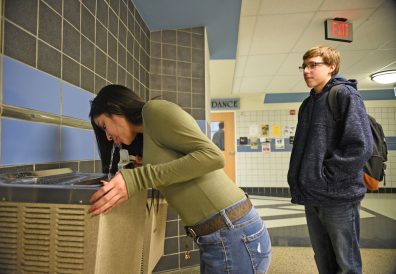
Not all Pennsylvania school districts are required to test their drinking water for lead.
But Washington School District, amid national concerns about lead levels in drinking water in schools and the recent controversy over lead in the water of a Butler County elementary school, recently took advantage of a free lead-testing program offered by Healthy Schools PA.
Dr. Roberta DiLorenzo, district superintendent, said the decision to test the water in the district’s schools for lead is precautionary.
“One of our school board members thought it would be a good idea and suggested we check our water. We haven’t had any complaints or suspicions, and there are no current concerns by any means. But certainly, there’s no reason not to have it tested,” said DiLorenzo. “It’s good information to have. We don’t anticipate any problems. We’re pretty transparent and it’s good, I think, to let the public know things are good.”
Healthy Schools PA, a program launched by Pittsburgh-based Women for a Healthy Environment, began offering school districts and child-care facilities in Southwestern Pennsylvania free water-testing kits nearly a year ago, after high levels of lead were found in water in U.S. school buildings, including those in Flint, Mich., Sebring, Ohio, and Newark, N.J.
An independent, Environmental Protection Agency-certified laboratory in Western Pennsylvania analyzes the samples collected from school districts.
“Lead exposure can cause neurological damage, and children are especially vulnerable,” said Michelle Naccarati-Chapkis, executive director of Women for a Healthy Environment.
Long-term exposure to even low levels of lead in children can cause physical and mental impairment.
The test coordinated by Healthy Schools PA covers water from drinking fountains and sinks used to prepare food items.
Fixtures that contain lead, such as water fountains and water heaters in older schools, can leach lead into water.
According to Healthy Schools, a recent Pennsylvania School Boards Association study found that 16 percent of Pennsylvania schools have cut spending on building maintenance, which could create potentially hazardous conditions.
In Pennsylvania, the law does not compel public schools that use municipal water supplies to conduct tests for the toxic metal.
But school districts that serve as their own water provider are required to test their water for lead.
Avella School District Superintendent Cyril Walther said the district, which draws water from an on-site well, tests water annually and sends a copy of the report to the state Department of Environmental Protection.
The school district recently completed a $3 million renovation project at the high school and elementary school, which included replacement of many original pipes in the buildings.
Walther said the school district has not encountered any problems with lead contamination, but noted the importance of providing children with access to clean, safe water.
“We’re in good shape here. But (lead) is a real concern nationwide, there’s no doubt about it. Ultimately, it’s about the safety of children,” he said.
Trinity Area School District, which uses a municipal water source, isn’t required to screen for lead. But in a proactive move, the district hired ENSPEC Environmental Consulting in the fall to conduct water-quality tests in all six schools, according to Dr. Michael Lucas, superintendent.
There were no traces of lead in the drinking water.
“The tests were completed as a precautionary measure to assure a safe learning environment for our students and staff,” said Lucas, noting that 24 air and water samples were analyzed.
Schools that do test and find high levels of lead in water, however, don’t automatically take corrective action.
Why not?
According to Naccarati-Chapkis, clean-up can be expensive and school districts with elevated lead levels might have limited options to fix a problem.
“We speculate that if a school district didn’t budget for repairs, they might wonder if they could pay to fix the problems,” said Naccarati-Chapkis.
Healthy Schools plans to offer free mini-grants to help schools and early learning centers address lead and radon concerns (for more information, visit healthyschools.org).
The Environmental Protection Agency recommends that schools keep lead concentrations in water below 15 parts per billion.
But Naccarati-Chapkis said no amount of lead is safe for children.
Healthy Schools encourages schools and day-care centers to take steps to make sure students aren’t exposed to lead, such as installing filters on fixtures used for drinking by students.
“We want to keep children safe,” said Naccarati-Chapkis.
Jefferson-Morgan School District Superintendent Craig Baily said the Greene County district, whose water is supplied by Southwest Water Authority, tested the water for several impurities in summer 2015, when a new water line that serves the middle school and high school was installed, and no problems were found.
“Ultimately, for superintendents, the buck stops here. Because we had a major line replacement, it was advised to us to test the water, and we went above and beyond what is required,” said Baily. “We’re responsible for students’ safety.”