

Noonan talks presidents in speech at W&J
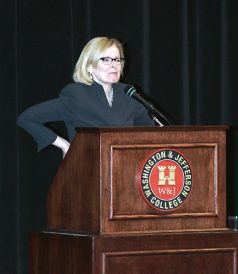
If you aspire to the political life, according to Peggy Noonan, you might want to pay more attention to Picasso or Van Gogh than Keynes or Hayek.
“A great political leader has more in common with an artist than with an economist,” the former speechwriter for President Ronald Reagan and current Wall Street Journal columnist said. “Artists are creative, intuitive, alive to history. They see the sweep of history.”
Appearing at Washington & Jefferson College’s Olin Fine Arts Center Monday night for what was billed as “An Evening of Perspective,” Noonan talked about presidential stagecraft, how the last five presidents have differed from one another and today’s national political scene.
It was the second lecture in the college’s J. Robert Maxwell Visiting Scholar Series, following a stop in November by New York Times columnist Nicholas Kristof.
Noonan crafted the words that Reagan spoke when he was president and for George H.W. Bush when he was Reagan’s vice president, and, of the recent chief executives, these are the two for whom Noonan clearly has the most affection. She described Reagan as “our last great president,” and “a person of such grace” who “spoke softly, never yelled, never lost his temper… He stood when a lady or an older person entered the room.” Moreover, “Reagan was the only person I ever knew in politics who was both great and good.”
Though conceding that Reagan had “some emotional reserve and a certain detachment,” the 62-year-old Noonan called Reagan “a friendly and happy introvert.”
Reagan’s successor, George H.W. Bush, possessed personal sensitivity to the point where he refrained from crowing about the fall of the Berlin Wall and the collapse of communism in Eastern Europe because he “didn’t want to rub it in,” Noonan said. Having been a presidential wordsmith, Noonan described Bill Clinton as having been “endlessly facile with words” and “articulate but not eloquent … more like a lawyer.” Noting Clinton’s halo of gray hair, she likened him to a “sun king” and said he was a “really good actor – that, for me, is not an insult.”
George W. Bush, on the other hand, was “not smooth, stumbled and was not particularly articulate.” But the younger Bush had a decisive streak and, in Noonan’s estimation, was less ambivalent about using presidential power than Clinton.
Barack Obama is “the most unusual president of our lifetimes,” and, especially when compared to his predecessors, is unknowable, in Noonan’s eyes. “He’s a different leader – aloof, yet omnipresent, verbal yet somehow withholding.”
On other subjects, Noonan expressed dismay over young politicos who publicly muse over their favorite rap stars, asking, “Could they not like Brahms? Could they not like Beethoven?” The author of a book on Pope John Paul II, she described the decision by Pope Benedict XVI to resign as “a decision of modern times, a CEO’s decision,” then added, “I don’t like modern times.”
She also doesn’t think much of people who have spent their whole lives laboring in politics: “What does that teach you but to be a jackass?”