

A school rally for us!
? Chapter TWELVE
The story so far: The S.O.R. special soccer team has yet to win a game. As the final game draws closer, with the last chance to win one game, desperation sets in.
At family dinner, Ma said to me, “In two days you’ll have your last game.” It was fake cheerful, as if I had a terminal illness and she wanted to pretend it was a head cold.
“Yeah,” I said.
“You’re going to win,” my father announced.
“How do you know?” I snapped.
“I sense it.”
“Didn’t know you could tell the future.”
“Don’t be so smart,” he returned. “I’m trying to be supportive.”
“I’m sick of support!” I yelled, and left the room.
Twenty minutes later, I got a call. Saltz.
“Two things. My father offered me a bribe.”
“To lose the last game?”
“No, to win it. A new bike.”
“Wow! What did you say?”
“I told him I was too honest to win a game.”
“What was the second thing?”
“At lunch tomorrow they’re going to have that pep rally. And worse.”
“What’s worse than pep?”
“They’re going to call up the whole team.”
I sighed. “Why?”
“That way everybody will know us,” said Saltz. “If we lose, we’ll be rounded up and left back to repeat the year.”
I was in my room doing homework when my father came in. “Come on, Ed,” he said. “I was just trying to be your friend.”
“Why can’t people let us lose in peace?”
“People think you feel bad.”
“We feel fine!”
“We won’t talk about it anymore. Why don’t you come sit with us and finish your dinner.”
Next day, when I walked into the school cafeteria, there was the usual madhouse. There was also a big banner across the front part of the room:
Make the Losers Winners
Keep Up the Good Name of
S.O.R.
I wanted to start a food fight.
Halfway through the lunch period, the president of the School Council, a kid named Clarissa, microphone in hand, called for attention. “We just want to say to the Special Seventh-Grade Soccer Team that we’re behind you.”
“It’s in front of us where we need people,” whispered Saltz. “Blocking.”
The president went on. “Would you come up and take a bow.” One by one, she called our names. Each time one of us went up, acting like cringing worms, there was general craziness, hooting, foot stomping, plus an occasional milk carton shooting through the air.
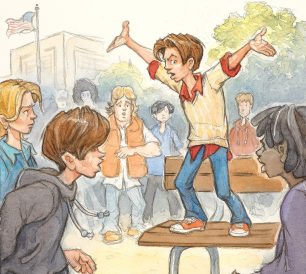
The president said, “I’d like the team captain, Ed Sitrow, to say a few words.”
What could I do? Trapped, I cleared my throat. Four times. “Uh, well… we… uh… sure… hope to get there… and… you know… I suppose… play and… you know!”
Everybody stood and cheered. They even began the school chant. “Give me an S! Give me an O…”
I went back to my seat. As I sat there, maybe two hundred and fifty kids filed by, thumping me on the back, shoulder, neck and head. “Good luck! Good luck!” They were beating me.
“Saltz,” I said when they were gone and I was numb, “I’m calling an emergency meeting of the team.”
We met behind the school. Everybody was feeling rotten.
“I’m sick and tired of people telling me we have to win,” I said.
“I think my family is going to disown me,” said Hays.
“Why can’t they just let us lose?” asked Fenwick.
“Yeah,” said Barish, “because we’re not going to win.”
“I’d just like to do my math,” said Fenwick. “I like that.”
Something clicked. “Hays,” I said, “you’re good at music, right?”
“Yeah, well, sure – hard rock.”
“Okay. And Fenwick, what’s the lowest score you’ve pulled in math so far?”
“A-plus.”
“Last year?”
“Same.”
“Lifsom,” I went on, getting excited, “how’s your painting coming?”
“I just finished something cool and – “
“That’s it,” I cut in, because Lifsom could go on forever about his painting. “Every one of us is good at something. Right? Maybe more than one thing. The point is other things.”
“Sure,” said Barish.
“Except,” put in Saltz, “sports.”
I said, “That’s their problem. I mean, we are good, good at lots of things. Why can’t we just plain stink in some places? That’s got to be normal.”
“Let’s hear it for normal,” cried Dorman.
“Doesn’t bother me to lose at sports,” I said. “Least, it didn’t bother me until I let other people make me bothered.”
“What about the school record?” asked Porter. “You know, no team ever losing for a whole season. Want to be famous for that?”
I said, “Did we want to be on this team?”
“No!” they all shouted.
“I can see some of it,” I said. “You know, doing something different. But I don’t like sports. I’m not good at it. I don’t enjoy it. So I say, so what? If Saltz here writes a stinko poem – he does a lot – do they yell at him? When was the last time Mr. Tillman came around and said, ‘Saltz, I believe in your being a poet!'”
“Never,” said Saltz.
“Yeah,” said Radosh. “How come sports are so important?”
“You know,” said Dorman, “maybe a loser makes people think of things they lost. Like Mr. Tillman not getting into pro football. Us losing makes him remember that.”
“Us winning, he forgets,” cut in Eliscue.
“Right,” I agreed. “He needs us to win for him, not for us. Maybe it’s the same for others.”
“Yeah, but how are you going to convince people of that?” said Barish.
“By not caring if we lose,” I said.
“Only thing,” put in Saltz. “They say Parkville is pretty bad. What happens if, you know, by mistake, we win?”
“I think,” suggested Hays, “if we just go on out there, relax, and do our best, we’ll lose.”
There was agreement on that point.
“Do you know what I heard?” said Eliscue.
“What?”
“I didn’t want to say it before, but since the game’s a home game, they’re talking about letting the whole school out to cheer us on to win.”
“You’re kidding.”
He shook his head. There was a long, deep silence.
“Probably hope we’d be ashamed to lose in front of everybody,” said Saltz.
I took a quick count. “Anyone ashamed of losing?” I asked.
No one. A complete vote of no confidence. I was encouraged.
“Well,” I said, “I don’t care if we lose.”
“Right,” said Radosh. “It’s not like we’re committing treason or something. People have a right to be losers.”
We considered that for a moment. It was then I had my most brilliant idea. “Who has money?”
“What for?”
“I’m your tall captain, right? Trust me. Bring your soccer T-shirts to me in the morning.”
I collected some money and we split. I held Saltz back.
“What’s the money all about?” he wanted to know. “And the T-shirts.”
“Come on,” I told him. “I think we can show them we really mean it.”
• NEXT WEEK: We send the world a message