

Aquaponics systems are in eight school districts in Washington, Greene counties
Trista Thurston/Observer-Reporter
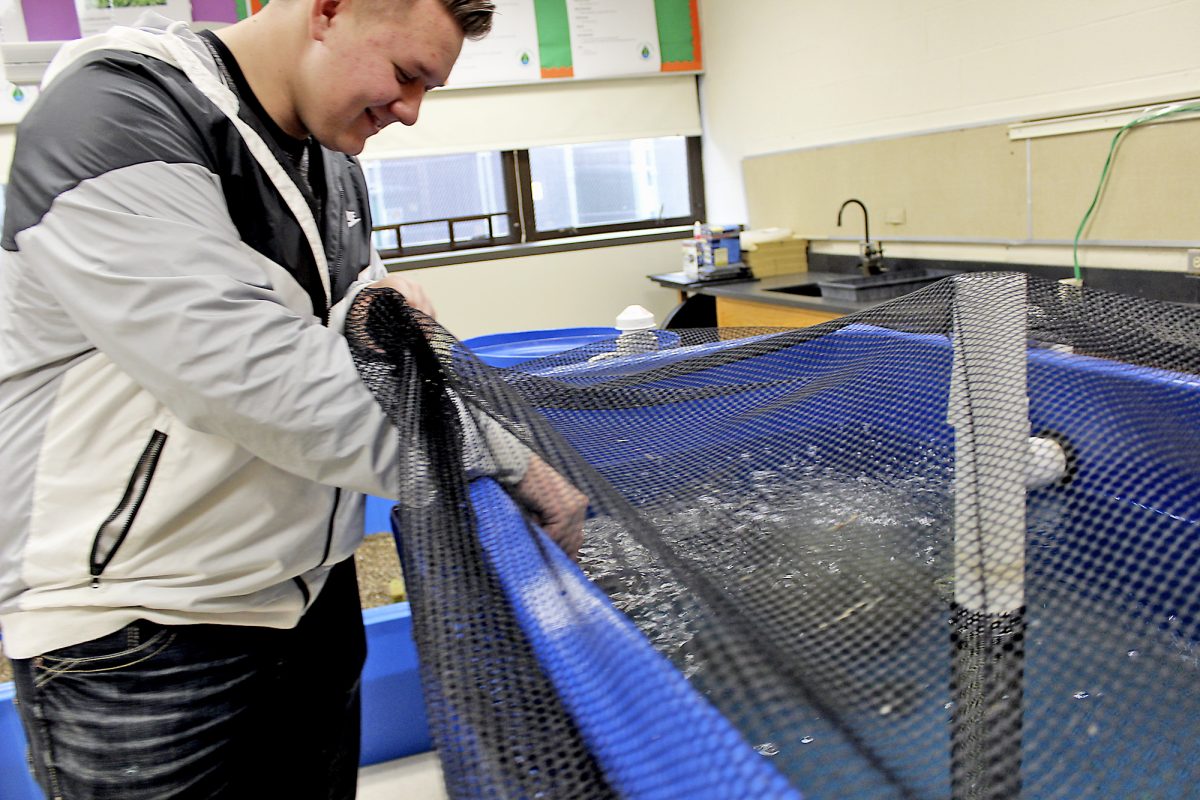
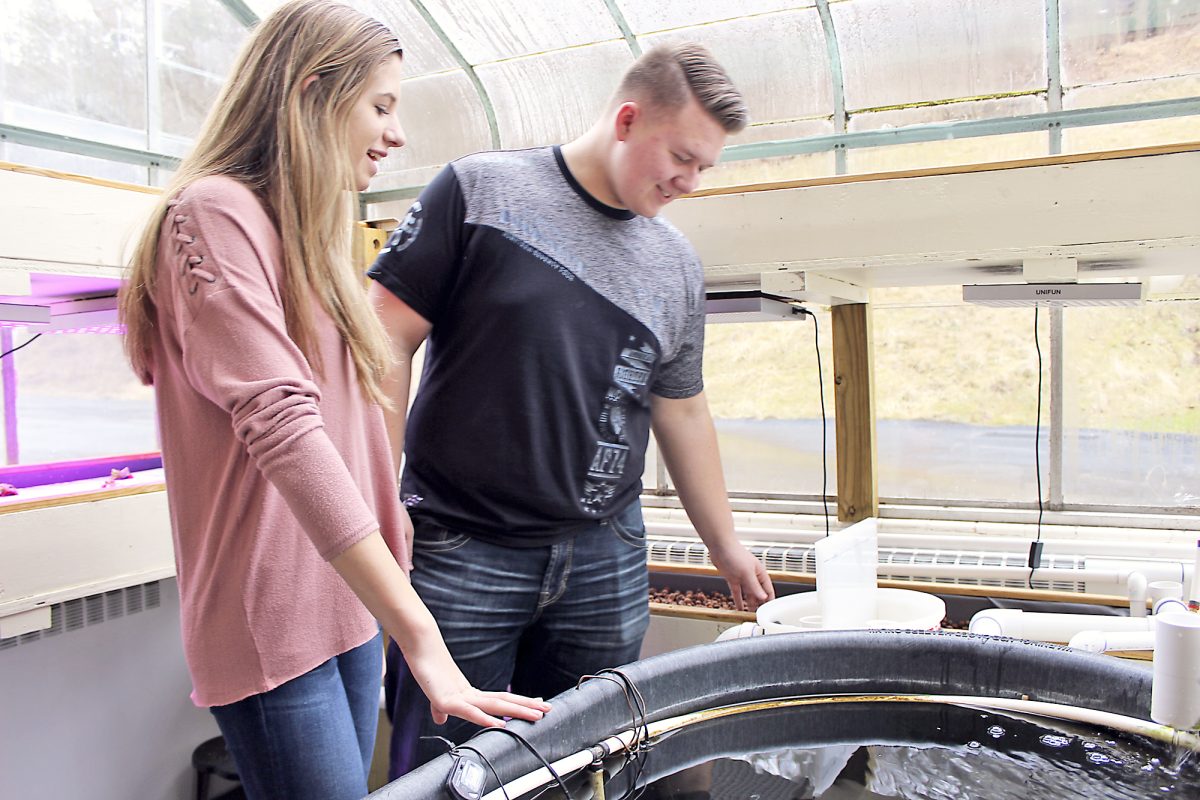
Zach Abbott pokes at the hungry tilapia in West Greene’s prefabricated aquaponics system.
Trista Thurston/O-R
The entrance to West Greene’s aquaponics room.
Trista Thurston/Observer-Reporter
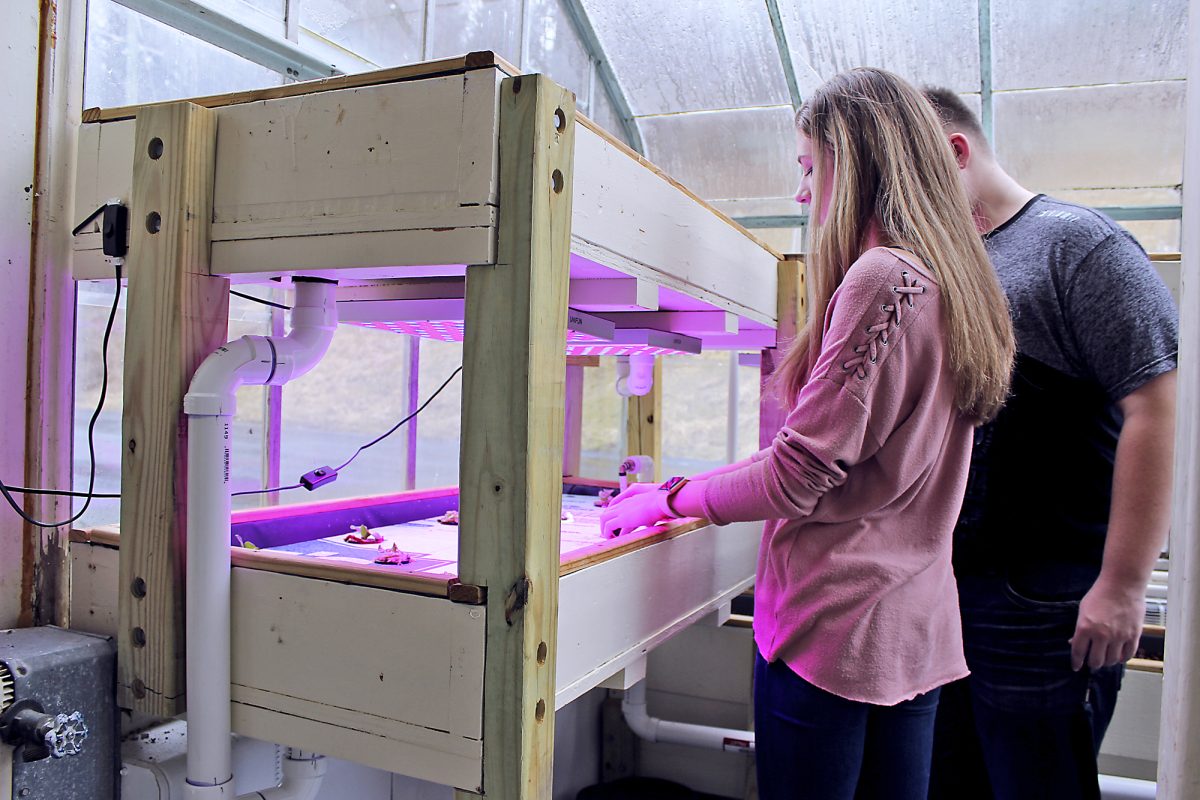
Kaitlyn Rizor and Zach Abbott look at the plants growing in West Greene’s homemade aquaponics system, which served as a pilot before the prefabricated system was installed.
CHARLEROI – A school of tilapia is helping to teach middle-schoolers in the Mon Valley about environmentally friendly and sustainable farming skills.
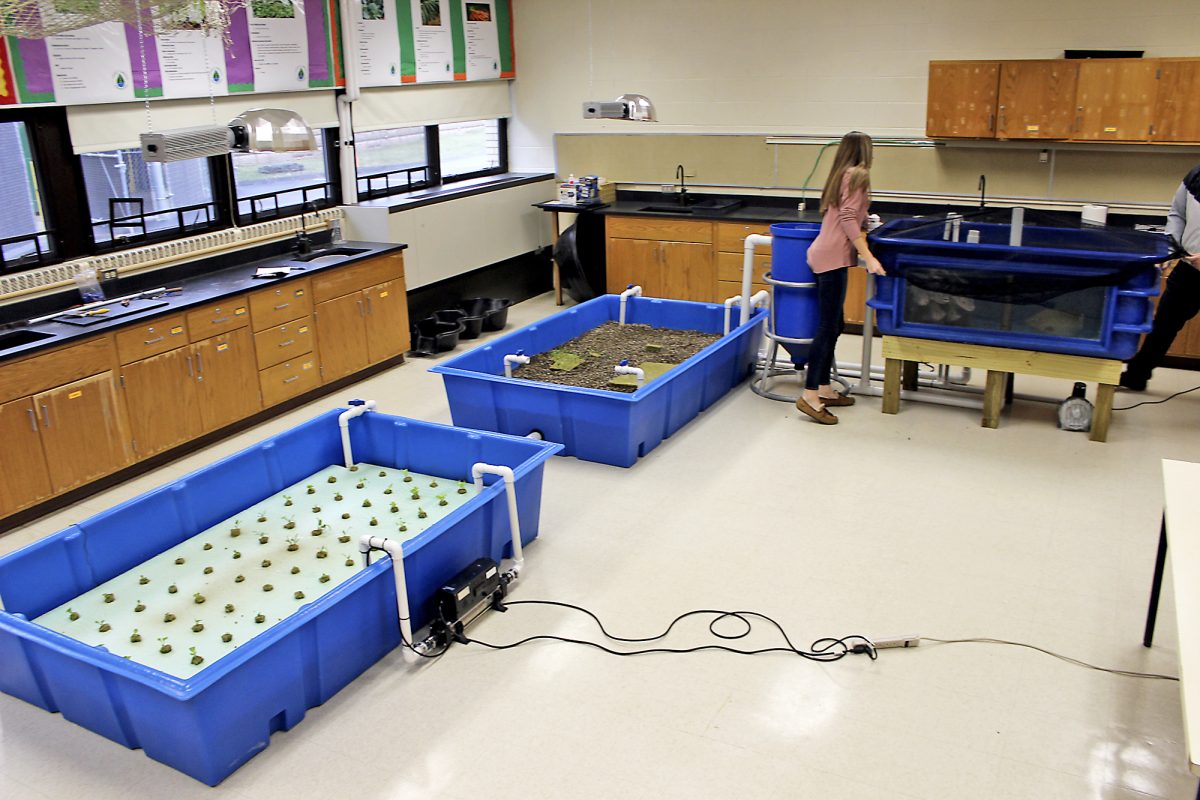
A new aquaponics system is feeding nutrients collected from 10 large fish in an aquarium to fertilize two growing beds in a classroom at Charleroi Area Middle School.
“It’s the future of how food will be grown,” said Ian Delp, a student teacher from California University of Pennsylvania who has been assigned to the Charleroi project.
McGuffey School District received a grant to plan and implement an aquaponics project several years ago, and it served as a guideline for installing others this term in the Charleroi, Avella, Chartiers-Houston, Ringgold, West Greene and Central Greene districts, as well as the Intermediate Unit 1 Clark campus, said Nancy Stahlschmidt, a curriculum specialist at IU1 in California. In addition, an aquaponics program that has been operating at Fort Cherry for about 10 years and McGuffey’s program will get some equipment upgrades as part of the Southwest Aquaponics Collaborative.
McGuffey used last year’s fish for a fish fry prepared at Western Area Career and Technology Center in Chartiers Township, Stahlschmidt said.
“They use 90 percent less water than traditional agriculture requires,” she said.
In Charleroi, fish waste and water is drawn from the tank into another that works like a septic tank. From there, the water follows plastic pipes to both growing beds, where plants remove the nutrients, and then it returns clean to the fish tank.
Students will grow vegetables and then plants that will be transferred as riparians to restore portions of five local streams that Charleroi has adopted for repair and water-testing projects, Delp said.
The students are stewards of Big Pike and Little Pike runs and the Mingo, Pigeon and Maple creeks, said Howard Johnson, Charleroi’s seventh-grade science teacher.
“The streams get beaten up by quads and litter,” Johnson said.
The planning phase of the project was funded by the Benedum Foundation, and the funding for implementation and upgrading of the systems is provided by EQT and Chevron.
Johnson said Delp’s expertise as a biology major at Cal U. brings a lot to the aquaponics project.
“It couldn’t have been a better match,” Johnson said.
Aquaponics is a new course offered this year at West Greene High School. Junior Kaitlyn Rizor and senior Zach Abbott are both part of the class, which is largely student-driven. Kurt Jones leads his 16 students, teaching them where their food actually comes from. Their two systems use tilapia, and they’re growing basil, lettuce and spinach this first time around. Leafy plants that use a lot of nitrogen work best.
Trista Thurston/Observer-Reporter
Trista Thurston/Observer-Reporter
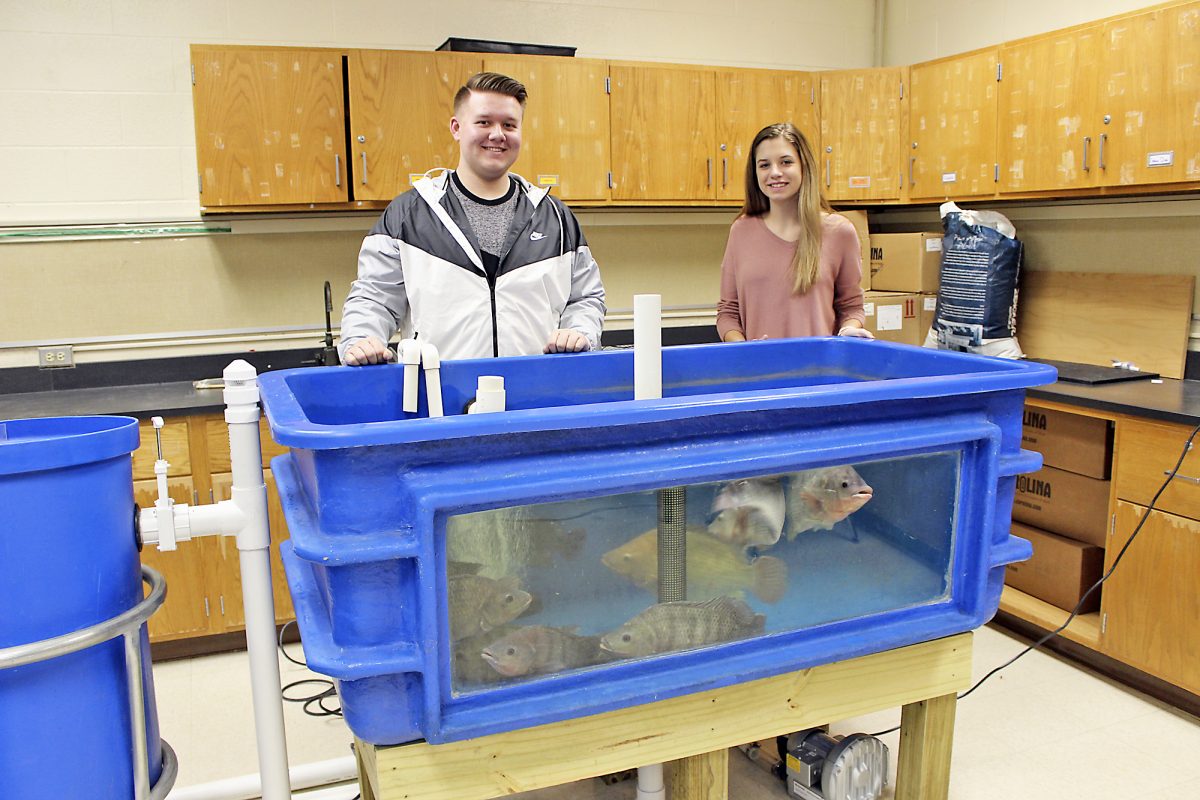
Zach Abbott and Kaitlyn Rizor are shown with West Greene High School’s prefabricated 600-gallon aquaponics tank. Both are in the school’s aquaponics program, a new class this year.
There are “multiple programs that we have involved with this one program,” said academic director Jed Hamberger, from aquaponics “to a coding course, an art course in the elementary school, to both of our other major science content areas, as well as our engineering course. It’s amazing how, when given the opportunity, everyone will jump in and let their students create.”
Students can take the aquaponics course or be involved in other ways. Students in other classes have 3D-printed holders for tank temperature sensors, as well as providing the code to automatically record those temperatures. The project is also spreading to the art department, said Hamberger.
Once elementary students are able to tour and ask questions about aquaponics, they’ll work on art projects based on what they’ve learned, as well as develop a mural in the hallway near the aquaponics room. The aquaponics students are the ones leading the tours and crafting the lesson plans in conjunction with Jones and the classes’ teacher.
The food students are growing at West Greene isn’t meant to be consumed, but for students to use as learning tools. They want kids on the tours to be able to touch things without being afraid of contamination. Everything is cycled through the system, so vegetables will be used to feed worms that live in the rock bed.
West Greene’s aquaponics program got its prefabricated tank near the end of Janurary. Fish came about a week later, once conditions had stabilized.
“The day the fish came, that room was packed full of people watching,” Abbott said.
“And they want to know more after they see it,” Jones added.
Trista Thurston/Observer-Reporter
Trista Thurston/Observer-Reporter
Kaitlyn Rizor pulls the cover over the fish tank of West Greene’s prefabricated aquaponics system.
Early talks for the program started at the beginning of the school year. Students did a lot of the research, solving problems and deciding which plants and fish would work best. Before receiving the prefabricated 600-gallon tank, students built their own system. That 300-gallon tank served as a trial run.
Trista Thurston/Observer-Reporter
Trista Thurston/Observer-Reporter
Kaitlyn Rizor and Zach Abbott look at West Greene’s 300-gallon homemade aquaponics tank, which served as a pilot before the prefabricated system was installed.
“Last year we didn’t have this class, so we researched it,” Rizor said. “It was hard to understand because we didn’t know what anything looked like or even what aquaponics really was. It’s a lot more interesting now that we’re doing it.”
Abbott was already familiar with plumbing and building through FFA, so he was able to put that knowledge into use in building their first system.
“Mr. Jones told us the class was coming, and he kind of recruited some of us that were taking his classes, so we did a lot of researching about it,” Abbot said. “When Mr. Jones introduced it to us – aquaponics, the class – I think it scared a lot of kids. The first week of the class, everyone wanted to join after we started talking about it because it is a lot of fun and underappreciated.”
Jones said his students become experts on certain aspects of aquaponics, and teach the other students what they know. He has also brought in guest speakers from Waynesburg University and West Virginia University to supplement instruction, but the class isn’t about standing in front of the students and talking at them. It’s very hands-on. Decisions, such as where to put new solar panels provided through a grant from First Energy, are made as a group. Jones said he wants to empower his students to make these decisions.
There have been trial-and-error issues in the process. Each student has a role, and is accountable for the lives of the fish and plants. That keeps them honest with their work. They’re also accountable to their fellow classmates.
Central Greene’s full-size aquaponics lab was installed in January. The district also has a mobile 20-gallon tank at Margaret Bell Miller Middle School, said Annette Vietmeier, director of academic accountability and innovation.
Farming has changed a lot over the years, and aquaponics incorporates many of those evolving aspects.
“Aquaponics sparks the interest of our students with a hands-on approach to learning. It is an environmentally friendly and sustainable way to approach farming,” Vietmeier said.
Students at Waynesburg High School are just starting to learn how to maintain the tank and the relationship among the fish, bacteria and plants, said teacher Dave Sarra. Middle-schoolers are using koi to grow leaf lettuce, basil, cilantro, beans, peas, and bok choy, while the high school is trying lettuce, herbs, tomato and peppers.