

Eighty Four senior honored for work to prevent scams
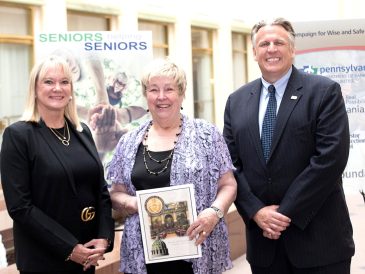
When Eileen Mazza retired as a director of general services from Columbia Gas of Ohio about 20 years ago, she wanted to make good use of her time.
“When I came out, I didn’t want to just sit around,” said Mazza, now 75. “I had heard stories about seniors who had lost a lot of money through scams and thought, ‘They need to know what’s out there.'”
So the Eighty Four resident started volunteering with AARP, and about 10 years ago, joined the organization’s Consumer Issues Task Force.
She and other senior volunteers are trained to present information on avoiding scams and frauds for free to groups and organizations.
Mazza is trained to help everyone – from people who have a lot of money to those who have little.
“People say, ‘I don’t have enough to worry about.’ I tell them ‘If you have a dollar, somebody wants it,'” she said.
Mazza said that senior citizens are usually victims because they don’t want to be rude.
“They are too polite to people. I tell them that you don’t have to be nasty or mean, but you need to be alert,” she said. “It’s your money and you need to protect it.”
Secretary of Banking and Securities Robin L. Wiessmann said that the cost of financial exploitation of senior citizens in the United States is estimated to be as much as $36 billion each year, and that Adult Protective Services in Pennsylvania reports that financial exploitation is the most reported abuse of senior citizens.
Many times, people who are attempting to scam money make contact with a potential victim, and start by asking what appear to be harmless questions.

Said Eileen Mazza, “I’m hoping I can save somebody a few dollars. We work too hard for our money to be giving it away to someone who just wants to take advantage.”
“I keep trying to tell folks, don’t feel stupid that you were taken. You are dealing with professionals. They know what buttons to push,” Mazza said. “I tell the audience the reason some of these old scams are still around is that they work. It’s an emotional thing. They know how to talk to you.”
Seniors also don’t realize how easily information about them can be accessed, Mazza said.
“If you give me your name and zip code, I can find out where you live, how many people live in your house…If someone wants to find information about you, don’t make it easy for them,” she said. “Use a shredder. There are still thieves who are dumpster divers.”
She warned seniors to be wary of affinity fraud, in which fraudsters pretend to be a part of a group to gain trust.
“Even if it’s friend or neighbor, if someone is asking you for an investment, you should check them out,” she said.
Mazza recommends checking with the Department of Banking and Securities, which can provide information about complaints. She also recommends reaching out to AARP to schedule a free information session with herself or another volunteer.
In a June ceremony in the East Wing Rotunda of the State Capitol, Wiessmann and representatives of AARP Pennsylvania and the Investor Protection Trust recognized Mazza and 11 other members of the task force for helping senior citizens avoid financial fraud and scams through the work of the Campaign for Wise and Safe Investing.
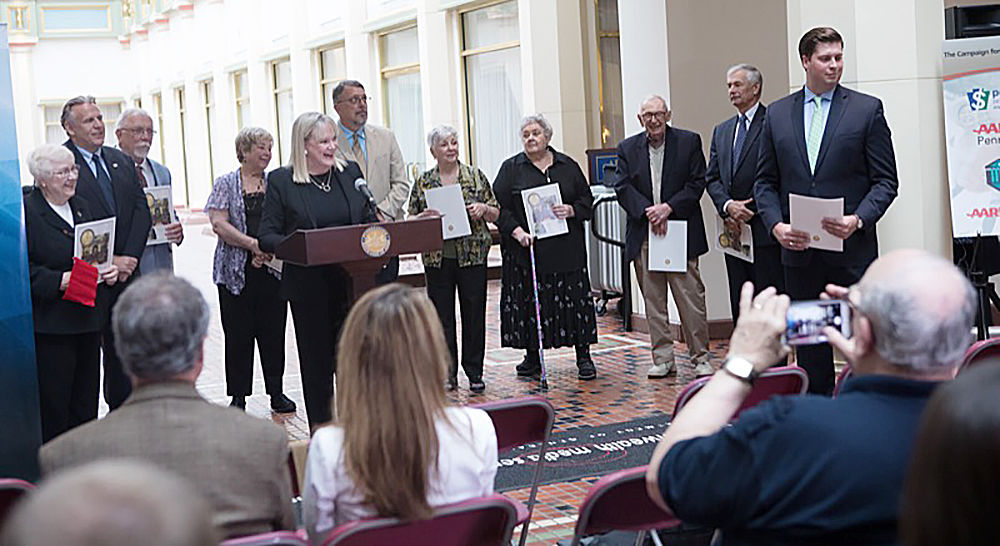
Eileen Mazza, fourth from left, retired from Columbia Gas of Ohio as a director of general services. She and 11 other members of the AARP Consumer Issues Task Force were recognized in a ceremony at the state Capitol.
Since the campaign began, AARP volunteers have made 1,110 presentations, and more than 49,000 Pennsylvania senior citizens have received information about “red flags” warning them of possible financial frauds and scams.
Mazza said that while the recognition is appreciated, she feels the greatest reward after giving a talk.
“I’m hoping I can save somebody a few dollars,” she said. “We work too hard for our money to be giving it away to someone who just wants to take advantage.”
Anyone can contact the Department of Banking and Securities at 1-800-PA-BANKS or 1-800-600-0007 to ask questions or file complaints about financial transactions, companies, or products, or email informed@pa.gov for more information. Members of the public can subscribe to the department’s newsletter at www.dobs.pa.gov.