

Editorials from the Past: July 25, 1968
In our new occasional series, we are going into the newspaper’s archives to republish excerpts from the editorial page. The names may have changed, but the topics for commentary remain the same: the president, politics and elections.
Enjoy a step back in time to these editorials from the July 25, 1968 edition of the Observer-Reporter.
Our Unsafe Roads
There was some justified elation when the long Fourth of July weekend ended with a total of “only 619” traffic deaths. The elation resulted from a comparison with estimates that 700 to 800 would die on the highways over that period.
But all the traffic accident news for 1968 is not good news. For instance, by the end of the first five months, to May 31, statistics showed 20,380 Americans had been killed in traffic accidents. During the same five-month period in 1967, the deaths numbered 19,270. The gain was 1,110 this year.
There is only slight consolation in the fact that there is some improvement by a different measuring stick. This is the traffic deaths per 100 million miles traveled. The figure last year was 5.1 and this year it is 5.
The conflict in the improvement in percentage against the increased number of dead is accounted for by more cars going more miles.
War or no war, American streets and highways continue to be among the unsafest places on earth.
Strange and Wonderful Campaign
In nearly all respects up to now, prior to the two national conventions, this has to be the strangest and wildest of all Presidential election years.
In any other Presidential year, the obvious advantages enjoyed by Democrat Hubert H. Humphrey and Republican Richard M. Nixon would have long since discouraged real opposition.
Instead, Senator Eugene McCarthy, and prior to his death, Senator Robert F. Kennedy, mount real challenges to Humphrey, and on the Republican side, Governor Nelson A. Rockefellar and Governor Ronald Reagan do the same to Nixon.
And, playing upon the fears of the nation, former Alabama Governor George Wallace is a strong third-party threat.
It is a strange yet wonderful election year that each day brings new surprises, new stories, new angles.
In just a single day this week:
Hubert Humphrey denied any possibility of any deal with Governor Wallace should the election be thrown into the House of Representatives.
Humphrey said that whether he would invited Senator Edward Kennedy to be his running mate depends upon Senator Kennedy’s wishes.
Ronald Reagan set up headquarters at the Governor’s Conference in Cincinnati that looked like a candidate’s headquarters while steadfastly denying he is a candidate as he has done all along while making campaign speeches across the country.
A story was published that Milton Shapp, the prominent Philadelphia Democrat who mustered the aid of Vice President Humphrey in his unsuccessful bid for the Governorship of Pennsylvania in 1966, now is considering endorsing Humphrey’s opponent, Senator McCarthy.
Senator Clark, who narrowly missed being upset in the Democratic Primary for nomination for the Senate by Congressman John Dent, appears at a fund-raising dinner for Dent to pay off the debts incurred when Dent was trying to beat Clark. Dent, meanwhile, has enrolled as a co-chairman of the Clark campaign.
It is a strange and wonderful campaign already and there are still the conventions and Fall campaign to come.

This editorial cartoon published on July 25, 1968, referenced embattled Supreme Court Justice Abe Fortas, nominated by President Lyndon B. Johnson to serve as chief justice. A year later, Fortas became the first justice to resign under threat of impeachment.
Lobbying Idea
To lobby for legislation expanding the food stamp plan, a number of Quakers and other campaigners delivered a homemade loaf of bread to each of the 435 members of the House of Representatives.
“Some crust,” one of the members reportedly said, leaving the question of whether he was criticizing the audacity of the lobbyists or complimenting the bakers up in the air.
Dress Revolution
Such a staid and conservative publication as Business Week has taken notice of the revolution in men’s wear. A recent issue featured a cover picture of a captain of industry decked out in a Nehru jacket, buckle shoes and peach slacks.
Business Week may be a little late. It is reported that more colored dress shirts are now sold than white, more than twice the proportion of only a few years ago when a white shirt was standard dress wear.
It is obvious that haircut styles for men are changing. A crew cut, on young or old, is as dated as World War II. Hair runs down the back of the neck, curls over the ears, and blocks the forehead.
The smartest men’s stores now feature beads and medallions for neckwear, ruffled shirts, and fragrances for almost anything.
Contemplating this revolution on a hot, humid July afternoon, it can only be hoped that the next step is right back to the American Indian.
A breech clout and a pair of moccasins without socks seems both logical and adequate.
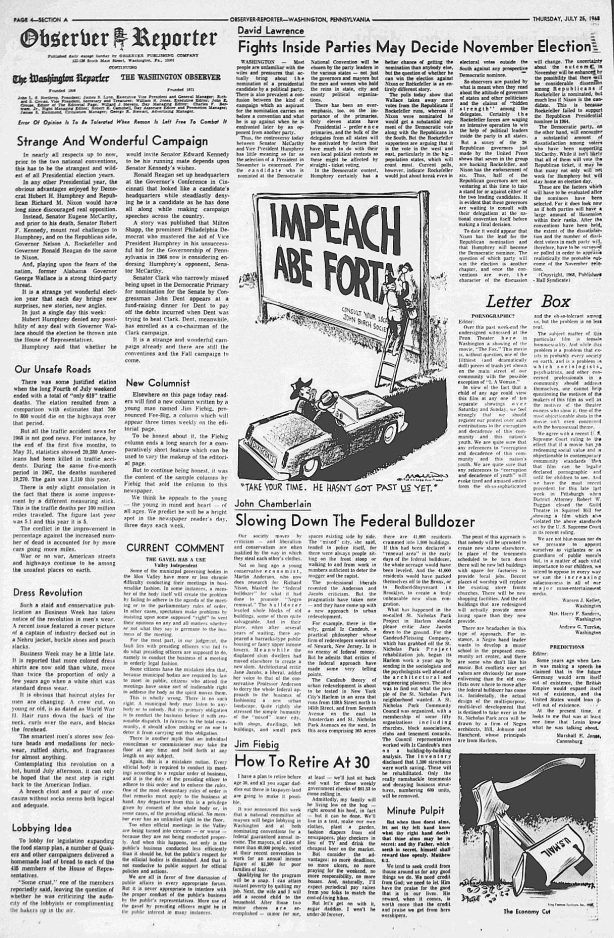
The Editorial page of the Observer-Reporter from 1968.