

Woman trapped in Washington collapse sues former owners
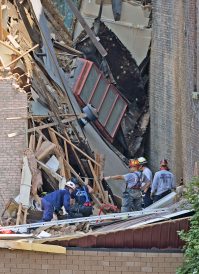
A lawsuit by the woman who was badly injured when she was trapped under rubble when her downtown Washington apartment building collapsed in 2017 is suing her former landlord and the owners of the neighboring structure.

Megan Angelone
Megan Angelone, who now lives near near Uniontown in Fayette County, filed a lawsuit Tuesday in Washington County Court. She alleges the negligence of her former landlord, Mark Russo of Washington, and his sister, Melissa, because they should have known the Montgomery Building at 15 N. Main St. was unsafe, yet “allowed residents to remain in the building despite complaints and evidence that the structural integrity of the building was compromised.”
The Russos owned the three-story building at the time of the July 12 collapse. Eight people, including Angelone, were in the building that morning. Most got out quickly, but Angelone was trapped under a refrigerator and fallen debris. Rescuers worked more than nine hours before freeing her.
Angelone’s attorneys – who are from the personal-injury law firm Saltz, Mongeluzzi, Barrett, and Bendensky – wrote that she was in “agonizing pain” while she remained “alert and conscious” that whole time.
“Ms. Angelone experienced horrific pain and unspeakable terror as she lay trapped in the building for hours,” her attorneys added.
The lawsuit enumerates “traumatic injuries” that resulted in Angelone spending two months in the hospital. She underwent “more than a dozen” operations to remove necrotic tissue from her lower body.
Angelone’s lawsuit contains a count of negligence against the Russos, alleging they ignored complaints from multiple residents and a city official about the integrity of the building. Her civil complaint points to a citation that city code enforcement officer Ron McIntyre filed in March over a cracked wall he called structurally unsound.
McIntyre had issued the citation in response to emails from Dennis McCullough, who’d lived in the building for years. In his correspondence with McIntyre, McCullough reported the foundation was sinking and that a wall had cracked more than an inch.
The citation was still pending when the collapse occurred. Angelone’s lawyers accuse the Russos of refusing to repair the problems.
Reached by phone Wednesday, Mark Russo, who no longer owns the property, disputed the assertions in the lawsuit.
He said his insurance company had the building inspected about a month prior to the collapse when he switched carriers. He also said he had the interior wall repaired with plaster in response to the citation.
“There’s no way that anyone could have determined this would have happened,” Russo said.
The Russos also face a lawsuit filed in May by Nathan Engott, who was living with Angelone in the building. He escaped but was allegedly struck by falling debris.
Angelone’s attorneys included a negligence complaint against Felix and Maria Magnotta, who own the Iron Building next to the Montgomery. The lawsuit claims water from the roof would drain from the Magnottas’ building onto the neighboring structure and contributed to the roof collapsing.
That theory echoes a claim the Russos’ attorney made in media reports following the collapse. But Felix Magnotta dismissed that explanation and said neither Mark Russo nor his attorney contacted him about inspecting his roof.
“No inspection of the roof was ever made,” Magnotta said Wednesday. “That claim was made out of the air.”
He said there was a wall that would have stopped water from traveling from his roof onto the apartment building.
Finally, he pointed to the report of an engineer working for his insurance company who looked at the Iron Building following the collapse. The report found “no evidence” that his building “caused or contributed to the collapse of the neighboring structure,” according to a portion Magnotta read aloud during an interview.