

Larry Spahr: from paper ballots to punch cards and beyond
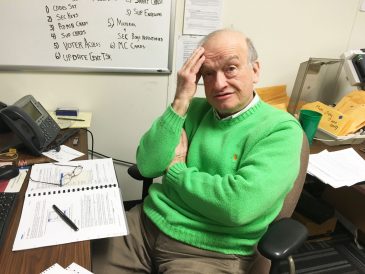
Washington County Elections Director Larry Spahr has spent many hours dealing with voting technology that records both paper and electronic totals.
But when the county commissioners sign what is expected to be a multimillion-dollar contract to purchase a new system with a paper record, the official action will be after Spahr’s retirement Thursday.
“He has offered to help in any way he can,” said Scott Fergus, Washington County director of administration, who plans to name Assistant Director of Elections Melanie Ostrander acting elections director.
When Spahr, 71, started working at the newly constructed Courthouse Square office building 38 years ago, he already had years of experience under his belt as a Democratic committeeman from Union Township and as a U.S. Marine.
In 1981, when Spahr reported to the Washington County elections office, punch card ballots were being introduced in half the precincts, while the rest of the voters marked paper ballots.
Having seen that transition, it wasn’t long before Spahr, at the helm of the elections office, found himself having to cope with the Election Day flood of Nov. 5, 1985.
Amid raindrops, he and Deputy Sheriff Sam Secreet headed to West Brownsville to monitor water levels.
The (Monongahela) river was really rising,” Spahr said. “Barges had broken loose and were just ripping down the river.”
Riverfront polls had to close and voters couldn’t make their way through flooded streets as the river crested at 42.7 feet in Charleroi, shattering the previous record set in 1967 by more than a foot.
There was little precedent about how to handle the situation, but Spahr found a case from Maine that dealt with an election day blizzard. He recalls the matter of the Election Day flood going before a panel of Washington County judges, who decided the affected Mon Valley precincts could be reopened for voting at a later date under what was labeled a “continuation.”
Fifteen years later, when the eyes of the world were upon Florida and the presidential election hung in the balance between Texas Gov. George W. Bush and Vice President Al Gore, the eyes of local media turned to Washington County because it, like Florida counties under scrutiny, used punch cards, and, because of a large number of candidates one year, had used a dual-column “butterfly ballot.”
The 2000 presidential election also introduced the phrase “hanging chad” to the American lexicon.
“Nobody is going to convince me that system isn’t accurate,” Spahr said Wednesday, noting that running the cards through a tabulator in Washington County produced the same results even when the process was repeated three or four times.
Spahr has his own recollection of what he called “slingshot chads,” when a tabulator reading 1,000 cards a minute spewed the card stock bits “like little stones whipping from a slingshot.”
Washington County election-night workers also recall running gloved hands over the cards to dislodge any hanging chads.
Some attributed the problem with Floridian ballots to either chad buildup in the devices or the state’s high humidity that kept the tiny rectangles from separating from the cards.
Materials, parts and support for punch cards went by the wayside, and in 2006, Spahr oversaw the county’s purchase of its direct-recording touchscreen voting machines.
Although he’s making his exit before they’re being replaced, Spahr still sees hurdles to overcome with paper absentee ballots, which voters will mark without heeding accompanying instructions, leaving their intent open to interpretation.
If he could make one change, Spahr would have state officials take into account the training of members of local election boards.
In some states, he said, those who work at local polls are required to take courses on updates that include passing an examination, and the pay is commensurate with skill.
But on the other hand, he notes senior citizens are the backbone of local election boards, and as the veterans retire, the election office scrambles to find replacements.
Spahr has seen many politicians over his nearly four decades, and remembers some for their humor and joviality.
“You don’t have that today,” he said. “Everyone is so damn cutthroat.”