

100 Objects
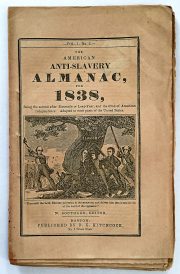
Anti-Slavery Almanac
Almanacs, popular publications in early American history, were read and used by a great majority of literate American adults. The Anti-Slavery Almanac, first published in 1836 by the American Anti-Slavery Society of New York and Boston, was intended to instruct, persuade and horrify its readers about the evils of the American slave system and the discrimination of people of color. The yearly publication included wood-cut illustrations, one for each month, depicting graphic images of the horrific treatment of slaves. There were written accounts of freed men being sold back into slavery, the separation of parents from children and the plight of runaway slaves. The calendar pages also included detailed charts of the daily times of sunrise and sunset, phases of the moon and high and low tides.
This volume focused on slavery in the South, serving to show Northerners the extent of the horrors for the first time, emphasizing its unchristian nature.
In an editorial in the 1838 edition, Nathaniel Southard wrote:
“In appearing the third time to spread before you the foul blood-guiltiness and imminent peril of this oppressive nation, I have reason to bless God for the candid hearing which has been heretofore been extended to me. Not less than seventy thousand copies of the two former numbers of this little annual have gone abroad to stir up the drowsy conscience of the nation. The time is now evidently near at hand, when the question is to be finally settled, whether we shall as a people, turn from our sins and live, or cleave to our sins and be dashed to pieces. We need only look at the slave code by the side of God’s law, to be convinced that slavery is at irreconcilable war with every principle of God’s moral government. Either His throne must be overturned that slavery may stand, or slavery must be annihilated that God’s government may triumph over every high thing that exalteth itself against him.
“But what has the North to do with slavery? … It has been the one great object of this publication to show that SLAVERY HAS MUCH TO DO WITH US.”
The Act Prohibiting Importation of Slaves passed in 1807. Slave trade did not end until after the Civil War.
Alice Burroughs is a volunteer for the Washington County Historical Society and a member of the antiquities committee.