

Too cold – or snowy – for school
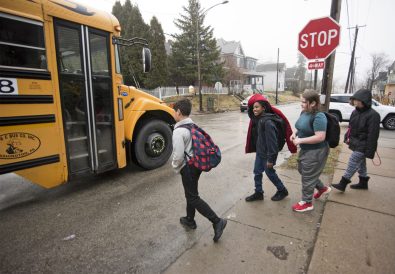
As a polar vortex approached Southwestern Pennsylvania, sending temperatures below zero, superintendents in Washington and Greene counties were exchanging text messages and emails, and poring over the weather forecast and other information to determine whether to cancel school.
“Yes, there was a lot of texting going on. We were all talking a lot,” said Canon-McMillan School District Superintendent Michael Daniels. “But it was a pretty easy call this time. The projections were that it was going to be dangerously cold.”
Daniels, along with superintendents of all other school districts in Washington and Greene counties, canceled classes on Jan. 30 and 31, when the thermometer sank as low as minus-5 degrees and some areas experienced wind chills of minus-25 degrees. Classes in most districts were also canceled Feb. 1 after a snowstorm dumped several inches on the area.
School districts have long canceled classes because of snowy days, but closing schools because of frigid temperatures has happened with more frequency in recent years.
“I feel like it’s true, like we’ve had more cold weather delays and cancellations than snowy delays or cancellations,” said Ed Zelich, supertinendent at Charleroi Area School District.
There are no state standards for school district officials to consult when considering closing schools on bone-chilling cold days, so the decision to cancel classes is a judgment call – although superintendents try to operate in solidarity.
“It’s not an exact science, but in today’s day and age, deciding to cancel comes down to common sense,” said Zelich.
Zelich said he relies on several sources to make a decision: hourly forecasts, information provided by the Washington County Public Safety Department, consultation with the district transportation director, and a wind-chill chart developed by the National Oceanic and Atmospheric Administration and provided by the National Weather Service that estimates how long it takes for a person to suffer from frostbite, based on temperature and wind speed.
Wind chill is a concern because of the effects exposure to the cold can have as students walk to school or wait for buses early in the morning.
Superintendents are in agreement that safety is the No. 1 priority.
When the temperature drops below freezing, school districts also have to pay attention to school buses – checking batteries and putting additives in the diesel fuel to make sure it doesn’t gel.
Schools also have to make sure buildings are properly heated for staff and students.
School officials said they consider calling cold weather delays and cancellations early enough to enable parents to make accommodations for child care.
Said Daniels, “I like to give our families enough time for child care. Mom and dad both work in most cases, so the sooner we can give the notification, the better for everybody.”
And, school districts also must consider how to provide the legally required 180 days of school, without adding days on at the end of the school year.
Central Greene School District Superintendent Helen McCracken said she and district administrators built five snow days into the 2018-29 school calendar, and the school district has used three – Jan. 30 and 31, and Feb. 1.
School districts are currently revising their school calendars, and several are considering eliminating vacation days that surround the Easter holiday, and using Presidents Day as a make-up day if they exceed their built-in snow days.
“I try to be as savvy as possible, based on my experience, about building snow days in,” said McCracken, “but I will say it can be a frustrating process. Sometimes, it’s very unpredictable. We do the best we can, my team and I, and our priority is to make sure the students are safe.”
McGuffey School District participates in a program called Flexible Instruction Days, which permits school districts to use as many as five “flexible instruction days” on days when regularly scheduled class days are canceled, usually because of bad weather (but cancellations can be called for other issues, such as mold, flooding, or security or safety issues). On FIDs, McGuffey students can complete their school day from home, or their parents can bring them to school between 10 a.m. and 3 p.m.
Students are responsible for notifying the school district how they will attend school for the day.
Twelve school districts were selected by the state Department of Education to participate in the three-year pilot program, which was launched in 2015-16 and was extended into 2018-19.
“Our primary concern is the safety and well-being of our children and our colleagues, so sometimes that requires altering our instructional day,” said Dr. Erica Kolat, superintendent of McGuffey School District, which also canceled classes on Jan. 21 due to cold weather.
State Sen. Kristin Phillips-Hill, R-York, plans to introduce legislation that would make flexible instructional days a permanent option for schools.