

Medical Assistance Transportation Program in jeopardy; would affect local shared-ride programs
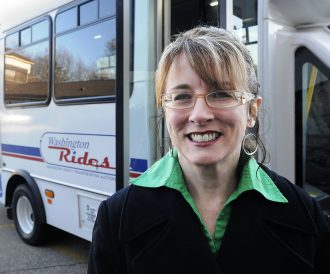
A movement to shift money away from local transit providers to private contractors could have a ripple effect that would jeopardize shared-ride services beyond the targeted Medical Assistance Transportation Program.
The objective of providing nonemergency transportation to those who are on medical assistance is to get people to a doctor so they don’t wait and wind up with catastrophic health problems, the treatment of which is funded with taxpayer dollars. It covers, for example, many kidney dialysis patients.
Last June, the state Legislature, through the Human Services Fiscal Code, directed the Department of Human Services to have brokers provide transportation to those on medical assistance. Gov. Tom Wolf also approved the change.
The addition of another layer of administration was “inserted into the Human Services code at the 11th hour,” said Sheila Gombita, executive director of the Washington County Transportation Authority.
“The overall ramifications, nobody really understood what those would be.
“They only looked at that program in isolation and not the impact on other programs.”
Because of its effect on counties and shared-ride services, a memorandum to their colleagues from three state representatives, including state Rep. Pam Snyder, D-Jefferson, is asking for further study because, instead of being reduced, the cost could increase significantly.
“In addition to concern about access, flexibility and a lack of understanding of local needs and resources, some of the feedback indicates the move could actually increase costs in the long run,” states the memorandum from Snyder and Reps. Aaron Bernstein, R-Beaver, Butler, Lawrence, and Jonathan Fritz, R-Wayne, Susquehanna.
In the state Senate, Camera Bartolotta, R-Carroll Township, is one of 20 sponsors of legislation that would keep the Department of Human Services from entering into a contract with any broker until the “Joint State Government Commission conducts a study on the positive and negative impacts to each county of utilizing a statewide or regional full-risk brokerage model.”
One of the provisions that would be studied, if the bill passes, is whether to provide the counties with the right to opt out of using a broker.
Brokerage brings with it a federal incentive that could mean $15 million for Pennsylvania, but the Pennsylvania Public Transportation Association, an advocacy group, has projected a 23 percent increase in cost, or $31.5 million to be borne by taxpayers.
The current Pennsylvania budget calls for the Department of Human Services to find two to three private brokers for the Medical Assistance Transportation Program statewide.
Under the request for proposals, the state will have three regions – western, central and eastern. Any one broker can’t be awarded more than two regions.
Proposals from private transit providers were due March 19, and the state anticipates negotiating a contract over the summer.
Under this calendar, “once they have an agreement signed, there’s a six-month time frame to rolling out a brokerage program any time between January and July of 2020,” Gombita said.
“A number of states have gone this route, and the rollouts have been disastrous,” Gombita said.
Under the current system, “essentially, the money comes directly to us,” Gombita said of local transit agencies. The exception is Philadelphia, which already uses a broker.
She called brokers “typically private, for-profit operators that are out of state.”
“If you take away 36 percent of business, we’re not going to be able to sustain the service,” Gombita said.
Under the new plan, a broker would provide only transportation to medical and health-related appointments, while the passenger would have to book other trips, such as shopping or social visits, through a county-based program.
Because there would be two providers, trips that were previously shared by subsidized and paying customers would have to be separated. More trips, the transportation providers say, would ultimately be more costly to the rider.
In Greene County, the transportation buck stops directly at the commissioners’ office.
Greene is one of seven Pennsylvania counties that administers a transit program in-house without sub-contractors.
And they’d like to keep it that way.
“We think it’s best that we do it,” said Blair Zimmerman, chairman of the board of commissioners. “With private entities, citizens may not get the services we provide for them.”
Zimmerman is familiar with the program not only as a commissioner but because his late father used Medical Assistance Transportation when his deteriorating health no longer permitted him to drive himself to kidney dialysis appointments.
Asked if they had communicated their concerns by writing to their state representative and senator, the Greene commissioner said they didn’t have to use a formal route – they all share the same office building and talk regularly.
Richard Blaker, transportation director in Greene County’s Department of Human Services, said Greene has a fleet of 18 vehicles, including 16 buses and two minivans, all of which accommodate wheelchairs. A 19th vehicle is destined to be auctioned soon.
“We do the administrative piece of the Medical Assistance Transportation Program in-house. Shared-ride is what makes us as efficient as we are,” Blaker said of the Greene system that runs Monday through Friday, with a limited schedule on holidays, primarily for recipients of kidney dialysis.
Blaker said, “In Greene County, the Medical Assistance Transportation Program accounts for about half of our daily runs, on average.”
Gombita said the brokerage requirement was an “11th-hour addition to the state budget that nobody really understood.”
“It was pushed through, but now we need to pause and listen to the concerns of people it’s going to affect,” Blaker said.
In Fayette County, the Medical Assistance Transportation Program is 60 percent of the shared-ride service, according to Lori Groover-Smith, director of the Fayette County Office of Human and Community Services.
Fayette Area Coordinated Transportation provides around 6,000 medical assistance shared-ride trips per month plus an additional 75- to 100-mile mileage reimbursement clients in the medical assistance program.
“FACT currently uses around 20 buses per day to provide the shared-ride service. Without the ability to coordinate these MATP trips with the other shared-ride trips, reimbursed by the lottery and Persons with Disabilities program, these remaining trips will see a significant increase in the cost to provide,” Groover-Smith wrote in response to an email inquiry.
“Fayette County would lose a significant amount of revenue from the MATP program,” she continued. “I believe that adding a for-profit broker to the MATP service will be an increase to the program rather than a savings. Obviously, the broker will have administrative expenses plus their profit margin, and the transportation provider, whether it is FACT or another provider, will also have administrative expenses and operating expenses.
“Transit agencies in Pennsylvania have worked for years to develop a coordinated cohesive method of delivering transportation for PennDOT public transportation programs. This and the Department of Human Services’ transportation programs will be destroyed by the implementation of the for-profit broker taking a huge piece of the coordination out of the mix.”
Not everyone who uses the MATP program uses shared-ride service.
“Some people have access to a vehicle, and they are reimbursed for mileage,” Gombita explained. “There are also people who live on bus lines.”
But to the shared-ride service provided under the Washington County Transportation Authority, MATP represents 36 percent or a little over $2.5 million.
Counties or agencies could bid on providing services, so the Washington County Transportation Authority might not be completely left out in the cold.
“We have not established that,” Gombita said. “It’s possible we could contract with brokers to do some of the service.”
But even if that’s possible, it might not work out to the transportation authority’s advantage in light of the unpredictability of traffic issues and weather.
“The mantra of some of these brokers is not to provide service or not paying for providing the service. If you don’t dot your i or cross the t one minute outside the time frame, they may not pay you for that even though the rider arrives on tine for the appointment.”
Approximately 2,500 Washington Countians participate in the MATP program. Statewide, in 2017, 37,000 people were eligible for the Medical Assistance Transportation Program.
“We have way more coordinated human service transportation than any state in the U.S.,” Gombita said.