

Defending the status quo of the Local Share Account
When McDonald Borough Council President Marilou Ritchie saw that state Rep. Bud Cook wanted to amend the Gaming Act and eliminate the the Local Share Account of gambling revenue, she was angry enough to fire off a letter.
Ritchie, who has been part of local government in a town that straddles the Washington-Allegheny County line, by her own estimate, for “25 years off and on,” wrote to the county board of commissioners and sent a copy to Cook.
“We were offended,” she said of Cook’s plan to apply a percentage of slots and table games proceeds to individuals’ school property tax bills.
With an annual budget of just over $1 million, McDonald Borough in the last decade has applied for and received local share money to replace two bridges, turn vacant property into a municipal parking lot, and repair facades of its business district buildings, constructed during the first oil and natural gas boom at the turn of the 20th century before richer deposits were discovered in Texas and Oklahoma.
“These are things we couldn’t afford,” Ritchie said. “This money has been a godsend. We’ve done things we couldn’t dream of before.
“We’ve been very well taken care by this LSA money. I’m a big proponent of LSA remaining in the county and the municipalities within.”
The local share contribution to McDonald’s bridge, facade and parking lot projects totaled $641,284, according to figures on the website of the Washington County redevelopment authority, which administers the program.
Ritchie’s predecessor was miffed that the Department of Community and Economic Development reduced the amount of money available for the bridge projects by $68,700, but the borough was able to make due.
Trista Thurston/Observer-Reporter
Trista Thurston/Observer-Reporter
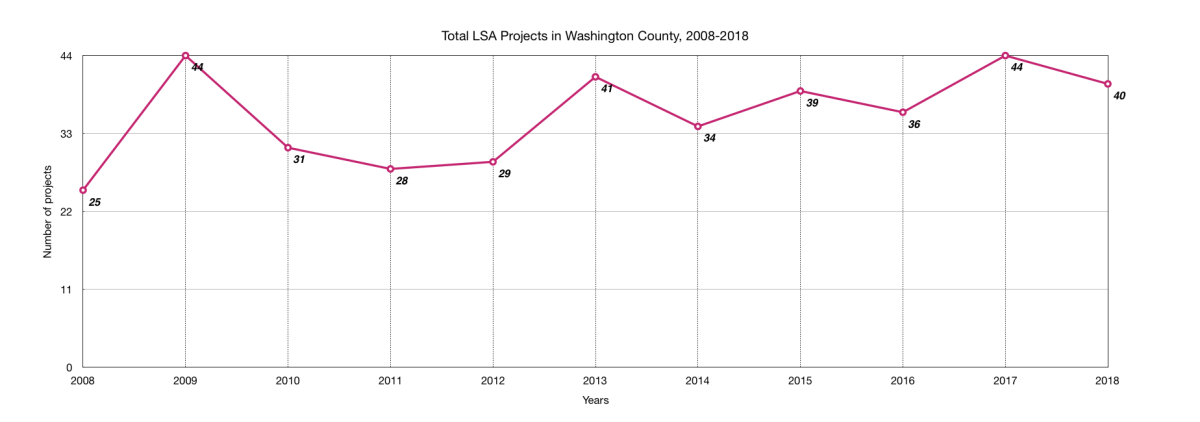
Bridges, a parking lot and facades in McDonald Borough are three of 391 projects financed or hoping for financing, in part, by the Local Share Account during the 11 years since The Meadows Racetrack first opened its temporary casino.
Included in the $89.7 million are $7.6 million worth of projects from December 2018 that the final authority, the state Department of Community and Economic Development, has yet to award.
Jeff Kotula, president of the Washington County Chamber of Commerce and chairman of the Local Share Account committee overseeing the annual allocation, noted last October that because of matching funds from other sources known as “leverage,” the value of the projects is closer to $473,733,753.
Trista Thurston/Observer-Reporter
Trista Thurston/Observer-Reporter
Under Act 71, known as the Gaming Act, the Department of Community and Economic Development and Commonwealth Financing Authority developed guidelines for Washington, Fayette and other counties of their size to distribute gambling revenue known as the Local Share Account.
Both Southwestern Pennsylvania counties must, by law, use the money for economic development, job training, community improvement projects and projects of public interest.
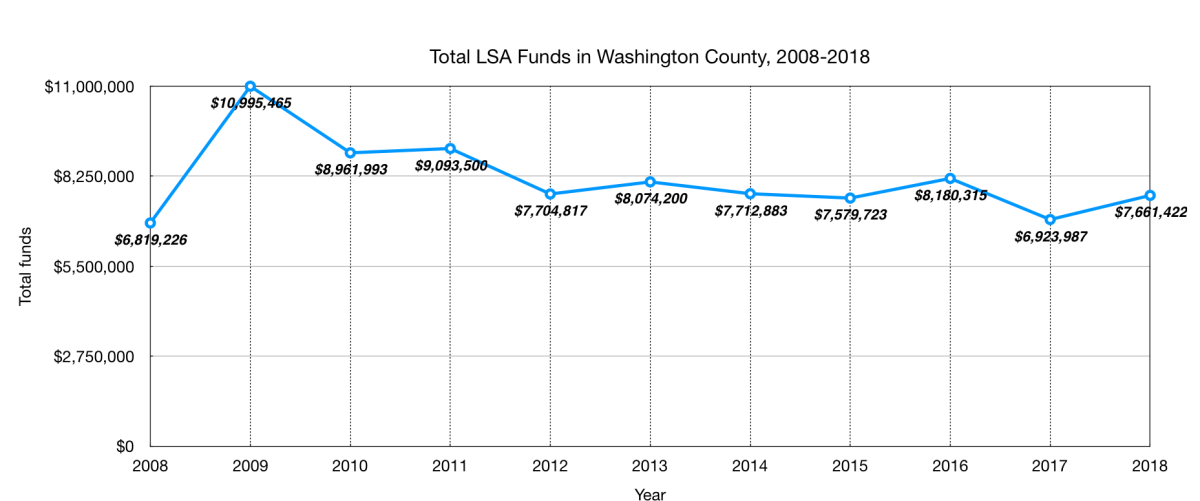
The amount of money available year by year varies according to how much money gamblers are willing to throw down.
The Meadows opened its temporary casino in June 2007, so Washington County’s first funding became available in 2008 with only six months’ worth of revenue.
The year 2009 shows a peak of nearly $11 million because each municipality with a proposal on how to use the money came hat in hand before the local share committee.
That changed, however, in 2010 when, under amended procedures, municipalities began receiving a direct allocation, based on population. Municipal officials no longer had to apply for permission, for example, to erect a sign or buy a snow plow with casino revenue; the money came directly to each municipality.
Sixty-four of Washington County’s 66 municipalities get $25,000 each plus $10 per capita. North Strabane Township, as the casino’s host municipality, receives a separate allocation, and tiny Green Hills doesn’t meet the population threshold.
During each year since casino money became available, proposals have exceeded the number of projects that make the list recommended to the Washington County commissioners.
The Washington Robotics Society made a case to receive $17,000 in 2015, but went away empty-handed.
In response to an email, Cheryl Putnam, president of the society, wrote that shortly after learning it did not make the cut, “We received $3,500 from NiSource and Range Resources. We decided to go in a different direction. Instead of offering a new program for students in eighth through 12th grade, we decided to expand our current program for students aged nine through 14.
“Although it was disappointing at the time to have not received the large grant, things seem to have worked out for the best.”
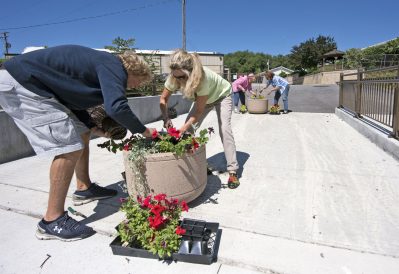
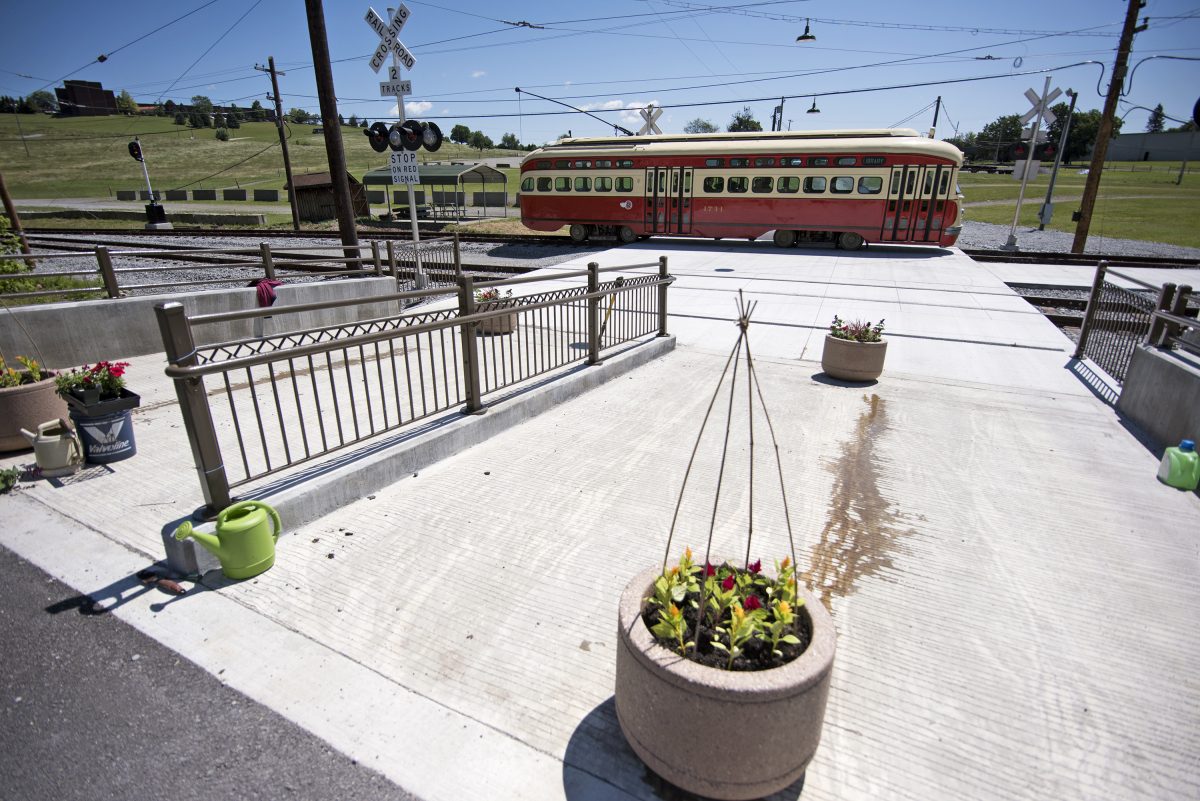
Master gardeners were busy earlier this month beautifying a redesigned entrance to the Washington County Fairgrounds. The cost of the redesign and rebuilding, which included widening a bottleneck bridge and fortifying the fair trolley stop with concrete, was completed at a cost of $1,488,566, which included $400,000 from the Local Share Account, a PennDOT grant of more than $700,000 and fairgrounds oil and natural gas lease proceeds.
Lisa Cessna, director of the Washington County Planning Commission, which oversees bridges, parks and the fairgrounds, has been a member of the LSA committee since its inception.
“I presented the project in the public hearing and when the committee met, I left the room,” she said.
“If any of us have any participation in the project, we don’t participate in the votes.”
Conveyances no longer used on local streets carry fairgoers to the annual event from the parking lot of Pennsylvania Trolley Museum, itself a recipient of LSA money.
Gambling revenue to the tune of $74,360 is going toward a brick and dual-track “Trolley Street” streetscape awarded in 2012 for the museum’s east campus.
Celeste Van Kirk/Observer-Reporter
Celeste Van Kirk/Observer-Reporter
The redesigned trolley stop at the entrance of the Washington County fairgrounds
Scott Becker, executive director of the trolley museum, has since applied for additional dollars for Trolley Street, a parking lot for visitors, and a welcome and education center, but even though he was shut out three times, he remains hopeful that the program will continue.
“I think local share is a very important program of quality-of-life amenities that would not be funded otherwise.
“I guess I step back and look at the greater good.”
Other entities which were left out in the cold for LSA dollars declined comment or did not respond when contacted for comment by the Observer-Reporter.
Kotula noted the state Legislature defined the criteria used by the committee: leverage – those matching funds – and impact.
“These matching resources are key in our review process because they show the project is able to move forward and that the applicant is committed to the success of the project as well,” he said.
As to impact, Kotula said the committee looks at the positive effects a project will have on a community, enabling committee members during public hearings to learn “firsthand from our municipal and community leaders the importance of their projects to their communities.
“This is where Washington County’s LSA process stands out from the rest of the state. It is locally driven by local people and responsive to the needs of our local communities.
“Through listening and responding to our local communities, the LSA has funded such projects as playgrounds in California, West Brownsville and Vestaburg, removed blight in Marianna and Washington and invested millions in water and sewerage projects across Washington County.”
Kotula said applicants for projects not recommended for funding are encouraged to meet with him or other members of the LSA review committee to fine-tune their requests for another year.
He pointed to Transitional Paths to Independent Living’s renovation of the former YWCA building and the Main Street farmers market in Washington, the Monongahela Aquatorium, Canonsburg Lake restoration and water and sewer projects in Centerville as examples.