

Crash that claimed Wichita State team still haunts C-M grads
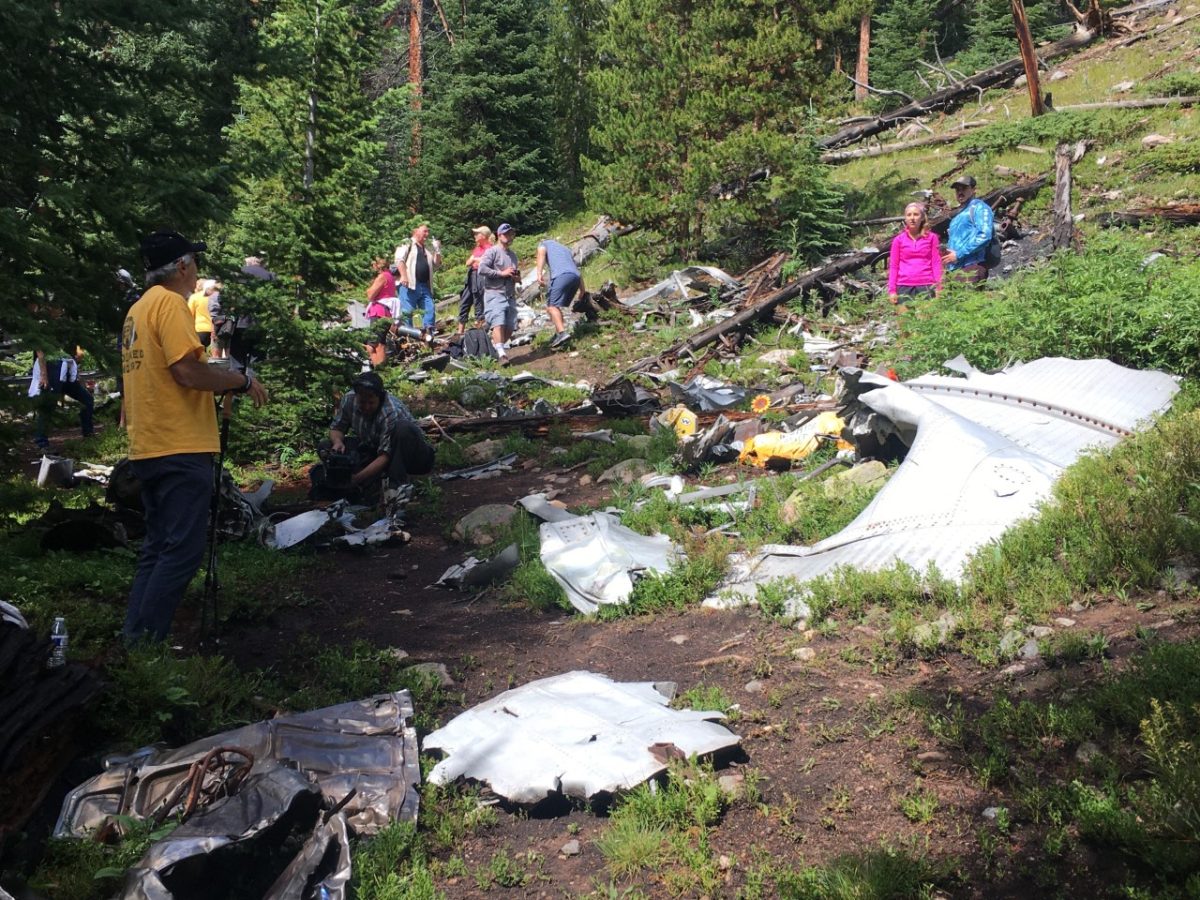
Friends and family members of the victims of the plane crash that killed most of the Wichita State football team go over the crash site last July.
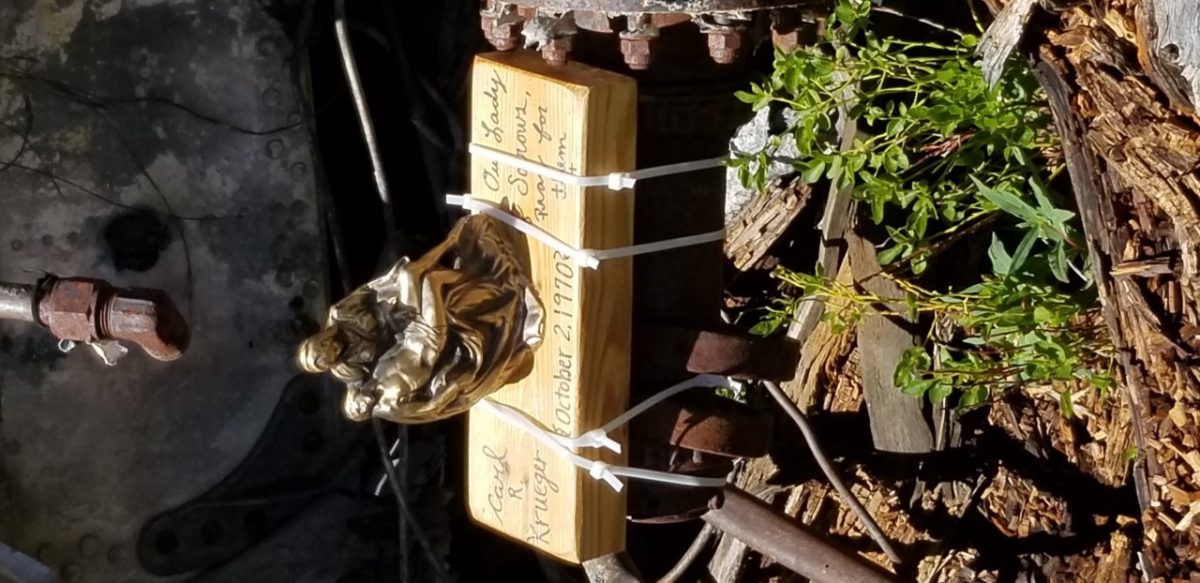
A memorial for victim Carl Kreuger sits at the crash site.
Ed Plopa and John Straka, sophomore members of the Wichita State football team, sat safely in their seats on an airplane that just landed in Logan-Cache Airport, Logan, Utah, Friday, Oct. 2, 1970.
Those were the last truly peaceful moments the two Canon-McMillan High School graduates would have for some time.
As they waited to exit the plane and begin the process for preparing to play Utah State the next day, they both saw an assistant coach emerge from the cockpit and walk toward them.
The coach stopped, gained everyone’s attention, and informed those on board that the plane carrying the Shockers’ starting players, head coach Ben Wilson and his wife, the athletic director and his wife, along with the team’s trainer, other administrators and several boosters to Logan, had crashed in the mountains in Colorado. {
The plane had been dubbed the Gold plane for that trip. The second plane, which Straka and Plopa were passengers on, was called the Black plane.
It was later learned that at 1:14 p.m. (MDT), 29 people were killed when the chartered Martin 404 airliner crashed into a mountain, eight miles west of Silver Plume – near Loveland Ski Area.
Among those killed was Plopa’s roommate and Straka’s friend – Carl Krueger – the team’s starting tackle.
Two more people died after being recovered from the crash of the twin-engine prop liner, which carried 37 passengers and three crew members.
Plopa and Straka, stunned at Kreuger’s death, took solace that nine teammates survived. But the traumatic experience shook their core.
“It was mind shattering when we were told, impossible to believe,” Plopa said. “The information initially was sketchy.”
Plopa said those sitting on the plane could see news reporters and others begin to surround the plane.
“Ed and I were sitting together,” Straka said. “I know the (assistant) coach leaned into the cockpit and then walked toward us. His look was stern and somewhat scared. I thought to myself ‘this is not good.’
“Eventually, we were given a list of survivors. That’s when the gravity of it hit us.”
Plopa was the second team quarterback for the Shockers going into the Utah State game. He said he had taken more snaps in practice the week leading up to the game and the starter was battling injury. He acknowledged that he could have been named the starter that week, which could have placed him on the ill-fated plane.
Kreuger was just promoted to starting guard that week and thus assigned to the Gold plane, which was assigned to the starters.
“Pete was one of the unfortunate ones,” Plopa said. “I could have been on that plane. I have reflected on that over the years.”
Plopa and Straka were standouts at Canon-McMillan, playing for Ray Campanelli, the late head coach of the Big Macs.
Plopa was the Big Macs’ quarterback. Straka was a linebacker.
Plopa was headed to Bucknell before he and Straka were offered scholarships to Wichita State.
Neither he nor Straka could have ever anticipated they’d be faced with the deaths of a number of friends and teammates.
“The first couple days, I don’t really remember,” Plopa said. “We left Logan for a bus ride to Salt Lake City at 4:30 a.m. Utah State players showed up at the hotel with cookies and coffee.
“I do remember staring mindlessly out of the window in the plane at the great Salt Lake. So much was going on in the world: Vietnam War, riots, bombings and chaos. This just seemed to be another thing
I didn’t really go around any players. I went and sat by a brook and just thought. I didn’t even call my parents at first.”
Ironically, six weeks later a plane carrying the Marshall football team crashed in Huntington, W.Va., returning from a game in North Carolina. All 75 on board died in the crash, devastating the football program and community.
For Pete’s sake
When the Wichita State players and coaches returned to campus, squad members were asked to go to their rooms and not discuss the crash to reporters or anyone. Grief counselors, group get togethers to express feelings or guidance from coaches, were not offered.
“Years later, our offensive line coach, said the coaches and the university ‘should have done more for you (players),’ Straka said. “They told us not to talk to anybody. Everybody seemed scattered, like nobody was really there. It was hard, very hard.”
Plopa asked Straka to return home. The two, along with another friend, packed a car and drove home. Plopa was from Cecil and Straka from Canonsburg.
“When we returned to Wichita after the crash, we were greeted by the freshmen,” Plopa said. “We looked at a lot of sorry faces. “We felt we needed to get out of there. We lost our friend and four other sophomore classmates. We packed the car and left. That was our way of coping with it.”
The decision to return home had implications for Plopa and Straka.
After serving as pall bearers at Kreuger’s funeral in Chicago, the two Big Macs returned to campus and the team, which voted to move forward with season. Wichita State was granted permission to use freshmen – which were not eligible to play varsity then – by the NCAA to enable them to continue with its schedule.
Shen practice resumed, Plopa had not been installed as starting quarterback. A freshman was the No. 1 guy on the depth chart. Straka was moved from linebacker to the offensive line.
“Something changed,” Plopa said. “That tainted us. I was the backup before the crash and then I see a freshman moved ahead of me. I was totally irate and wanted to stick it to them.”
Said Straka: “There is no doubt us leaving was held against us. We didn’t have any support.” Straka said Robert Seaman, an assistant who was named head coach after Wilson’s death, convinced him to stay.
Both Big Macs stayed at Wichita State and were members of the Shockers’ 1972 team that went 6-5 – the program’s first winning season in 10 years and last until 10 years later.
Wichita State’s football program was discontinued after the 1985 season.
What happened?
With speculation growing over why the plane crashed and why the university contracted with the company, some facts became clear.
- Two planes departed Wichita Mid-Continent Airport as planned.
- The planes made an unplanned stopover at Stapleton International Airport in Colorado.
- The pilot of the Gold plane decided to take a more scenic route through the Colorado mountains.
- The second aircraft – the designated Black plane – flew a conventional route.
- About three months before the crash, Wichita State contracted Golden Eagle Aviation to supply a Douglas DC-6 to fly the football team to away games.
- The four-engine DC-6 was large and powerful and could accommodate the entire team. After the agreements were made, the DC-6 was damaged and was unavailable for use.
- A pair of Martin 404s, which had not flown since 1967, were recertified for flight. The replacement aircrafts were taken from the Jack Richards Aircraft Company facilities in Oklahoma City to Wichita, instead of the DC-6.
- The president of Golden Eagle Aviation, Ronald G. Skipper, was the pilot flying the Gold plane. He acted in the capacity of a first officer because he did not have a type rating on the 404.
- During the flight to Denver, he visited passengers in the cabin, telling them they would be taking a more scenic route than the original flight plan.
- Skipper purchased aeronautical sectional charts for the scenic route during refueling.
- A National Transportation Safety Board investigation report concluded the crew did not allow enough time for the charts to be studied properly to avoid high terrain before takeoff.
- After takeoff in clear weather, the two aircraft took different paths from Denver. The NTSB concluded the probable cause was pilot error in “in-flight decisions or in planning.”
Amazingly, no one or no entity took responsibility for the crash. No one was officially or criminally blamed or held responsible for the tragedy. Wichita State constructed a memorial for those who died from the crash called Memorial ’70. Each year on Oct. 2 at 9 a.m., a wreath is placed at this memorial.
A roadside memorial plaque listing the names of the victims is located near the Colorado crash site, adjacent to westbound Interstate 70.
Closer to closure Straka earned his pilot license in the 1980s.
He said he was often bothered by what really happened that day in October 1970.
He had a much greater perspective after visiting the crash site with other teammates, including Plopa, and friends in late July.
“The plane didn’t have the capabilities to do what (Skipper) was asking it to do,” Straka said. “It was crazy.
The high-altitude hike to the site was steep and the hikers had to deal with tough terrain and downed trees. The site is nearly two-miles above sea level.
“It was worse than I expected,” Straka said. “I didn’t expect to see all the wreckage. It brought it all back. It makes you understand how fast things can turn.” “Once I got to the crash site, I could see. The top of that mountain was 12,000 feet. They were not turbo charged engines. The plane was overweight (by 2,600 pounds). Nobody in their right mind would have tried that. He made a horrible mistake. “Once I looked at the area, I knew what transpired. I was flabbergasted. He was ill-prepared.”
Plopa’s first visit to the crash site was 1989. He visited again in 1990 and then this July.
“I don’t know why, but I just didn’t feel like it was necessary for me to go before I did,” Plopa said. “We (his son went with him) ended up on the wrong mountain. We went back up (the next year) and we could see where bulldozers left a trail up the mountain.”
He added that the three-quarters of a mile trip straight up the mountain took about 40 minutes to an hour.
“The crash site was in front of us,” Plopa said. “Aluminum, pieces of landing gear were all over the place. I was kind of blown away. It was pretty emotional, more spiritual.
“I could still feel a vibe. What I saw, could have knocked me down. In some spots, it looked like the mountain was trying to reclaim itself. But many parts haven’t rejuvenated. An entire area is contaminated. Some of the mountain is still scarred.”
Plopa added that the hike in July to the crash site with teammates, 80 to 90 people in all, was “a unique experience.”
Straka found some comfort in going.
“I’m glad I made the trip,” he said. “I feel a bit more at peace. It’s still sad.”