

American and Russian students take part in seventh cyber conversation at Cal. U

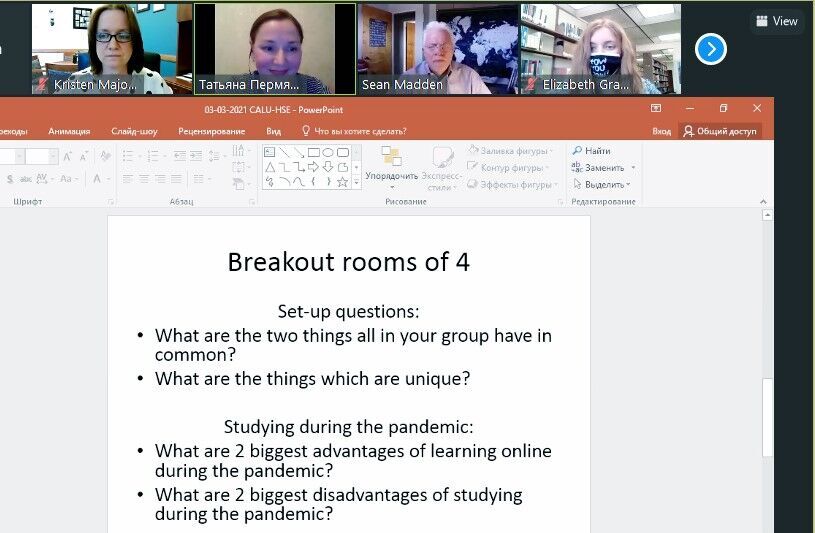
A California University of Pennsylvania student takes part in a Zoom conversation with students from a Russian college on Wednesday to discuss cultural differences and similarities.
Mark Hofmann/For the Observer-Reporter
On Wednesday, students with California University of Pennsylvania took part in a Zoom conversation with students from a Russian college to discussion cultural differences and similarities.
Carrying on a seven-year tradition, students at California University of Pennsylvania held a Zoom meeting with students in Russia on Wednesday.
Curious to learn about their contemporaries’ ways of life, about 30 students from Cal. U and the National Research University, High School of Economics in Perm, Russia, asked one another about social media, COVID-19 vaccination distribution, sports and national anthems.
They also delved into whether all Russians drink vodka, and all Americans drink whiskey.
“I think first and foremost, based on responses over the years, is that students in Russia and the U.S. come to realize that for all of the cultural distinctions, there are many more similarities and shared interests,” said Dr. Sean Madden, a professor in the Department of History and Political Science at Cal. U and host of the call.
“I think students on both sides also come to realize that each culture has its own divisive issues,” he said.
One topic that was off the table Wednesday was politics.
He said the Russian students are aware of the divisive political partisanship in American, and his students are aware of the difficulties Russian students could face for speaking out against their leaders.
“It is a little more tricky recently given the fear of repression of opposition in Russia and this discomfort felt by American students to express themselves for fear of very uncomfortable responses,” Madden said.
Yet, learning more about a culture than is portrayed in television or movies can be eye-opening, he said. And the most frequent and immediate response he receives from his students and the Russian students is asking when can they take part in such a session again.
“Many students, on both sides, are hesitant to say anything,” Madden said, adding that it’s especially true for the Russian students using English as their second language. “The responses are always very positive and by the end of each session, it is clear that students start to become aware of similarities and start to get more comfortable with each other, resulting in the request for more sessions.”
Madden has been hosting the cyber conversations between the students in the countries since 2014, when it started because of the Winter Olympics that were held in Sochi that year.
“We’re really broadening who we’re reaching out to here,” he said.