

Controversial GOP-led voting bill would create elections audit bureau
The Republican-led voting reform bill passed Tuesday night in the state House would create a Bureau of Election Audits, and although it’s unlikely to become law anytime soon, it appears to be a road map for the GOP to review future election results.
House Bill 1300 passed mostly along party lines and now heads to the Senate for a vote, but Democratic Gov. Tom Wolf has criticized the bill and vowed to veto it if it remains in its current form.
Among many changes, the bill would require voter identification at the polls, limit mail-in ballot drop box locations and shorten the voter registration and absentee ballot application period, while also allowing pre-canvassing of mail-in votes and creating a mechanism for early in-person voting.
Republicans claim the bill is needed to protect elections integrity, while Democrats say it will disenfranchise low-income and minority voters.
Part of the bill would establish the Bureau of Election Audits within the state Auditor General’s office to perform various reviews of county elections offices. The bureau would “have subpoena power to request from the department or a county any documents, records, papers, data, ballots, election materials or testimony necessary for the efficient completion of the audits.”
The bill also sets forth conditions for a “post-election audit” before certification in which the bureau would be permitted to perform a “result-confirming audit” with ballot comparisons. It’s not clear how often the “risk-limiting audit” would be performed or who would decide when or where to conduct it. Other reviews of county elections offices would be performed on a rotating basis, according to the bill.
That would be a welcomed development for state Rep. Bud Cook, R-Daisytown, who is one of the bill’s sponsors and has publicly stated he would like to go even farther to conduct a “full forensic audit” of the 2020 election. While he’s unsure if that’s still possible, he would like to see a similar review available to future elections with the help of HB 1300.
“I just wanted to let everyone know that’s not off the table, but 1300 is our way forward,” said Cook, who represents parts of Washington and Fayette counties. “You would have to take a look at everything from top to bottom. I’m not sure we have a way to get that done.”
Republican leaders in Pennsylvania have made calls to “audit” the 2020 election similar to the widely criticized partisan review that is currently occurring in Maricopa County, Arizona. President Joe Biden won both states by narrow margins over Donald Trump, prompting the former president to claim without evidence there was widespread voter fraud.
One such review has already occurred this year in Pennsylvania in Fulton County, where technology contractor Wake TSI performed an “assessment” of the 2020 election and submitted its report in February.
The West Chester-based contractor “did not conduct a forensic technology audit of the election management” because it did not have permission from county officials, according to its report. But its workers having any access to the county’s Dominion scanning machines concerned both the Pennsylvania Department of State and Dominion, according to the Arizona Mirror news website. In response, Dominion claimed Fulton County violated its lease agreement and the machines in question were not permitted to be used in last month’s primary election, forcing the county to spend $25,000 to lease new machines, the Mirror reported.
Fulton County Elections Director Patti Hess declined to comment Wednesday when contacted by an Observer-Reporter staff writer, and she directed questions to the county’s Board of Elections. A secretary who answered the phone said the board’s members, which are the three county commissioners, were not in the office Wednesday.
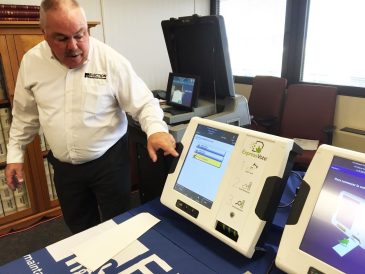
The situation in Fulton County is what concerns Washington County Elections Director Melanie Ostrander the most when she hears discussions of election audits that could involve the county’s ES&S voting machines that were purchased for more than $2.8 million in 2019. If an unapproved contractor has access to the voting machines, vendor ES&S would void its warranty with the county and the machines would be decertified by the state, Ostrander said.
“It’s part of the Pennsylvania certification that was done by the Department of State that we have to keep control (and) chain of custody of the voting machines,” Ostrander said Wednesday while overseeing cleaning of the machines at a warehouse where they’re stored. “If we were to lose chain of custody, the machine would be considered decertified, we would not be able to use it and we’d have to purchase a new machine.”
Ostrander has no problem with a hand recount of paper ballots submitted either at the precinct or by mail. Wolf ordered all counties to change their voting machines before 2020 in order to have a backup paper ballot that could be stored and counted in the event of a recount.
But Ostrander is unsure of the scope of power that the proposed elections audit bureau would have and how it would conduct its reviews. As part of HB 1300, the state treasurer would reimburse counties only 50% of the cost to purchase a new voting machine if it was decertified.
“If they want some sort of audit that involved that, they would need to work with the Department of State to ensure our voting machines would not be decertified,” Ostrander said. “Whatever is in the law, we’ll follow the law.”
While HB 1300 is unlikely to become law this year, Republicans are expected to continue calling for a full review of the 2020 election and pursuing similar voting legislation in the future.
“If we can get the audit, fine,” Cook said. “If not 1300 allows you to take those actions.”