

Payne Chapel AME in Canonsburg receives cemetery preservation grant
Katherine Mansfield/Observer-Reporter
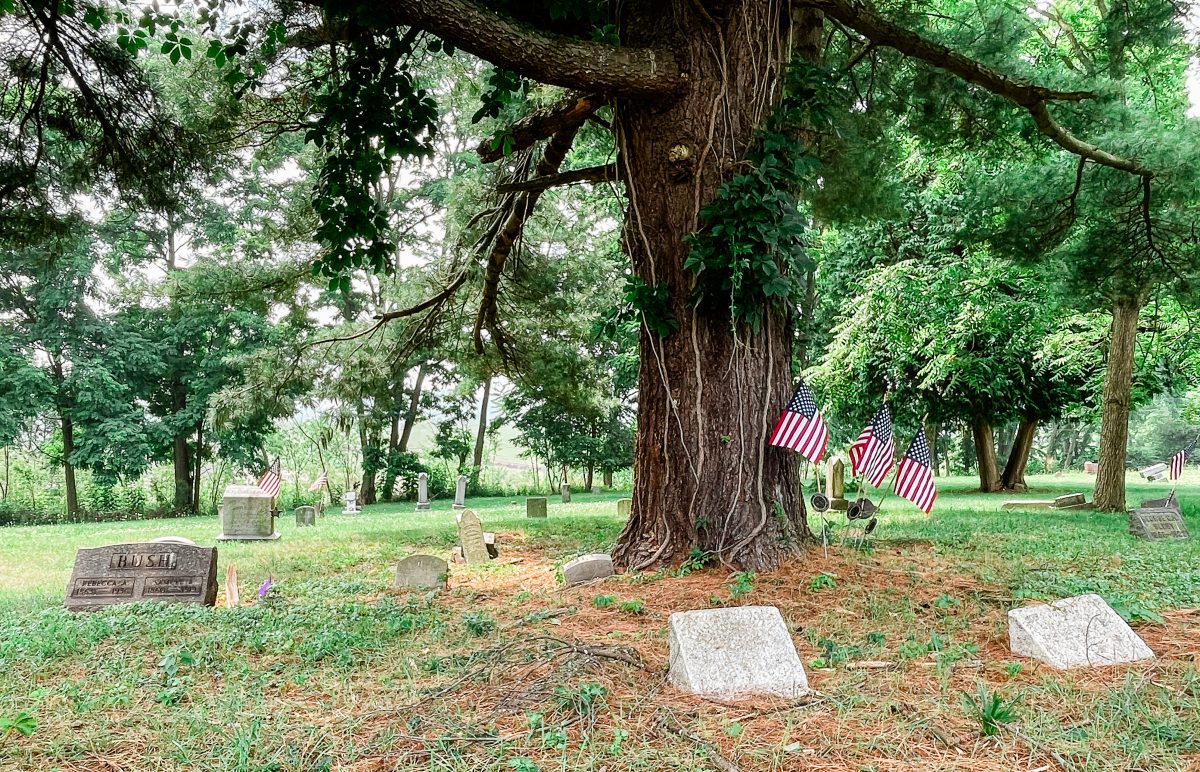
Three flags honoring U.S. Colored Troops soldiers stand beside a tree in Payne Chapel AME Church Cemetery, where those three soldiers’ headstones could not be identified for proper honoring. The Canonsburg church recently received a grant to restore the cemetery, including cleaning and repairing headstones.
Katherine Mansfield/Observer-Reporter
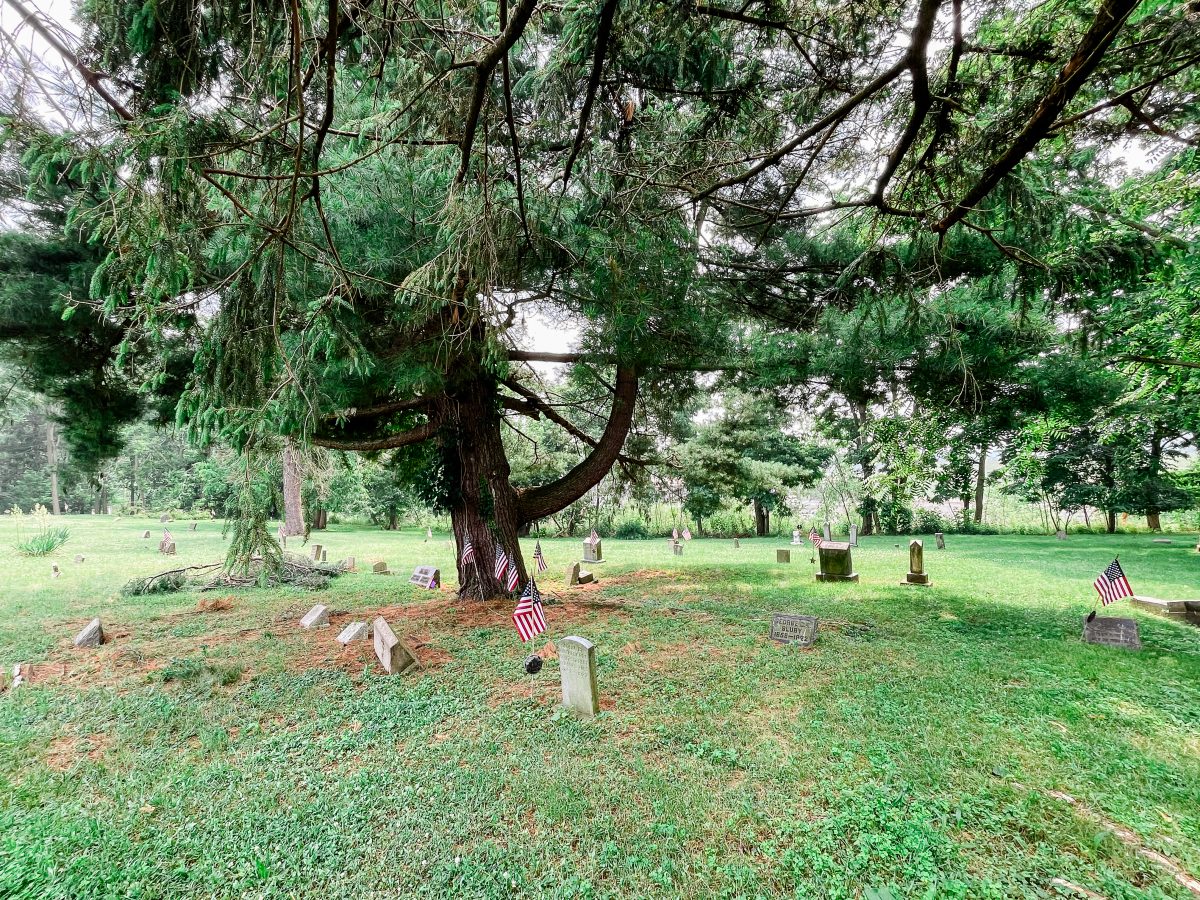
Payne Chapel AME Church in Canonsburg is one of 13 churches statewide to receive funding for cemetery restoration from Pennsylvania Hallowed Grounds. The cemetery needs headstones cleaned and repaired, trees dated and removed, the hillside cleared and the ground leveled.
Katherine Mansfield/Observer-Reporter
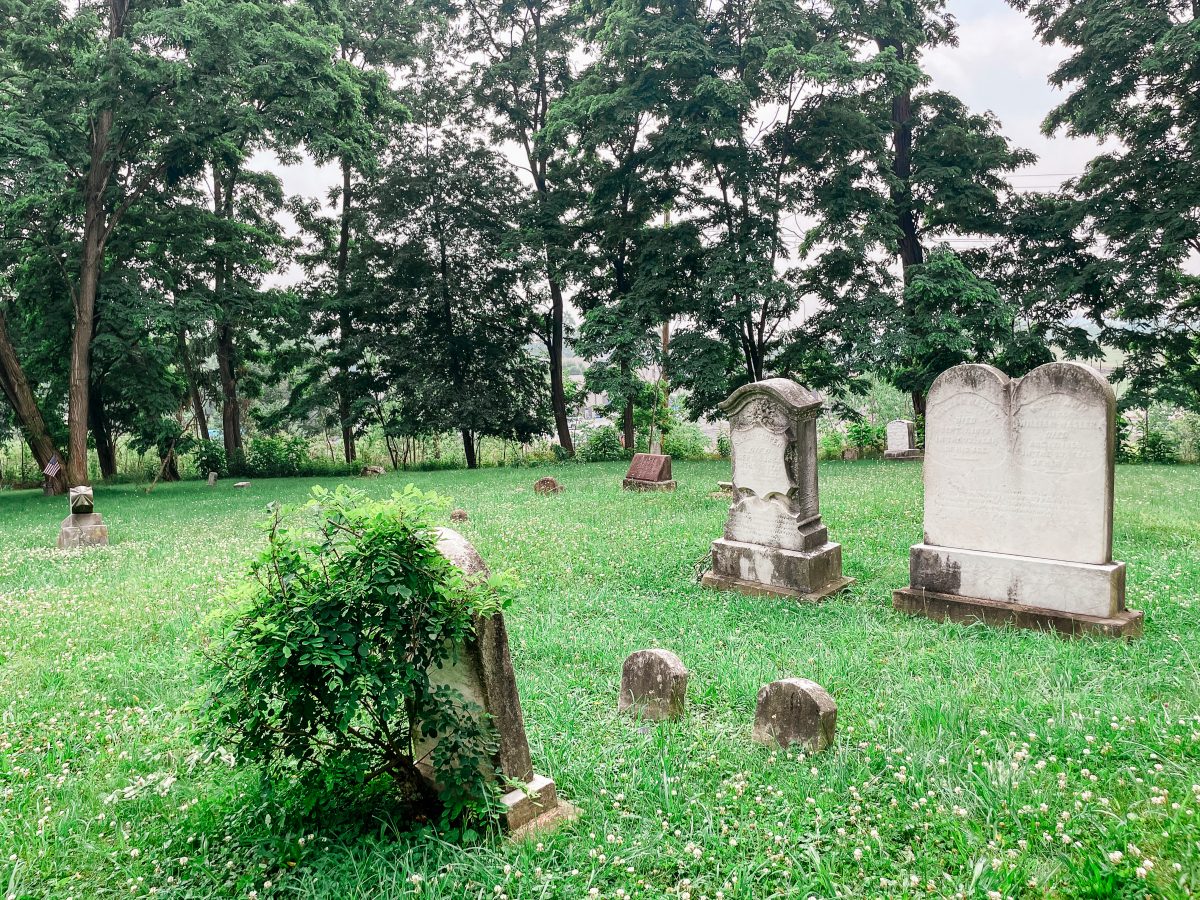
A tree grows beneath a headstone in Payne Chapel AME Cemetery, a Canonsburg site in need of TLC. The church recently received a grant to restore the cemetery, including clearing trees and repairing headstones.
Katherine Mansfield/Observer-Reporter
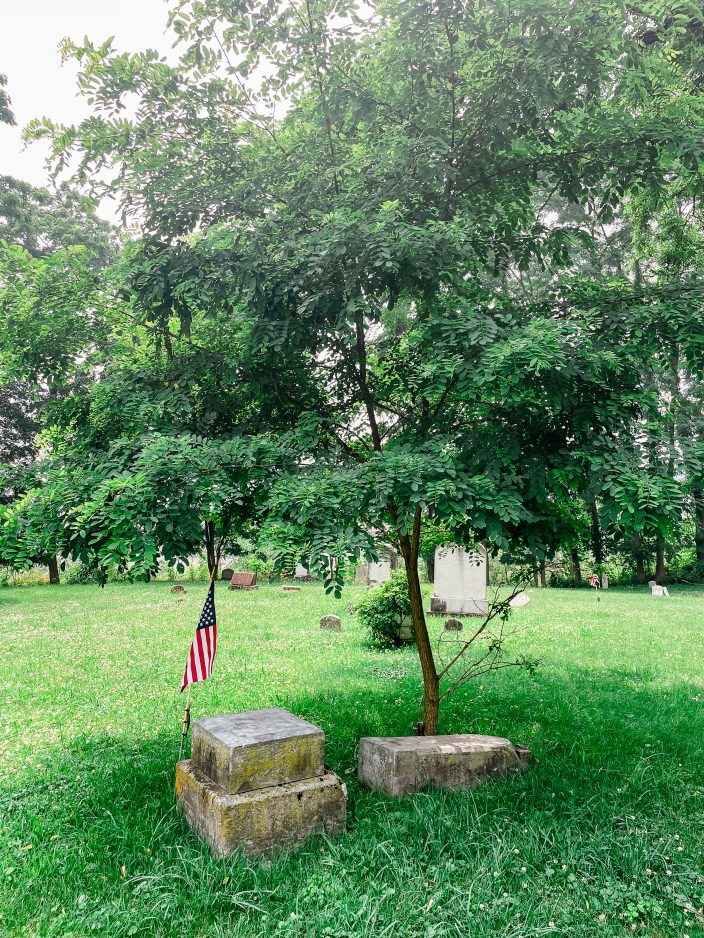
So far, 27 U.S. Colored Troops soldiers have been identified at Payne Chapel AME Cemetery in Canonsburg, and their headstones, along with many others, are in need of cleaning and repair. Payne Chapel AME recently received grant funding, a first step in restoring the historic site.
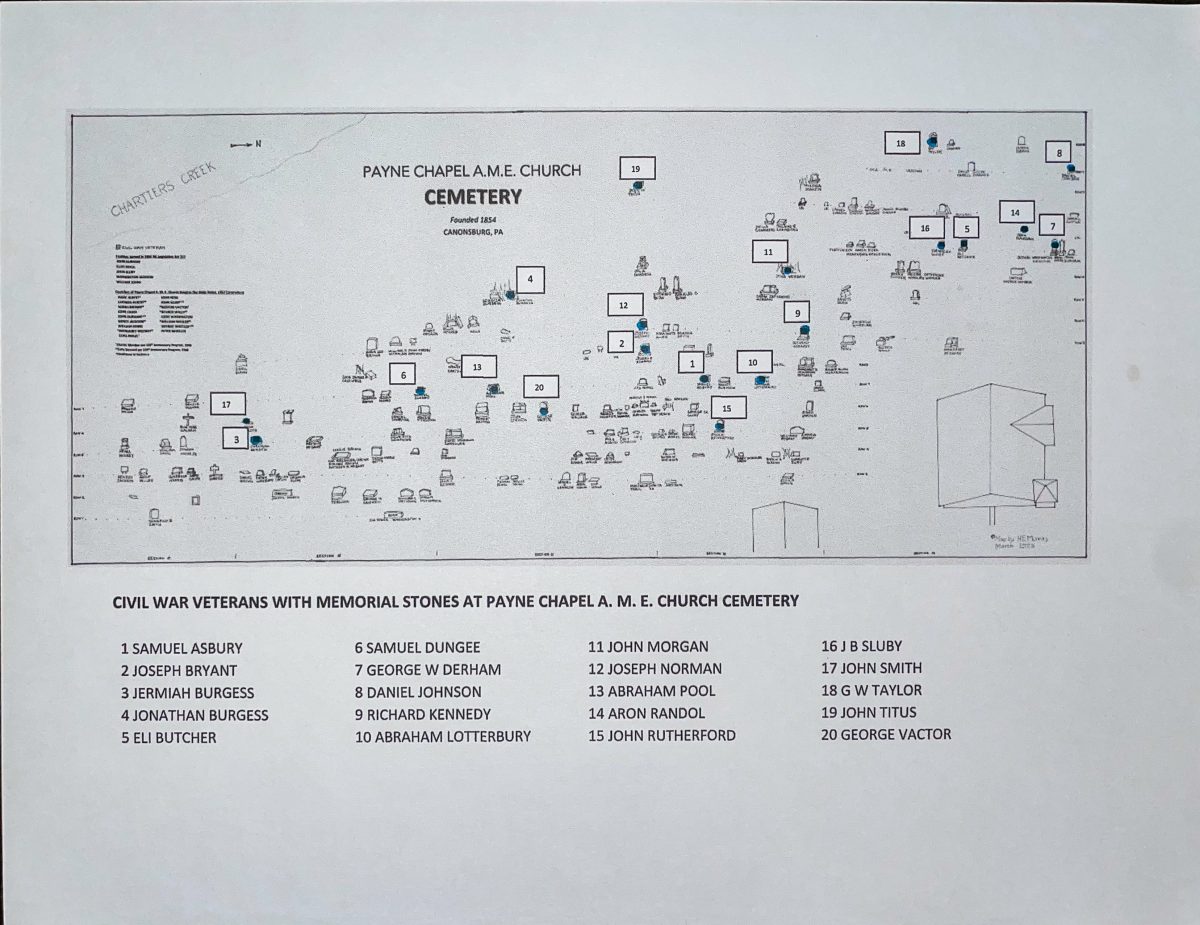
Hazel Murray meticulously charted the headstones and, when able, names of those buried at Payne Chapel AME Church Cemetery in Canonsburg, and created an art map of the historic site that houses the remains of Black Civil War veterans.
Katherine Mansfield/Observer-Reporter
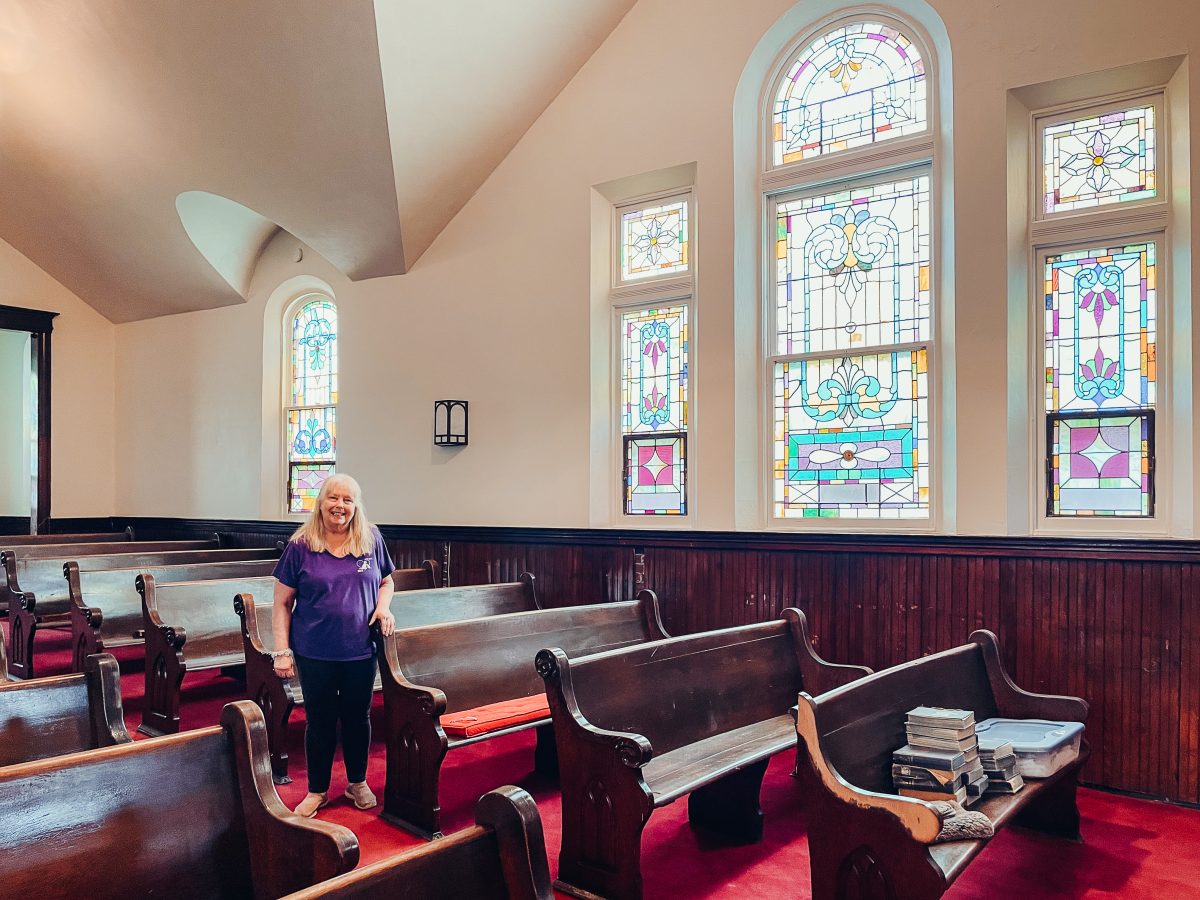
In this photo from May, the Rev. Marilynn Fisher stands in the nave of Payne Chapel AME Church in Canonsburg.
Every headstone at Payne Chapel AME Church cemetery, said Hazel Murray, has a story.
“This is history that I didn’t know about. I grew up in Washington County; my bachelor’s degree is from Washington County. And I never heard anything about African American Civil War veterans,” said Murray, who now lives in Elizabeth and attends Payne Chapel AME Church in Canonsburg. “As an adult, as an older adult, I had been learning more and more about the history of the United States and how many places there should have been stories told that weren’t told, and how the absence of those stories has shaped how people interact with each other.”
Now, thanks to a grant from Pennsylvania Hallowed Grounds, in conjunction with Preservation Pennsylvania, Payne Chapel AME is going to tell the stories that have for so long been buried in a small cemetery in a corner of Canonsburg.
Earlier this year, Payne Chapel AME reopened under the direction of Pastor Marilyn Fisher, and now that upstairs renovations are complete and services are held each Sunday, it’s time for the church to focus on the 27 or more U.S. Colored Troops soldiers and other forgotten or nearly-forgotten Black men and women who call Payne Chapel AME Church Cemetery their final resting place.
“We don’t learn in Black history about pre-Civil War African Americans having wills, owning property,” said Murray. “These the United States Colored Troops, over half of the men who are buried here at Payne, they were free. They weren’t fighting to get free from slavery. They were born free, yet they stepped up to the plate. These are the stories to be uncovered.”
A small committee of stewards is undertaking the large task of restoring the 1.3-acre cemetery, including cleaning and repairing headstones, clearing the brush-covered hillside, locating and marking what some speculate are hundreds more unmarked graves, and removing trees that are not a part of the original cemetery’s layout.
Murray, who is leading the charge after completing a comprehensive map layout of burial places verified by church records, has two goals: landscaping, including leveling the ground for easy walking, and repairing headstones.
“I did an inventory of how many stones need to be repaired. At least 41 are in danger of being lost forever,” said Murray.
The project will take additional funding and manpower, and Payne Chapel AME hopes to get the community involved. Fisher and Murray would love to connect some Canonsburg residents to their buried histories, and a younger generation to hands-on education.
But first, the church is working with Pennsylvania Hallowed Ground (PHG), who for the first time in its more than three decades of existence this year awarded 13 grants to state cemeteries filled with Black history and in need of restoration.
“You can’t have American history without having Black history, Asian history and all the other histories,” said Barbara Barksdale, chair, Pennsylvania Hallowed Grounds. “What we are trying to do is make sure, for those (cemeteries) that we can salvage, that we can at least notate where they were … and that we can help preserve not only the physical site, but also the memory of those who are there.”
Barksdale helped restore Midland Cemetery in Dauphin County (the cemetery was recently added to the National Register of Historic Places), and understands firsthand the difficulties small churches face in preserving their history.
“When I got started 32 years ago, I had nobody, for the most part, that I could go and talk to to help me, guide me,” she said, noting she did have some mentors but lacked a network. “I just had to go on the instinct of what I had to do next. Blood, sweat and a lot of tears. I don’t want these people … to not have a source.”
As part of the grant, PHG is sending professional consultants to create a site plan for Payne Chapel AME and the other dozen grant recipient churches. Consultants, together with cemetery stewards and PHG board members, will collaborate to ensure preservation of these sites.
“There’s Black cemetery networks all across the country. We’re really trying to get word out about how to protect, how to preserve, our cemeteries. Especially over the last 10 years, it’s been broadcast a little bit more. Over the country there’s all kinds of laws being passed and bills being set up to help preserve the cemeteries and making sure this history is documented,” Barksdale said, noting Black cemeteries have been built over by highways, neighborhoods and universities.
“I want this history to be restored … so that our youth and generations to come can come back and see this. We must use all these cemeteries. It doesn’t matter if it’s Black or white, I want people to use them for educational purposes,” she continued. “In research, we’ve found a lot of veterans whose families didn’t even know they were veterans. A lot of people, especially with Black veterans, never got the right benefits, they never got a true headstone, they aren’t going to be identifiable as you walk through the cemetery.”
On Memorial Day, VFW Post 191 paid respect to U.S. Colored Troops soldiers’ headstones in Payne Cemetery, but the flags don’t do justice to the stories Murray and Fisher hope to uncover as property renovations progress. Murray said she knows a little bit about every soldier in Canonsburg; some stories lead to names of other Black Civil War soldiers, and others reshape our understanding of early America.
Take, for example, the story of Samuel Cottle.
He died in 1861, the year the Civil War began, and his will states his property should be sold and all proceeds given to his daughter Melinda, a slave living in Monroe County, Virginia, so she could purchase her freedom. If Melinda could not buy her freedom within three years, Cottle asked that his money be used to educate “poor colored children of Canonsburg and the vicinity,” Murray said.
“Now that packs a lot. Here’s a free man living in Canonsburg with his wife. He’s in the 1860 census. They’re free. He has property, he has assets, and he dies. But he has a daughter who is a slave. How did he get here? Why isn’t she here? Did she buy her freedom?” Murray said. “His will just raises so many questions about history, the history of the United States of America, where you could have a man here, his child a slave. It’s just a beautiful story.”
Murray and Fisher are eager to dust off the pages of the church’s history, restore the cemetery and share it with the community at large. They’re thrilled to be working with PHG – “We didn’t expect to really get that grant,” Fisher said – and are looking for volunteers to help clean headstones or offer services, including repairing split and toppled headstones and removing young trees.
Murray and Fisher also need assistance locating additional burial sites. Findagrave claims more than 600 people are buried in Payne cemetery, but there are only about 175 headstones on the property.
Donations are also helpful in continuing the project post-grant.
But the grant from Pennsylvania Hallowed Grounds, Fisher stressed, is the first step of a worthy, rewarding and ongoing project.
“It’s a great beginning,” said Fisher. “It means a lot because it means now somebody has noticed something. When you say Payne Cemetery, we’re not some little thing. Monetarily, it’s not the thing to us, it’s the being able to get the work done. When (the grant was awarded), honestly the first thing I thought of was now the work can begin.”