

A fond farewell
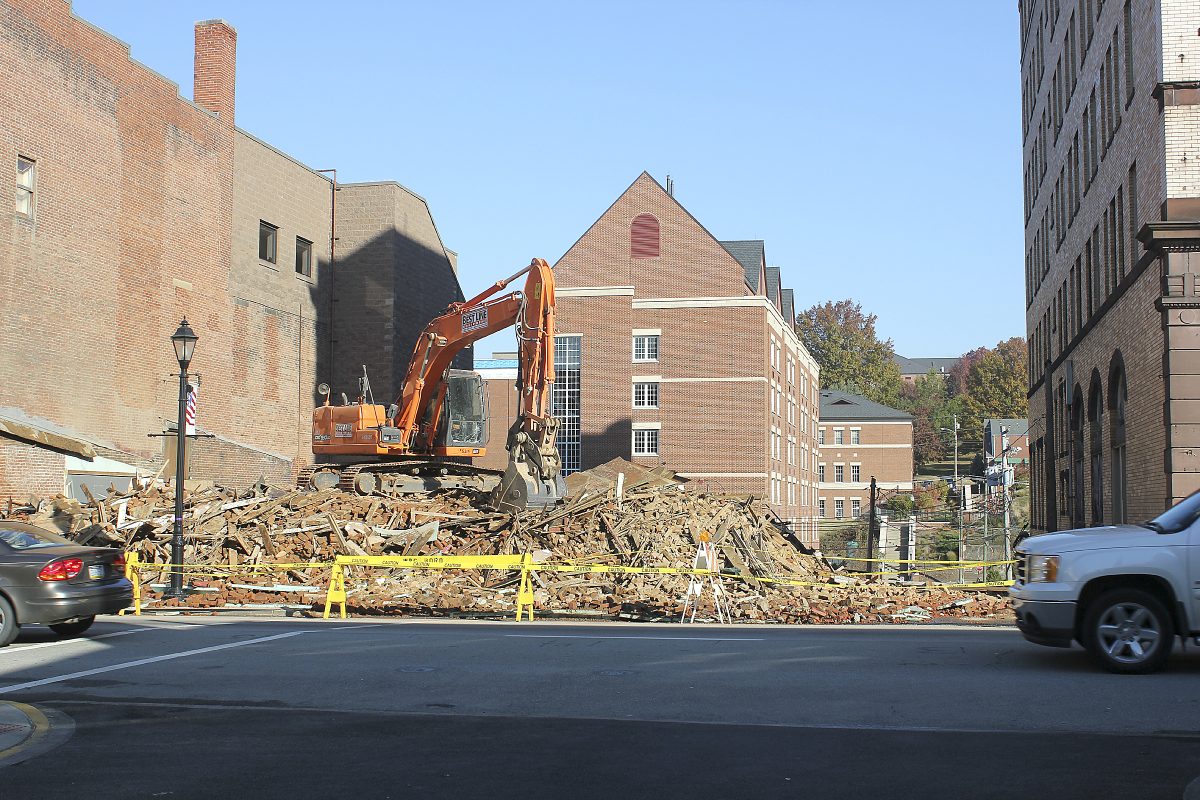
Gone … All that remains of the Allison Building and its 180 years of memories and secrets is a pile of bricks and lumber.
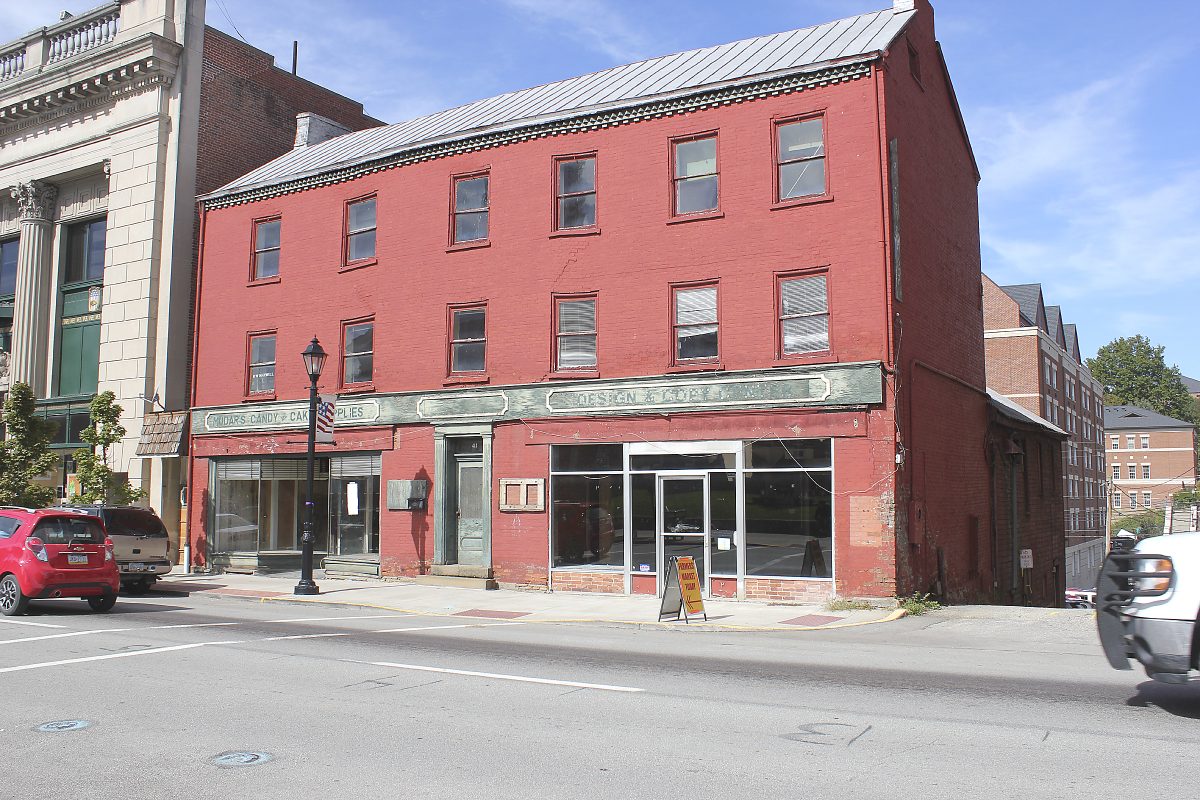
The Allison Building on High Street, which once housed a drug store, law offices and several businesses since the early 1800s, was vacated in the last year when numerous structural deficiencies were discovered
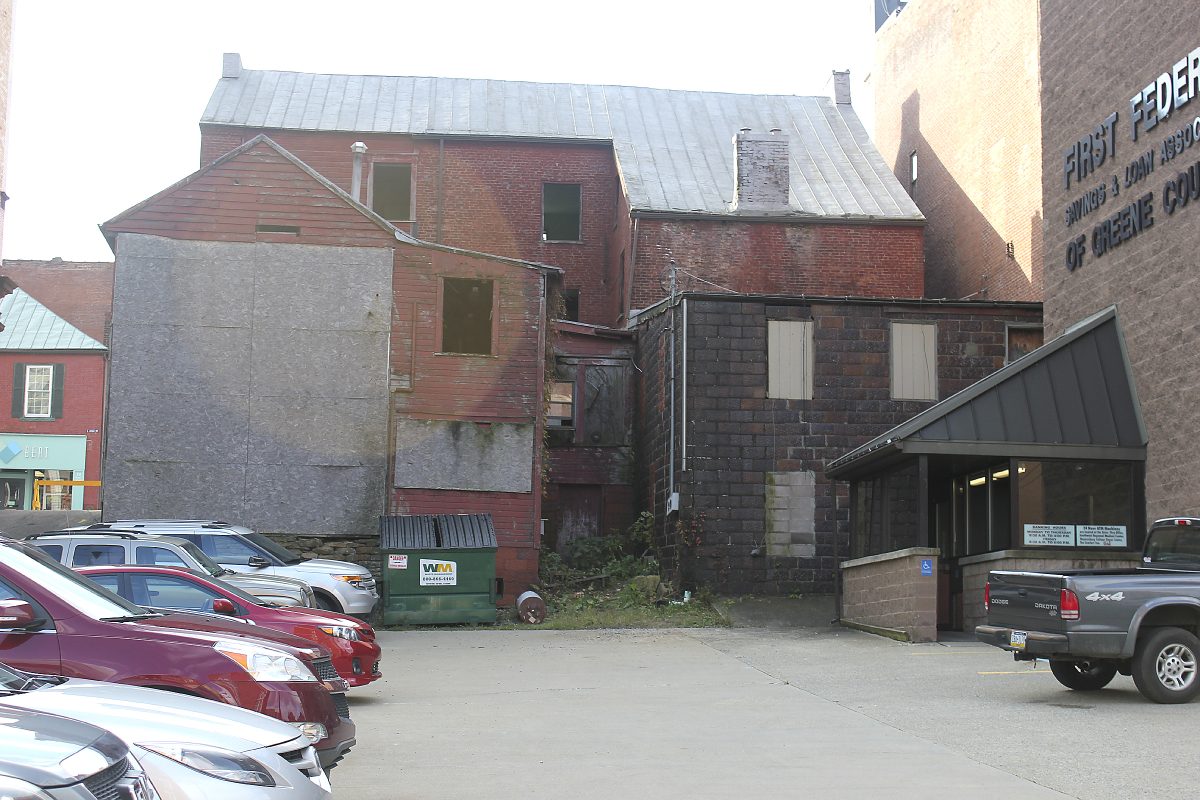
This shows the rear of the Allison Building and its deteriorating condition. It was purchased in June by First Federal Savings and Loan Association, which contracted to have it torn down.
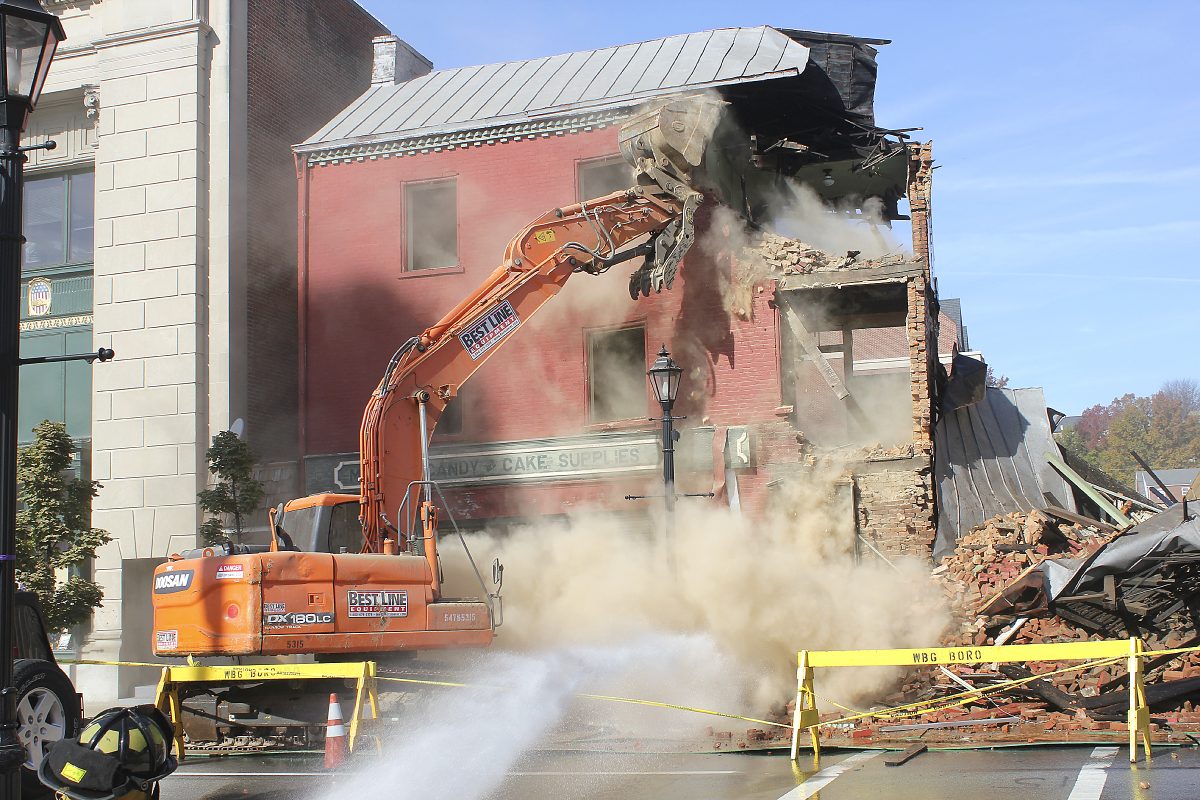
Going … A piece of construction equipment owned by Tap Excavating of Uniontown, takes a bite out of the Allison Building in October as the storied structure, once considered the birthplace of Rain Day, begins to crumble.
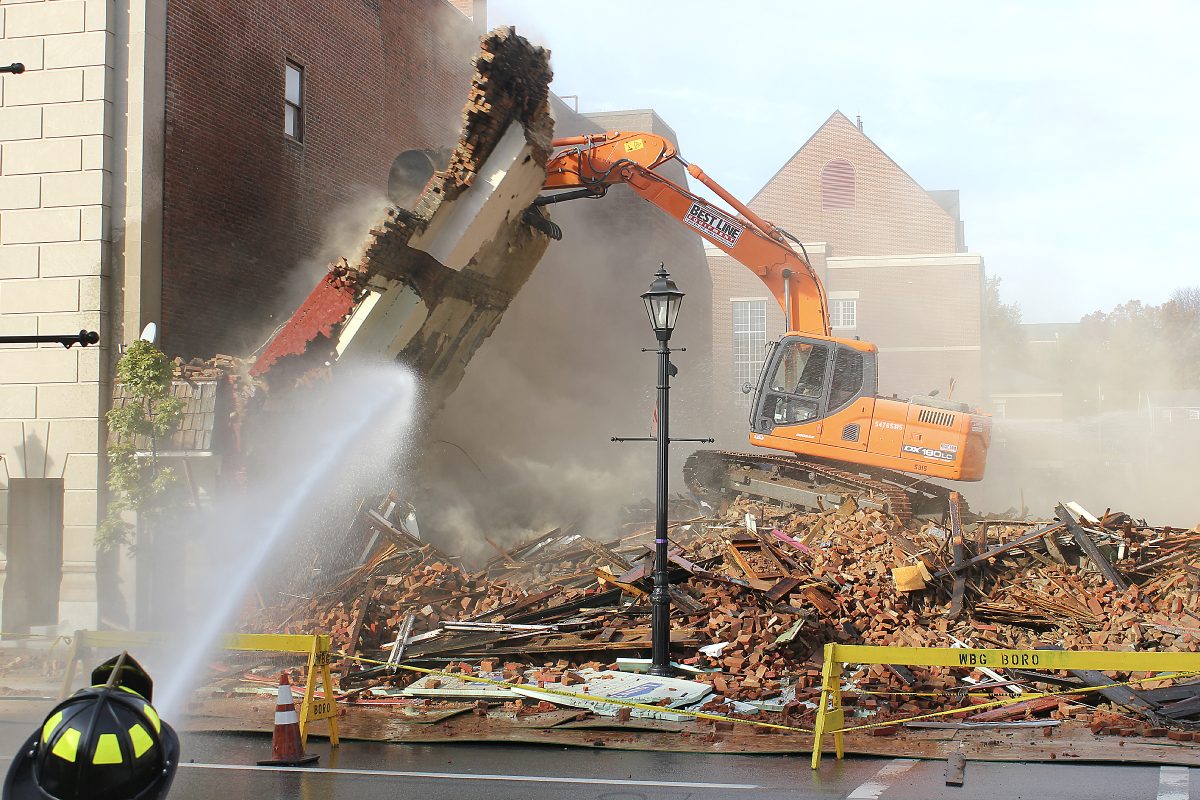
Going … A fireman with the Waynesburg-Franklin Township Fire Department directs a stream of water on the dust-producing rubble that was once the Allison Building on High Street.
Story and photos by BOB NIEDBALA
The Allison Building was one of the oldest structures in downtown Waynesburg, but what made it special to many area residents was the central role it played in the town’s tradition of Rain Day.
The three-story brick building at the corner of High and Church streets, constructed in the early 1800s and considered the birth place of Rain Day, was demolished in October after engineers determined structural deficiencies made it not feasible to repair.
Rain Day, celebrated annually, is based on the belief it always rains in Waynesburg on July 29. Precipitation has fallen in the borough on 114 of the last 138 years, according to Rain Day accounts.
The Allison Building, legend has it, is where Rain Day had its start in 1875 and where for many years a drug store there kept record of the years it rained July 29. Over the years, the legend became bound to the store and to the building.
A drugstore had occupied the building for more than 100 years and when the last one closed in 1986, the Jesse L. Ross Drug Store, newspapers accounts noted the store’s ties to Rain Day, but also spoke of the loss to the community of its soda fountain and its “locally famous coffee milkshake.”
During its nearly 180 years of existence, the building served as home to its owners and boarders; it provided space for local attorneys and a photographer; it housed shoe stores, the local chapter of the American Red Cross and the first local telephone exchange.
The building itself, or at least part of it, may have dated back to the beginning of the town, said Mary Beth Pastorius, an architectural historian and Waynesburg native.
The town was formed in 1796, the same year the state created Greene County from five townships that were then part of Washington County and appointed a board of trustees to acquire land for a county seat, according to G. Wayne Smith’s “History of Greene County, Pennsylvania.”
The land purchased for the county seat was divided into 201 lots, which were sold at auction in October 1796. It also included a public square, on which the county’s second courthouse was constructed in 1800.
The lot later occupied by the Allison Building would have been considered a very favorable location, being in the center of town and across from the courthouse, so “it’s logical and probable that a building was on that site as early as 1800,” Pastorius said.
It’s also possible that part of the original building still existed at the time of its demolition, she said. It was common in earlier days to build an addition onto an existing building, rather than tear down and build anew, because of the effort involved in construction then, Pastorius said.
The building as it last existed appeared to include an addition. This is evident by the distances between the windows on the upper floors. Windows on the left side of the building were spaced wider apart than those on the right, Pastorius said.
The building, as it last stood, is believed to have been completed by Levi Rinehart, a dry goods merchant, sometime between 1825, when he purchased the lot, and 1837, when he sold it, she said.
Pastorius, who researched the property deed, found that Rinehart had bought the Allison Building lot and another lot for $1,000 and sold the Allison Building lot alone for $1,900. This represented a large increase in value between when he bought it and when he sold it, which would indicate a building was constructed on the site between those dates, she said.
A “three-story brick house” also is referred to in the deed when Rinehart sold the property in 1837 to Jesse Lazear, who later became a U.S. Congressman representing Greene and surrounding counties.
Lazear’s obituary, published Sept. 5, 1877, in the Waynesburg Republican, states that for a number of years Lazear had engaged in the mercantile business in what was known at the time of his death as the Allison Building.
After Lazear, the property was owned by Thomas and George Hoskinson. They sold the property in 1847 for $2,000 to Albert Gallatin Allison, a Waynesburg merchant and the father of the man credited as being the founder of Rain Day.
Allison’s son, William L. Allison, worked as an assistant druggist in the Allison Building for the J.T. Rogers & Co. Drugstore. The Allisons owned the building and William Allison’s brother-in-law, John T. Rogers, ran the business.
According to Rain Day legend, Allison started keeping a record of the weather July 29 after hearing a farmer complain it always seemed to rain every year on that date.
He began making friendly wagers with residents and traveling salesmen that it would rain July 29. After William Allison died in 1910, the tradition was continued by his brother, Albert Allison Jr., also a pharmacist in the store.
In 1909, the store was sold to Byron Daily, who joined with Carl M. Spragg to operate the Daily and Spragg Drug Store in the Allison Building.
After Albert Allison died in 1927, Byron Daily became the keeper of the Rain Day ledger, or, as that person was called, the Rain Day prophet. By this time, calling for rain July 29 and accepting wagers on the outcome was an accepted tradition among local residents.
Daily continued his role of rain prophet until his death in 1938, when his son, John L. Daily, an attorney, assumed the responsibility.
It was about that time that Rain Day began to attract national attention thanks to the news dispatches of local reporter John O’Hara, and the Rain Day bets, once made with residents and salesmen, began to be made with celebrities, that included Bing Crosby, the Three Stooges, Johnny Carson and Muhammad Ali.
Though Rain Day has continued to be celebrated to the present day, its ties to the store and the Allison Building probably came to an end with Byron Daily’s death.
After his death, Glenn Headlee purchased Daily’s half of the business and the store became known as the Headlee and Spragg Drug Store. The store was then purchased by Glenn Zeiler and it became the Jesse L. Ross Drug Store, which closed in 1986.
The Allison Building’s most recent tenants were Modar’s Candy and Cake Supplies and the Design and Copy Center.
The building was purchased in June by the First Federal Savings and Loan Association of Greene County. An engineer inspected it and found it had numerous structural deficiencies, including collapsed load-bearing walls. It was determined the building was not economically feasible to repair.
The bank currently has no plans for the lot and will use it for parking. If a building is later built on the site, a bank official said, it will be built to resemble the Allison Building.