

Orphan Journey Home Chapter Sixteen
? Chapter Sixteen
THE STORY SO FAR: A wealthy widow rescues the Damron children and gives Jesse and Louisa special medicine for their fever and ague. But Moses and Jesse are horrified to discover that the widow owns one hundred slaves.
July 14-19, 1828. North Fork of the Licking River, Kentucky.
The next morning I wake up to find a white woman with iron-gray hair holding my wrist. “Your fever’s broken,” she says, “a good sign. Time for another dose of medicine.” She stirs a spoonful of powder into a glass of water. “Cinchona bark,” she says. “The Indians use it in South America. It saved your life. Drink it down, now.”
Mama never gave us anything that tasted this bad. It’s so bitter it makes me gag, but the woman’s steady eyes mean business. I don’t dare spit it out. I swallow the powder and lean back against the pillows.
Soon the Widow Hopkins lets me get up and move around. She watches us all the time, which makes me feel funny. And she spoils us, giving us new clothes and presents as if it were Christmas – except Mama and Papa could never give us a Christmas like this one. Louisa has a fancy doll with a china head. Solomon has a wooden boat on a string that he floats in the Licking River. I have a real book to read, and soon, Emmy tells me, I’ll have another surprise.
Meanwhile, Moses won’t wear the linsey-woolsey shirt the widow gave him. My first time outdoors, he pulls me aside. “She acts like she owns us,” he says. “The wagon’s all set, and my foot is healing. Soon as you and Louisa are strong, we’ll go home.” He hitches across the yard to the barn and grooms Sadie until her coat shines. Even though he’s itching to be gone, I’m almost happy to feel weak. It means I can wake up in the pink-flowered room a few more times and pretend I’m in heaven with Mama and Papa.
The next morning I come out on the porch to find Emmy waiting for me. “My daddy says the surprise is ready,” she says.
She leads me to the cabins where the slaves live, behind the barn. I drag my feet, but not because I’m wobbly. I’m scared of what I’ll see.
The cabins are mean and shabby; most are empty. A tall man sits outside on a cobbler’s bench polishing a pair of shiny brown boots. “Hey, Daddy,” Emmy says. “Here’s Jesse.”
The man glances at my bare feet before he looks at my face. “I believe these will do you,” he says.
“You made those for me?” I whisper.
Emmy nudges me. “Try them.”
I take them carefully in my hands, as if they were one of the widow’s fine china cups. The leather is smooth and soft, the color of walnuts. I slip my bare feet inside and lace them tight. “Thank you,” I tell Emmy’s father. “They fit just right. How did you know?”
Emmy laughs. “The Widow Hopkins measured your feet when you slept. You didn’t move when you had that fever. You like them?”
“They’re beautiful. I never had new shoes of my own before.”
“Me neither,” Emmy says in a low voice.
I look down, ashamed. Emmy’s feet are as bare as her daddy’s. Something twists inside me, like a rope turned around itself. I unlace the boots and pull them off. “Here,” I tell Emmy. “You take them. They’ll fit you.”
Emmy glances at her father, her eyes afraid. “Can I, Daddy?”
His eyes narrow. “Of course not. If the foreman saw you in those new boots, you’d get a lashing.”
“I’ll ask the Widow Hopkins,” I say. “My grandma will buy me some shoes when we get home.” Of course, Grandma doesn’t have that kind of money, but I don’t say so.
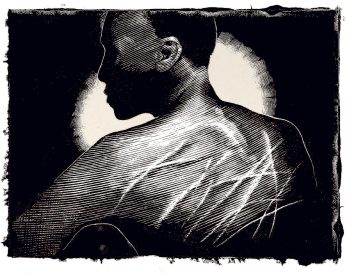
Emmy’s father stands, turns his back, and lifts his shirt. A long scar crisscrosses his spine. I gasp. When he looks at me again, his eyes are scary. “That’s what the whip does. You want to give Emmy scars like mine?” he asks.
I can hardly speak. “No, sir,” I whisper.
“Then you take those boots.” He tucks in his shirt and pulls Emmy close. “On some plantations, the children are sold away from their parents. Her mama and I have been lucky; we’ve kept the family together so far. I don’t want to lose her.”
I bite my lip, holding back the tears. He makes me think about my own mama and papa buried under that big oak tree. “I’m sorry,” I whisper. “It’s not fair.” I clutch the boots to my chest and stumble to the house, so mixed up I want to scream.
Later that afternoon the Widow Hopkins calls Moses and me out onto the shady verandah, where it’s cool. She sits straight on a wooden chair, her hands folded in her lap. Moses balances on his crutches next to me.
“I’d like you children to stay here with me,” the widow says.
My throat feels tight and dry. “We’re not to be – bound out,” I stammer.
“Of course not,” she says in a tight voice. “I’m fortunate to be a wealthy woman. I would adopt you, give you a comfortable life – and an education.”
Education. That word is as sweet as flapjacks with honey. I remember Papa, before he died, making me promise I’d get an education – and teach the little ones, too. I think about having real book learning, about knowing how to spell words like solemn and protection. But what about swearing on the Bible, saying we’d take the little ones home? What would Papa say if he knew I was wearing boots made by a slave?
“Well?” the Widow Hopkins asks.
Moses scowls. I know what he’s thinking. But what do I want?
• NEXT WEEK: Like a Real Coondog