

Thankful to be alive

Jim Uhrig uncovers his driver as he gets ready to tee off at Lindenwood Golf Course in North Strabane Township. The stuffed head cover at left, Grumpy, was given to him by his granddaughter.

Jim Uhrig is an avid golfer who plays at Lindenwood Golf Club in North Strabane Township.

Uhrig gets ready to tee off at Lindenwood Golf Club in North Strabane Township.
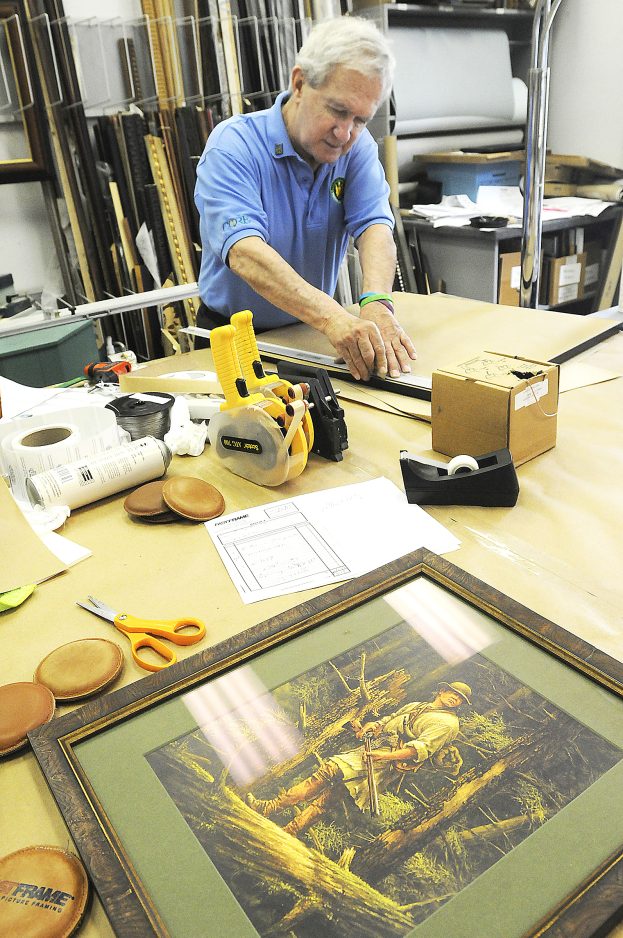
Uhrig finishes a framed print in his shop, Fastframe, in Peters Township.
Jim Uhrig was losing his battle with idiopathic pulmonary fibrosis, an often fatal hardening of the lungs that interferes with the ability to breathe.
When he received a telephone call in the middle of the night on April 20, 2009, telling him that donor lungs were available, doctors estimated that Uhrig had between six and eight weeks to live.
About an hour later, Uhrig arrived at University of Pittsburgh Medical Center, Montefiore for the double transplant operation.
“I took a shower and I didn’t break the speed limit,” said Uhrig, of Peters Township. “When you finally get that call, you have to be ready to go. You only have a small window for doctors to perform the transplant.”
Uhrig, 68, a retired refractory salesman and college football official who, with his wife, Donna, owns Fastframe in McMurray, details the challenges of receiving an organ transplant and the sacrifices made by donor families and care givers in his book, “Partners 4 Life.”
Uhrig recently marked the five-year anniversary of his transplant, but it’s not an occasion that he celebrates.
“Other recipients celebrate their fifth anniversary, but I have humble feelings because of the death of my donor. From a recipient’s standpoint, there can be some feelings of guilt, but I feel I’m taking her gift of life to me and pushing forward with things she wanted, which are donor issues,” said Uhrig.
Uhrig’s donor was Judy Murphy, a 51-year-old nurse from northwest Kansas who died from a cerebral hemorrhage.
He struck up a friendship with Murphy’s oldest son, Travis Murphy, who sent Uhrig a letter telling Uhrig about his mother, an organ donor advocate.
Uhrig carries the letter with him.
In the five years since Uhrig underwent his transplant, he has tried to live a full life, kayaking, playing golf, cross-country skiing, gardening and working.
“I’ve tried to live my life. I think the key to staying healthy, with all the drugs you take – and the drugs slow you down physically and mentally – is that you have to challenge yourself physically and mentally,” said Uhrig.
Uhrig was diagnosed with IPF 11 months before his surgery. Routine activities like tying his shoes and walking up steps left him short of breath, but he attributed it to being a few pounds overweight and getting older. He felt achy, like he had the flu, and decided to go to his primary care physician, who told him he had IPF.
“I had never heard of it before, and I didn’t know that the only solution was a transplant. My wife printed out pages of information from the Internet, and as I read about it, I realized how serious it was,” said Uhrig.
He contacted a friend, John Sullivan, who had a single and a double lung transplant, who encouraged him to get in touch with the Dorothy and Richard Simmons Center for Interstitial Lung Disease, a research facility at the UPMC Montefiore.
Uhrig began to visit the Simmons Center weekly and started using oxygen tanks (he called a small tank that he kept in the back seat of his car R2-D2 because it reminded him of the robot in “Star Wars) and he joined a support group, which he still attends in order to provide support for other lung transplant patients.
Throughout his ordeal, Uhrig drew strength from family, friends, doctors, medical personnel and co-workers who encouraged and supported him. He attributes much of his recovery to those caregivers, who he calls his “angels” and “partners.”
Uhrig’s condition had deteriorated rapidly – his lungs had become as hard as bricks – by the time the hospital called to tell him they had lungs available from a high-risk donor (anyone over 50 is considered a high risk donor because of age).
Days after the surgery, Uhrig contracted an infection but he recovered.
Five months later, her returned to work at the store and as an industrial sales manager and Uhrig said his challenge now is to stay healthy.
“I feel like I’m still getting stronger, five years after the transplant. I work hard at it. Working hard every day is important,” he said.
To stay well, he uses hand sanitizer often and wears a mask while gardening and cutting grass.
Uhrig also wears a signature hat, a floppy Tilley hat that offers him UV protection and keeps him warm. He wears layered shirts and hoodies because he tends to be cold.
Two years ago, Uhrig retired from his sales job in order to concentrate on the book, which he wrote to help other potential transplant patients and caregivers.
He also works with the Center for Organ Recovery and Education as a motivational speaker and participates in the Transplant Games.
“My number one priority now is to help other people. I try to pass on what I learned through my experience to the other people who are going through something similar,” said Uhrig. ” I have people who email me or contact me by phone, and I welcome those calls, 24/7.”
And every day, he thinks about Judy Murphy and her gift that gave Uhrig and several other recipients of her organs another chance at life.
Travis Murphy sees Uhrig as an inspiration.
“Our family is fortunate to have someone like Jim who is so passionate, so engaged, so energetic an advocate for organ donation and we treasure our relatinship with him,” Murphy said. “He carries with him a part of our mother and we know that her energy lives on in him. To know that Jim and our mother’s donated gifts are touching the lives of so many others gives us comfort and we hope that it serves as a striking illustration of why organ donation is so important.”
More than 120,000 men, women and children are waiting for organ transplants in the United States, according to CORE.
Uhrig attibutes his “five bonus years” to Judy Murphy’s generous decision to be an organ donor.
“My second chance at life wouldn’t have happened if not for her and her decision to be a donor,” said Uhrig. “Travis said she had a great sense of humor and she used to yell at referees at her sons’ basketball games, so she would get the biggest laugh of all that her lungs went to an official. I am so grateful for her. I feel blessed.”
“Partners 4 Life” is available at Amazon, Barnes & Noble and other book sellers. A portion of the proceeds will benefit the research work of The Dorothy and Richard Simmons Center for Interstitial Lung Disease at the University of Pittsburgh Medical Center.