

Road to Recovery
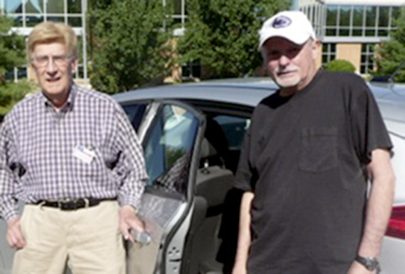
To David Juba, the American Cancer Society’s free ride program has been a lifesaver.
If not for the society’s Road to Recovery program, Juba would need to rely on friends or public transportation for his cancer treatment.
“Without them, I don’t know how I would ever get to my appointments,” the 59-year-old McDonald man said about the volunteers with Road to Recovery.
Road to Recovery provides patients with free transportation to any medical appointment related to cancer, including doctor visits, mammograms, blood tests and chemotherapy or radiation treatments.
And right now, the program needs volunteers.
Judy Prado of McMurray, who along with Mary Jo Closser of Washington, coordinate the ride program, said the number of drivers has dwindled over the years to just five people.
“Sometimes, we can have 10 rides a week, and for five drivers, that’s tough for us,” she said.
Among the volunteers is George Villani of Canonsburg, who began transporting patients when he retired about 10 years ago.
“It’s done me as much good,” Villani said. “You meet so many grateful people, such inspirational people. It puts your life in perspective. You think you have a problem until you meet these people.”
On this particular day, Villani had driven Juba to the UPMC Cancer Center off Race Track Road, where Juba was scheduled to have blood work. Villani sat in his car and read the newspaper while Juba went inside. Had the test revealed a problem, Juba said Villani would be willing to take him right to the hospital.
“Whatever my need is, they’re there for me,” Juba said.
During the three years he has transported Juba, Villani said they rarely talk about his cancer but share other interests.
He looks forward to their trips. “You just become friends,” Villani said.
UPMC Cancer Center is where many patients need to be driven for chemotherapy. Those treated with radiation are taken to Washington Hospital.
But Road to Recovery takes patients to any hospital within the tri-state area. However, some drivers don’t drive into Pittsburgh.
That’s OK, said Prado, who tailors the program to what drivers are willing to do.
Cancer patients call an 800 number, which is answered in Austin, Texas, and the transportation request is emailed to Prado.
“Most of them are in need,” Prado said. “Their spouse is working, and it’s a burden if they have to go every day for radiation.”
It’s been 10 years since Prado became Road to Recovery’s first volunteer. Volunteers must supply their own vehicle, and they are not reimbursed for their fuel. Some drivers log as many as 3,000 miles a year transporting patients.
“People think it’s a big commitment, but once the training is over, you drive when you can,” Prado said. “You don’t have to drive five days a week. You go according to your own schedule.”
For Juba, the American Cancer Society has provided him with a caring, stress-free alternative to some type of public transportation.
He recalled one service that would pick him up at 6 a.m. for a 9 a.m. appointment. Worse, however, was the two-hour wait for pickup following one of his treatments.
“I can’t be doing that. I need to get home. I’m tired. I need to eat,” he said.
For more information or to volunteer for Road to Recovery, call ACS at 800-227-2345.