

A life changed by war
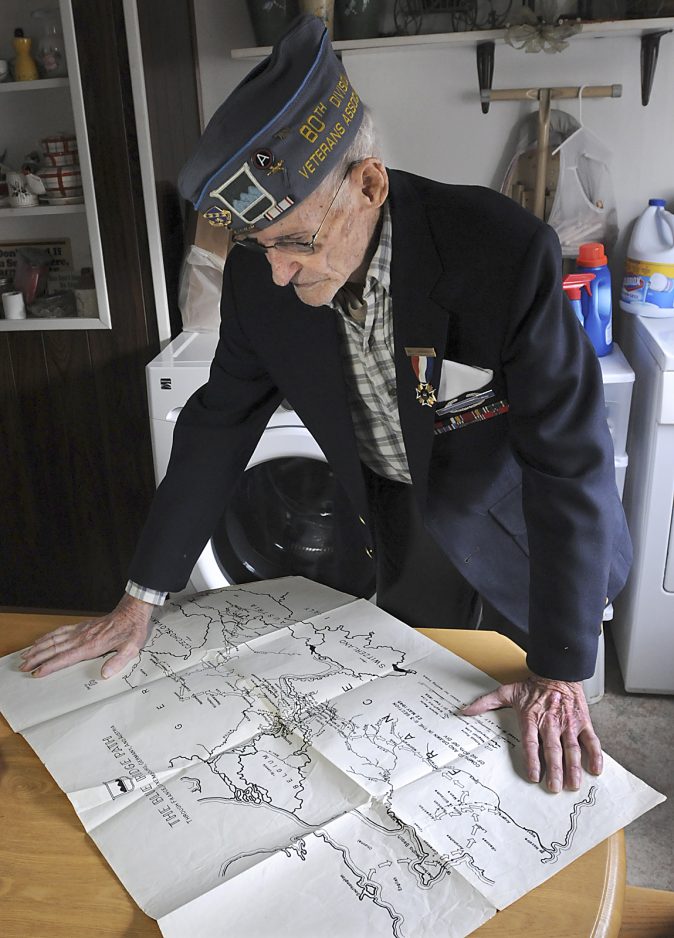
Clarence Brockman, 94, of McDonald, looks over a map of the Blue Ridge path, which was taken by the 80th Infantry Division, 317th HQ Company, during World War II.
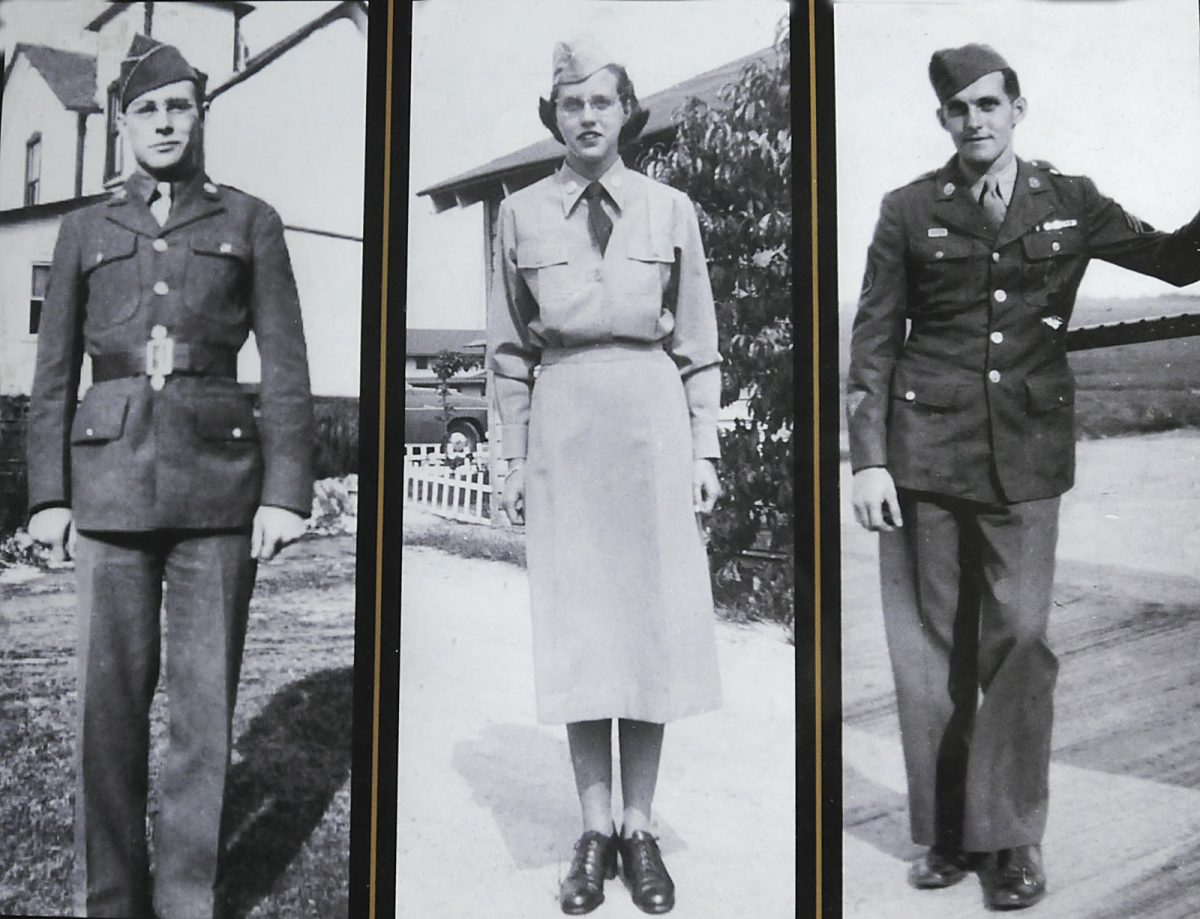
A composite photo of Clarence Brockman, left, his sister, Ruth Brockman, and his brother, Robert Brockman. The photo of Clarence Brockman was taken in Kimbolton, England, in 1942.
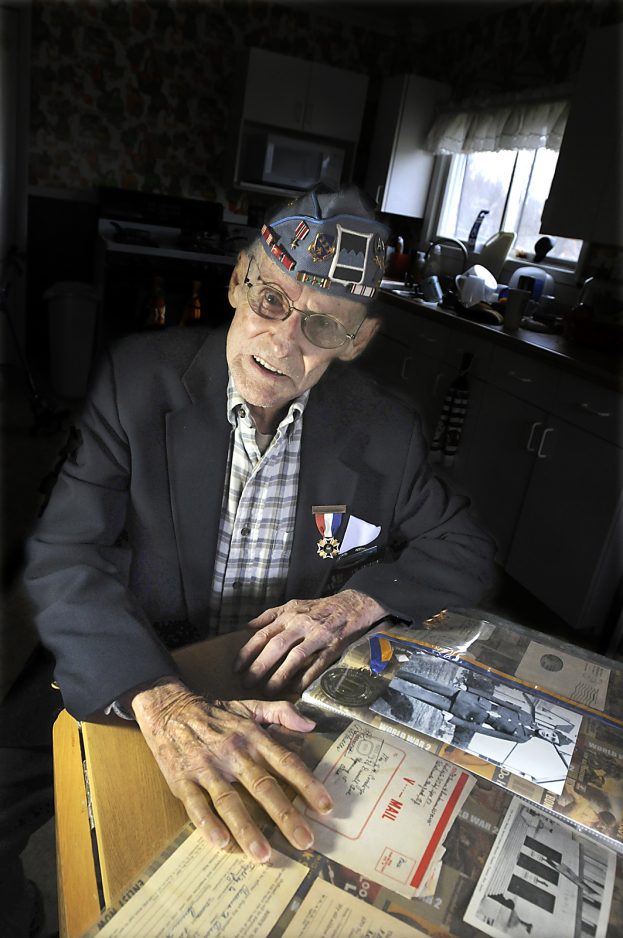
Clarence Brockman, 94, of McDonald, is shown in his kitchen looking over a scrapbook of his journey and other memorable moments during World War II.
McDONALD – Many of the rapidly dwindling number of World War II veterans carry souvenirs of their service, whether it’s a medal or a creased photograph taken during a moment of calm between skirmishes.
Clarence Brockman, a 94-year-old Army veteran who lives in McDonald, has carried a memento with him every second of every day for most of the last 70 years – a tiny shard of black shrapnel just a smidgen above a knuckle on the middle finger of his right hand. It’s been lodged there, just below the surface of his skin, since the Battle of the Bulge, the last-ditch effort by the Germans to make up lost ground in Europe. The battle started 70 years ago next week and carried on relentlessly for a month.
Sunday marked the 73rd anniversary of the day everything changed for Brockman and nearly every other young American male in his late teens or early 20s at the time. When word spread Dec. 7, 1941, that the Japanese attacked Pearl Harbor, finally forcing America out of its isolation from the European conflict and Japan’s imperial designs in the Pacific, Brockman was working at a gas station.
“I woke up in the morning, and a guy said Pearl Harbor had been bombed,” Brockman recalled last week, sitting in the front room of his house, where he is surrounded by memorabilia of both his time in the war and Pittsburgh sports. “We all said, ‘Where the hell is Pearl Harbor?’ We finally found out Pearl Harbor was somewhere out there in the middle of the ocean.”
In the immediate aftermath of the attack, when America was eager to strike back and men were flooding recruitment offices, Brockman joined them. “What are we going to do? I said, ‘We’re going to join the Army,'” Brockman recalled.
At first, Brockman was turned away from the Army recruitment office in the immediate aftermath of Pearl Harbor, owing to faulty eyesight. However, a draft notice landed in his mailbox months later, and he soon embarked on a round of training in Tennessee before being shipped off to the European front.
Along with surviving the Battle of the Bulge, which took 19,000 American lives and left 89,000 injured, Brockman was on hand for the liberation of the concentration camp at Buchenwald, which happened April 11, 1945, just 24 hours before the death of President Franklin Roosevelt on the other side of the ocean.
At Buchenwald, he was confronted by a horrifying scene – a noxious odor, stacks of bodies and survivors so emaciated and dirty their skin was brown. It was a scene so shocking Brockman didn’t even tell his daughter or son he was at Buchenwald until a couple of years before they traveled to Germany to attend a 65th anniversary commemoration in 2010. Brockman’s recollections of the liberation of Buchenwald were included in the 2010 volume, “The Liberators.”
“He never said anything about it,” said his son, Jim Brockman, also a McDonald resident.
The younger Brockman said his father stayed in touch with the small cadre of veterans who witnessed the same things he did, and carry the same kinds of memories, both triumphant and terrible.
“They would come up to the house all the time,” Jim Brockman said. “He knew people in McKees Rocks and just about any place.”
And though World War II took up a relatively small portion of Brockman’s long life – after he returned from Europe, he eventually settled in at a job with Consolidated Coal Co., retiring in 1984 – it still brings him recognition and plenty of questions from people who only know World War II through what they read or what they watched on television or at the movies.
“He’s had a very eventful life, to say the least,” said Brockman’s daughter, Barbara Brockman. “It’s been a life.”