

Murder, he wrote
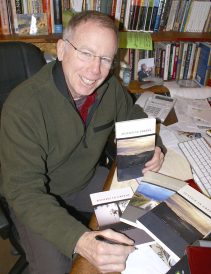
JEFFERSON – Pastor John Dorean has a man cave in the basement of Jefferson Baptist Church, where murders not only have been hatched, but also brought to life in the pages of three books.
Last October, just in time for Christmas, “Justice in Greene,” the last of this trilogy of murders with a redemptive twist, set in the familiar territory of Greene County, was published. Fans of Dorean’s mysteries hurried to buy the book that spells out the pains of drug addiction and how this path can lead to either murder or the blessings of true love, painfully won.
“I’ve read so many Christian writers, and the good guys are so good and the bad guys are so bad. But people are a combination of both, even pastors. Life is much more complicated, and so much depends on the choices we make,” Dorean said, sitting at his desk in the church basement to sign a copy of his newest whodunit, surrounded by shelves full of books, photos and mementos. “My intention in all three books was to show that.”
Dorean’s first published work, “The Kingdom Adventure,” offered his perspective of Christian living in the real world. But the urge to write this message as a puzzle to be solved by the reader was the creative call that Dorean could not resist.
When does someone who is busy ministering to his flock, including the residents of the county jail, leading support groups in that same basement, helping with the monthly Jefferson Food Pantry and serving the mission of Habitat for Humanity and as a board member of the county Redevelopment Authority find time to write?
“Usually after 9 p.m. after a meeting. I write two or three hours until the next scene is about to unfold, then I go to bed and think about what happens next,” Dorean said. “With ‘Murder in Greene,’ I had one scene in mind when I sat down to write the book.”
Protagonist Pastor Mark Stewart is introduced to the reader as he rolls his wheelchair into the scene of the crime during his daily exercise routine on a country road just outside of Jefferson. The trilogy owes its literary life to Dorean’s wife, Merry, who found the manuscript for “Murder in Greene,” which had been tucked away on a shelf since 1997, and had 20 copies made in 2011 for a Christmas present for her husband.
The back cover teased the reader: “Welcome to Greene County – where everything is peaceful and pastoral. Or is it? Surely there couldn’t be a murder … or a pastor in a wheelchair who notices the only lead for the case … near Bell’s Bridge?” The summation was accompanied by a promise of a Mark Stewart trilogy.
“It was totally a joke,” Merry Dorean cheerfully admits. But those who read “Murder in Greene” believed what the back cover promised, and Dorean got to work writing more mysteries based on events that were happening around him.
In true Agatha Christie form, Dorean’s Greene County seems like a placid, small town and country kind of place. But a pastor’s insight into human nature and real- life problems finds dangerous currents beneath that surface. The roads, towns and places to shop and eat are real, and Dorean populates his stories with familiar, yet fictional personalities.
Stewart tends to his flock in an imaginary Grace Presbyterian Church, just around the corner from Dorean’s Baptist Church on Pine Street in Jefferson. Sometimes, Stewart plays dartball with the Baptists. Sheriff Humphrey, a fellow sleuth, played football for the West Greene Pioneers; drugs might be hidden near Pollocks Bridge; and good and bad guys can be found eating at local restaurants, shopping at Giant Eagle or drinking at local bars.
After writing three books full of real places and events that just might happen here, Dorean is sometimes surprised to find facts following fiction.
“I’ve seen stories in the Greene County section of the Observer-Reporter that happened in real life after I wrote my books. That bad well explosion happened a week after “Witness in Greene” came out. People sometimes ask me, ‘These stories are real, right?’ They’re not, but … “
Dorean’s second mystery, “Witness in Greene,” starts with a breakout at the county jail that Dorean knows well from his years of being chaplain there, and uses tensions around the Marcellus drilling industry that has filled the roads with tanker trucks to set the scene for accidental homicide.
“They set off the explosion to raise awareness of the dangers of drilling. How could they know that one of the guards would come back and be there when it went off?”
In “Justice in Greene,” there’s a drug dealer’s house in Mather, but Dorean invented Ninth Street for it to be located. “I didn’t want anyone in Mather to think it was happening next door to them,” he said, grinning.
But for Dorean, the real drug problem in Greene County is no laughing matter.
“Ten years ago when people began telling me there was a terrible heroin problem, I poo-pooed it. But now I deal with this problem on a weekly basis. It’s amazing how fast people become addicted. I’ve ministered to people who got addicted, lost their jobs and families and went through their life savings in a year or two,” he said.
“We have a support group for families dealing with issues with addiction, and they meet here,” Dorean said, pointing to the scattering of couches and armchairs in his office and in the room next door. “When people realize you’re not condemning, they open up.”
In “Justice in Greene,” the plot revolves around the three stages of dealing drugs: from the guy in the white brick house in Mather to his mysterious local contact, with hints of bigger providers beyond the county line.
“But the scenes in the hospital with overdosing are based on my own experiences being there with parents when their children are brought in, and the support groups we run,” Dorean said. “I created my own Greene County Drug Task Force with parole, state police and the district attorney’s office for the details and drama.”
What happens to the family of Piper, the young heroin addict in the story, is based on sad facts, Dorean said.
“People don’t want to face up to the problem, but it’s there for kids, from late teens and those into their 30s and 40s. It’s when parents start to find things missing that they realize it’s happening to them,” he said. “Part of the story is coming in and out of addiction, and Piper and her efforts to beat the habit. The part about families being ruined financially, paying for rehabilitation, is something I’ve seen firsthand. Addiction is hard, but it can have horrifying effects on the families. It’s not a matter of rich or poor. It can happen to anyone.”
Like the Christie books, historical time is captured in the trilogy. The CB scanners in book one give way to 21st-century communication devices, computers improve and old landmarks disappear – the Iron Griddle Restaurant in Morrisville is no more.
But the good times of corn-hole tosses, Pony League games and the down-home food served at parish dinners and cookouts stand the test of time for Stewart, and, one can deduce, for Dorean as well.
The fictional Stewart and Dorean’s family and their community of good people are challenged to deal with the pain and the glory of life, which tests faith even as it empowers fellowship and friendship in a world filled with problems with the power to destroy.
The books can be purchased at Giant Eagle in Waynesburg and Dry Tavern, Belkos Grocery in Mt Morris, Waynesburg and Jefferson, Artbeat Gallery, Waynesburg Milling Co., Quality Herbs, the Greene County Museum, Rush’s in Rogersville and The Little Store in Jefferson.