

In it for the long run
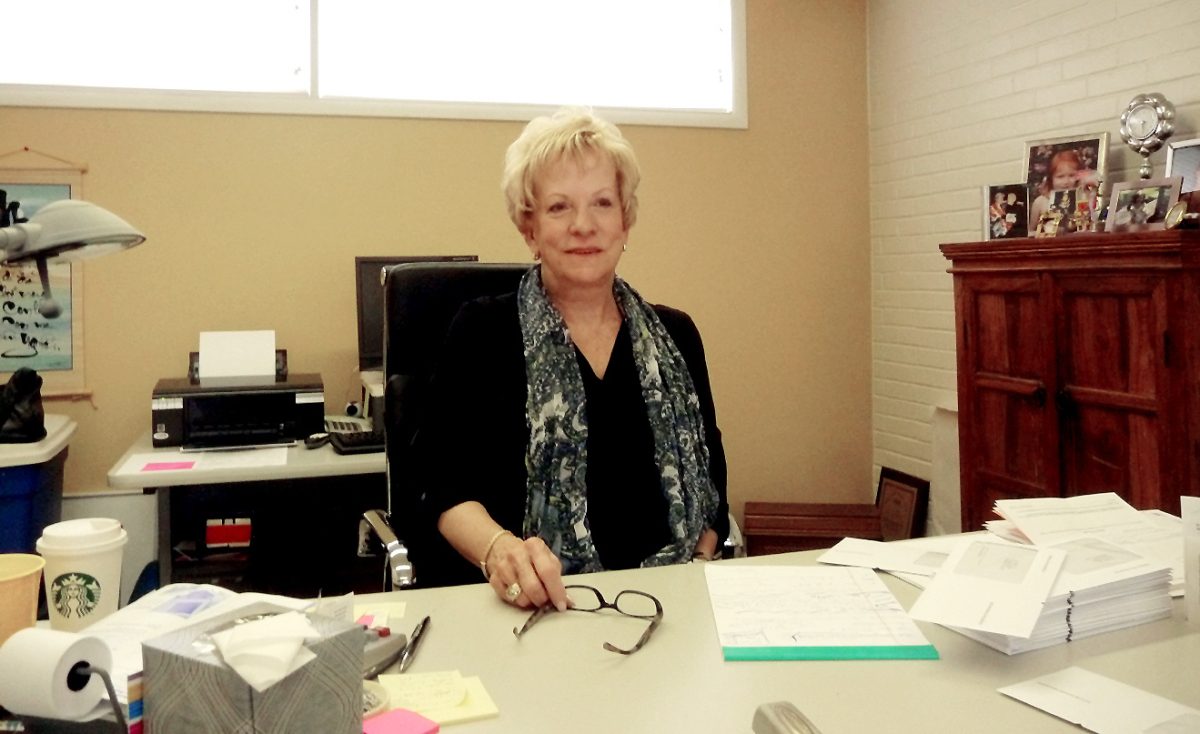
Billie Morris has operated Washington Ambulance & Chair Service since it started operations in September 1962.
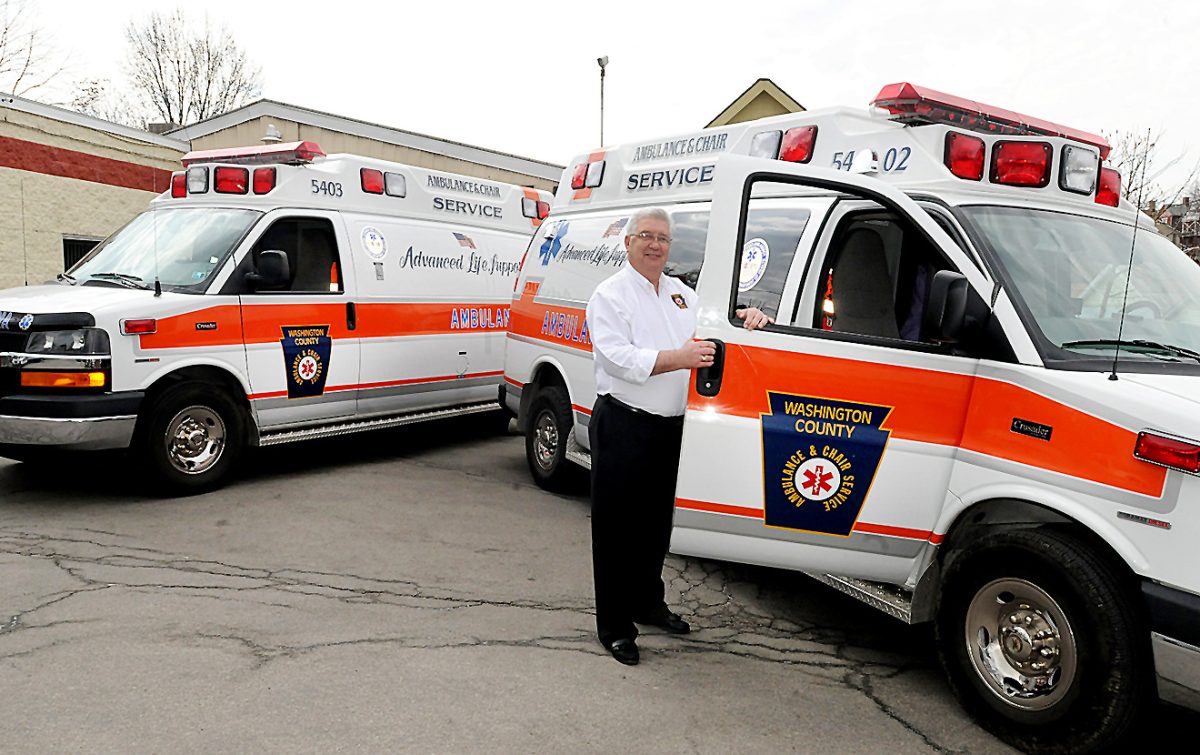
Rodney Rohrer stands outside the Washington Ambulance & Chair Service facility in Washington with two ambulances from the service’s fleet Wednesday. Rohrer has been with the service for nearly 30 years.
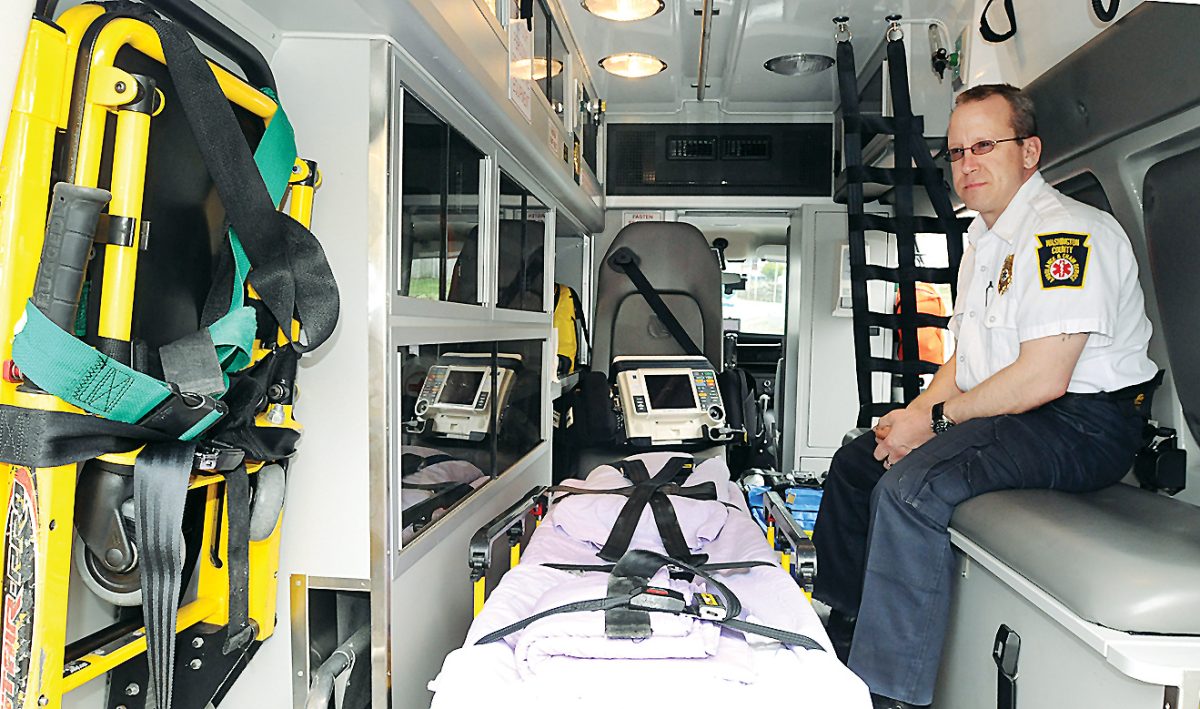
Brad Walker, a paramedic with Washington Ambulance & Chair Service for 20 years, is shown inside one of the service’s many fully equipped ambulances.
She was 19, the mother of an infant and a business owner in a primitive, male-dominated field. Billie Morris was inundated, but not overwhelmed, back in 1962, so she took on more.
As the owner/operator of the fledgling Washington Ambulance & Chair Service, Morris was responsible for emergency calls coming in from the city of Washington and much of the surrounding county. She had the calls routed to her home, and to assure she wouldn’t sleep through, she connected the phone line to firehouse bells hanging above her bed.
It would be a long-term routine.
“I answered the phone seven days a week, at all times, for 19 years,” Morris said, chuckling mildly. “I got so used to it, I could take the baby out of the bathtub and start drying before the second ring.”
More than 50 years after those first calls, Morris is still answering the bell – metaphorically. She has been in charge of Ambulance & Chair since its birth in September 1962, nurturing it the way she did her three children, putting and keeping it at the forefront of emergency services companies, and guiding it through a half-century of change and financial challenges.
“Being in this profession has been a financial juggling act for 50 years,” said Morris, head of a for-profit organization.
She is no longer awakened at 3 a.m. by shrill bells two feet above her head, but at 69, Morris remains busy in a busy business.
“This is 24 hours, seven days a week,” she said. “We don’t close at 5 o’clock.”
Today, she oversees a company with 82 employees – full and part time – that serves 27 municipalities in Washington County, covering 385 square miles. It responded to 15,670 calls last year, or about 43 a day.
Amidst its frenetic, cash-strapped existence, Ambulance & Chair has a reputation for innovation. According to its website, ambulanceandchair.com, the company co-sponsored the first Emergency Medical Technicians class in the state (1971); trained and employed the first paramedics in the county (1973); and developed and implemented the first Automated External Defibrillator (AED) program in Pennsylvania (1992).
“I’m not sure of the number of lives saved with the AEDs. That wouldn’t have occurred without Billie getting some funding,” said Gene Vittone, Washington County district attorney and former assistant manager for Ambulance and Chair.
“They have been the gold standard in terms of medical care since day one,” said J. Bracken Burns, a former county commissioner who worked for Morris in the 1970s.
“They’ve always been on the cutting edge,” added Burns, a licensed paramedic who ran the county’s emergency management and emergency medical services departments for 20 years. “It was the first (organization) that required a paramedic being on every ambulance. Other organizations in the state are decades behind Ambulance & Chair.”
Paul Paris, the company’s medical director for the past year, said, “I’ve been involved with many EMS systems and I’ve never seen such a sense of pride and dedication as I see here.”
Paris, also an emergency physician for UPMC and a professor of emergency medicine at the University of Pittsburgh, added that “despite being relatively rural, they’ve always provided state-of-the-art care.”
Rodney Rohrer, service director for the organization, said “one reason we’ve been able to survive is Billie has been able to adapt to change in EMS over the years. Whether it’s training, equipment, whatever, she’s been very proactive.”
Morris, a lifelong Washington resident, long ago pledged to be progressive.
“I’m proud of (the company reputation), but we can’t rest on that,” she said. “I’m proud of everyone who has been involved, but we don’t stop here. There are constantly new equipment and procedures and we keep up with that.”
Ambulance & Chair, like many ambulance services that go back to the Kennedy administration and beyond, had crude, humble beginnings. In general, local funeral directors used their vehicles to transport patients to hospitals. A group of them merged in the early ’60s to form Ambulance & Chair.
The company name, Burns said, evolved out of the directors pooling their “ambulances” and chairs from their businesses to serve patients.
“There were no standards back then,” Burns said. “You could run out in a station wagon and pick up someone having a heart attack and take them to a hospital.
“It was really a bunch of funeral directors in converted hearses taking patients to hospitals. Ambulance & Chair grew out of funeral directors wanting to get out of that because it was not their stock and trade.”
Rohrer said: “We started with Cadillac ambulances. I started with Greenlee Funeral Home in Beallsville when I was 16. There was no training. They just wanted a driver.”
Morris remembers those times vividly. She said the vehicles used had only oxygen and a stretcher inside.
“They went fast and they said a prayer,” said Rohrer, a 27-year employee who said he virtually oversees day-to-day operations.
The industry has changed dramatically over the past half-century with procedures, personnel and technology.
“To move from what it used to be to having paramedics and sophisticated ambulances with EKGs and drugs being administered in the field was unheard of in the 1970s,” Burns said.
Staying in business isn’t easy for any emergency services company, and many shut down. Operating costs – including new equipment, vehicles and payroll – can be prohibitive.
Morris said Ambulance & Chair does not get tax money and is not eligible for grants. It bills patients, has membership drives and borrows money.
“I have good credit,” she said. “We pay our bills.
“At times, it has been extremely difficult to make payroll. At times, employees have gotten paid and I haven’t. Fortunately, things have gotten much better, but it’s still a juggling act.”
Paris, the medical director, appreciates her dexterity in keeping the plates spinning.
“It’s like Billie’s family business. She’s begged and borrowed to keep it floating.
“I think the citizens don’t realize what a high-quality service they have. There are a lot of services going out of business or can’t provide the services necessary. Billie has kept it going. She has a heart as big as the county.”
“I grew up with Billie’s business,” Vittone said. “I’m one of her children. That business has always generated a certain amount of pride. You want to work there.”
Although Paris is with UPMC, Morris said Washington Hospital was its medical director for 35 years and her company still has a strong relationship with it. She also said patients choose where they want to be transported.
Although she will turn 70 this summer, Morris plans to continue to, perhaps, infinity and beyond. She is trim, in great health and not planning to retire.
“Once in a while, I hear through the grapevine that I’m retiring. I don’t know where that comes from, but I don’t know how to retire.
“I love it. It still excites me when we have successful trips, when someone saves a life with a procedure we didn’t have 10 years ago.
“There is stress, but there are so many good things that outweigh the stress.”
She acknowledges that she works “normally now,” and has “learned to appreciate my private time. All my efforts go to this company, my children and grandchildren.”
Morris has a daughter, son and two granddaughters in Richmond, Va., and a daughter in London.
Then there is her larger family.
“I’ve raised a lot of children here,” Morris said of Ambulance & Chair. “I wouldn’t be alive if I didn’t have a great staff around me. There’s no No. 1 in this company.”
Oh, but there is.