

W&J entrepreneur awardees took risky paths to success
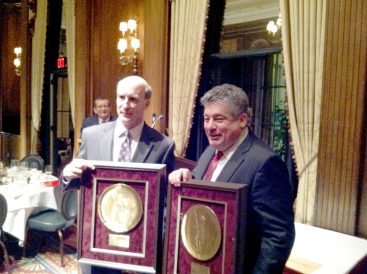
PITTSBURGH – Washington & Jefferson College honored two city builders with its “Entrepreneur of the Year” award Thursday during a banquet at the Duquesne Club in Pittsburgh.
Both honorees, who received plaques from W&J President Tori Haring-Smith, noted in their remarks, which were aimed at current entrepreneurial studies students attending the event, that they had envisioned more traditional careers before undergoing a transformation into more risky but ultimately more rewarding entrepreneurial paths.
David Ross, a 1978 W&J graduate who is founder and president of Atlantic Realty and has developed 10 million square feet of commercial, industrial and retail property in Washington, D.C., and Baltimore, and Dennis Yablonsky, chief executive officer of the Allegheny Conference on Community Development, accepted the honors at the 27th annual event, which is hosted by the college’s entrepreneurial studies program.
Ross, who graduated from W&J with a degree in political science, had originally planned to attend law school but changed his career path after an internship with a local planning commission that led him to earn a master’s degree in urban design from the University of Pennsylvania. During graduate school, Ross worked on a project that made Atlantic City, N.J., a more pedestrian-friendly city.
After graduation, he said, he received two important offers, one working for Alcoa on a variety of the company’s business projects, and another with real estate developer Rouse Co. in Columbia, Md., doing market research for its new communities division.
The salary at Rouse “was more than half” of the Alcoa offer, and Ross noted that interest rates at the time were 18 percent or more, making the real estate job more risky.
But after four years at Rouse, he became a vice president of leasing for another commercial real estate firm, and a decade later formed Atlantic Realty.
Yablonsky, who in 2009 became CEO of the Allegheny Conference and its affiliates – the Greater Pittsburgh Chamber of Commerce, Pennsylvania Economy League of Southwestern Pennsylvania and the Pittsburgh Regional Alliance – had a similar story of deciding to veer from the opportunity of a traditional career path for something much more entrepreneurial.
When he received a degree in business administration from the University of Cincinnati in 1975, Yablonsky was offered a job in marketing at consumer products giant Procter & Gamble, which he described as a coveted position for new grads.
He opted instead for a position at a 50-person company that at the time was one of only three software development companies in the United States.
“When I joined … my family thought I was nuts,” Yablonsky recalled, adding that his wife, Ronnie, encouraged to take the more uncertain job.
The experience paid off, with Yablonsky becoming chief operating officer of a successful Cincinnati tech company by age 32.
He would come to Pittsburgh in 1987 to lead the Carnegie Group, an artificial-intelligence company, and ultimately help to transform Pittsburgh into a science and technology center, becoming CEO of the Pittsburgh Digital Greenhouse and the Pittsburgh Life Science Greenhouse.
Prior to joining the Allegheny Conference, Yablonsky served as secretary of Pennsylvania’s Department of Community and Economic Development under Gov. Ed Rendell, playing a lead role in the development of an economic stimulus program that featured more than $3 billion of investment in the commonwealth’s infrastructure, core communities and job-producing businesses.
Yablonsky told the audience that Pittsburgh in the early 1900s was the entrepreneurial center of the country, a giant in business, social, civic and philanthropic efforts, driven by people like Andrew Carnegie, George Westinghouse, Henry Clay Frick and Andrew Mellon.
“But then we got complacent and that entrepreneurial spirit went away,” he said.
What is encouraging, he added, is that three of the five economic development sectors that contributed to Pittsburgh’s economic well-being during the early days – manufacturing, finance and energy – remain core industries today.
And on the high-tech frontier, the conference works with 1,600 information technology companies in the region.
The other startling fact about the region today is that it has the second-highest concentration of philanthropic assets in the country.
“It took 30 years, but look where we are today,” he said.
Ross encouraged the young entrepreneurs in the audience to make the most of their education at W&J, with participation in independent study projects.
“Be disciplined about achieving goals while not being afraid to reach beyond those goals,” he said.
“And have fun.”
W&J’s Entrepreneurial Studies Program was started in 1986 with financial support from 84 Lumber Co. founder Joseph A. Hardy III. Thursday’s banquet was attended by 11 outstanding students of the program, who are designated as Hardy Scholars.