

The sky’s the limit Renowned engineer sees bright future for solar’s potential at home
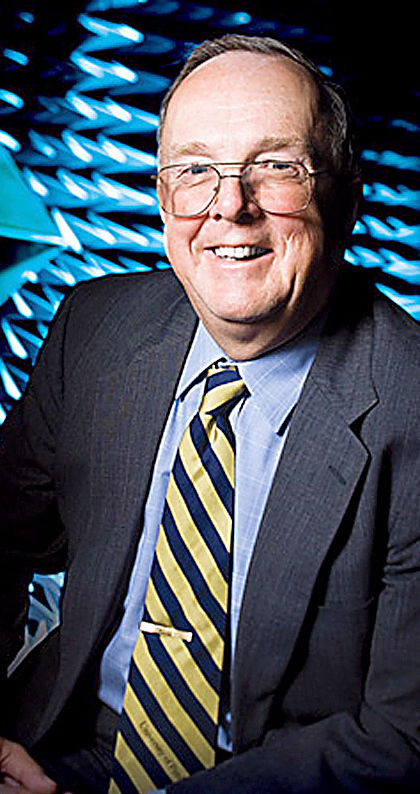
Dr. John A. Swanson
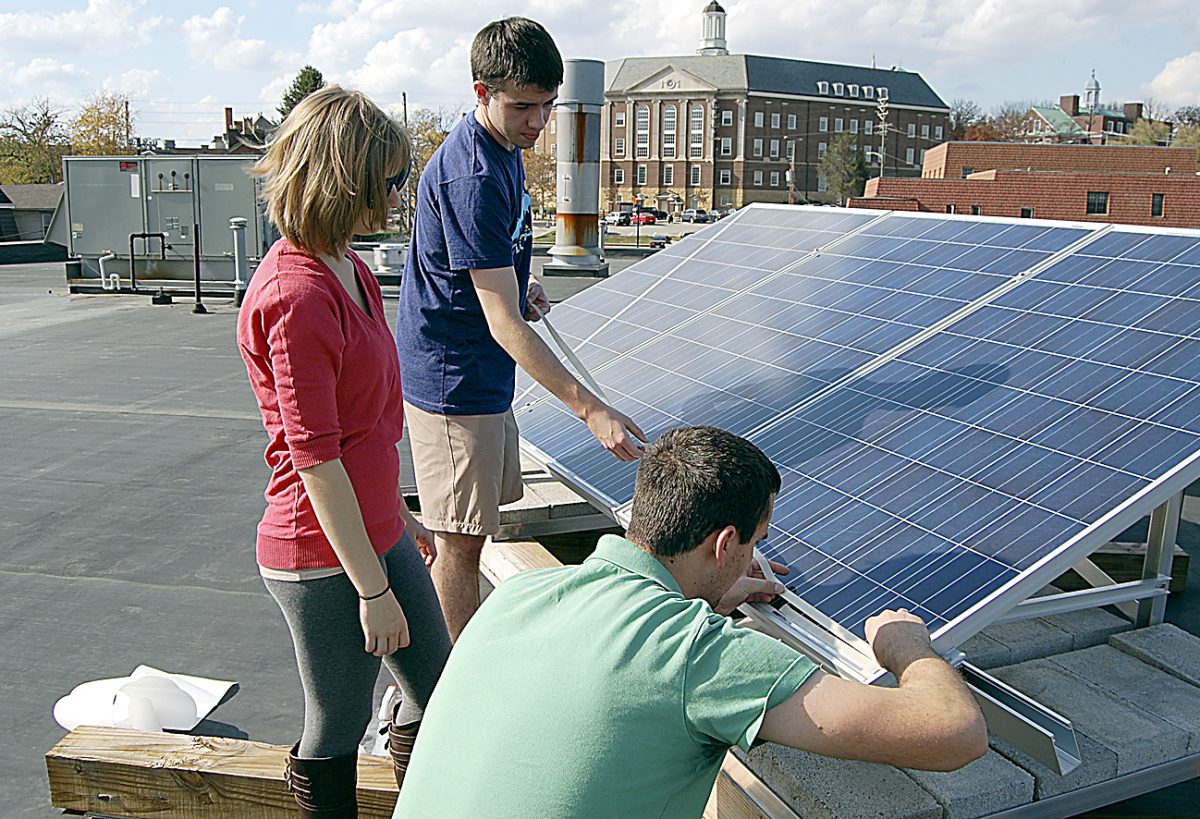
Washington & Jefferson College students Cameron Glagola, foreground, Megan Nissley and Michael Roth test the impact of masking tape patterns on solar panels mounted on the roof of the college’s Facility Services building.
John A. Swanson is an internationally recognized engineer, a fabled philanthropist and a big man on three campuses.
He also is an energy maven, and few things energize him the way solar does – as an audience at Washington & Jefferson College came to realize.
“It works and anybody can do it,” Swanson said Oct. 3 as the kickoff speaker in the W&J Energy Lecture Series for this academic year.
He spoke for an hour on “The Future of Small Scale PV Solar Energy,” a lecture that was breezy, spiced with wry humor, and captivated a crowd of about 70 inside the Howard J. Burnett Center’s Yost Audiorium. Swanson fielded questions for about 20 minutes afterward.
“We don’t have an energy problem in this country. We have an energy opportunity,” Swanson said, en route to explaining how solar can be – and should be – a larger part of that equation.
He pointed out that this renewable source naturally produces light and heat, but provides a mere 1 percent of electrical energy in the country – and that 10 percent is a reasonable goal.
Solar’s pros are many, Swanson said in a PowerPoint demonstration accompanying his lecture. They include: sunlight is free and widely available; energy is produced at the point of use; large distribution lines are not needed; there is no noise or carbon dioxide production, as with coal; and a solar system is economically sound and environmentally friendly.
Non-daylight, clouds and jet trails are the leading cons.
The expense of implementing a residential solar system, with multiple panels, and fears of the resultant appearance dissuade a number of people. “It’s viewed as too expensive, and people complain that it’s ugly. No, it’s not in either instance,” Swanson said.
He has a 10-kilowatt system on the roof of his retirement home in Florida that initially cost $50,000-plus. Federal incentives lowered the price, however, and it is a long-term investment that pays off in lower utility bills. Plus, a homeowner with excess electricity can sell it back to a utility.
Panel prices also have declined precipitously over the past 35 years, and maintenance is not horrific. Cleaning is recommended, of course, and can be expensive, but throughout much of the nation, it can be done infrequently without significant loss of energy efficiency.
“I have a solar panel I haven’t washed in three years,” Swanson said. “Now if you live in a desert and put in a system, because of dust, you may have an issue with cleaning.”
Photovoltaic solar panels – the aforementioned PV – is the key to everything. Each goes about 3 feet by 5 feet, weighs 42 pounds, and converts sunlight to electricity by producing direct current. DC is converted to alternating current by system inverters, which are sometimes criticized for wearing out in 10 to 20 years.
Swanson’s conclusion about solar? It does, indeed, work for anybody.
“It’s price-effective, and the prices are coming down,” he added. “If someone can fix inverters, we can go gangbusters.”
His imprint on W&J is profound. He was on the board of trustees there for 12 years, provided the naming gift for the John A. Swanson Science Center and is assisting a team of students that has undertaken a solar project there.
W&J President Tori Haring-Smith spoke of his largess – financial and otherwise – when she introduced Swanson at the lecture.
“At the groundbreaking for the Swanson Science Center, he said, ‘Most people say you should give until it hurts. I give until I smile.'”
The Swanson School of Engineering at the University of Pittsburgh also bears his name. Swanson also has donated large sums to Cornell University, where he earned bachelor’s and master’s degrees in mechanical engineering.
A member of the National Academy of Engineering, Swanson began his career at the Westinghouse Astronuclear Laboratory in 1963. Seven years later, he founded Swanson Analysis Systems, which eventually was renamed Ansys Inc. It is a global provider of engineering simulation software that is based at Southpointe.
Swanson was preceded on the dais by Evan Rosenberg, a W&J senior who leads a four-student team that, for 15 months, has done solar panel research on campus. The four are collecting data from 18 solar panels at the Swanson Solar Laboratory, on the roof of the Facility Services building.
Rosenberg said they are trying to determine “whether it is worth investing in” setting up a permanent array of panels on campus.
He, Bayleigh McMenamin, Zachary Rosinger and Michael Roth comprise the team that is under the auspices of Swanson and assistant professor Michael McCracken. Rosenberg thanked Haring-Smith for helping to secure funding and Swanson for donating panels.
The second lecture in the five-part series will be at 6:30 p.m. Oct. 23. The topic: “Should We Rethink Nuclear?”