

Decline in fossil fuel industries here led business news in 2015
Michael Bradwell/Observer-Reporter The exterior of the Mylan headquarters
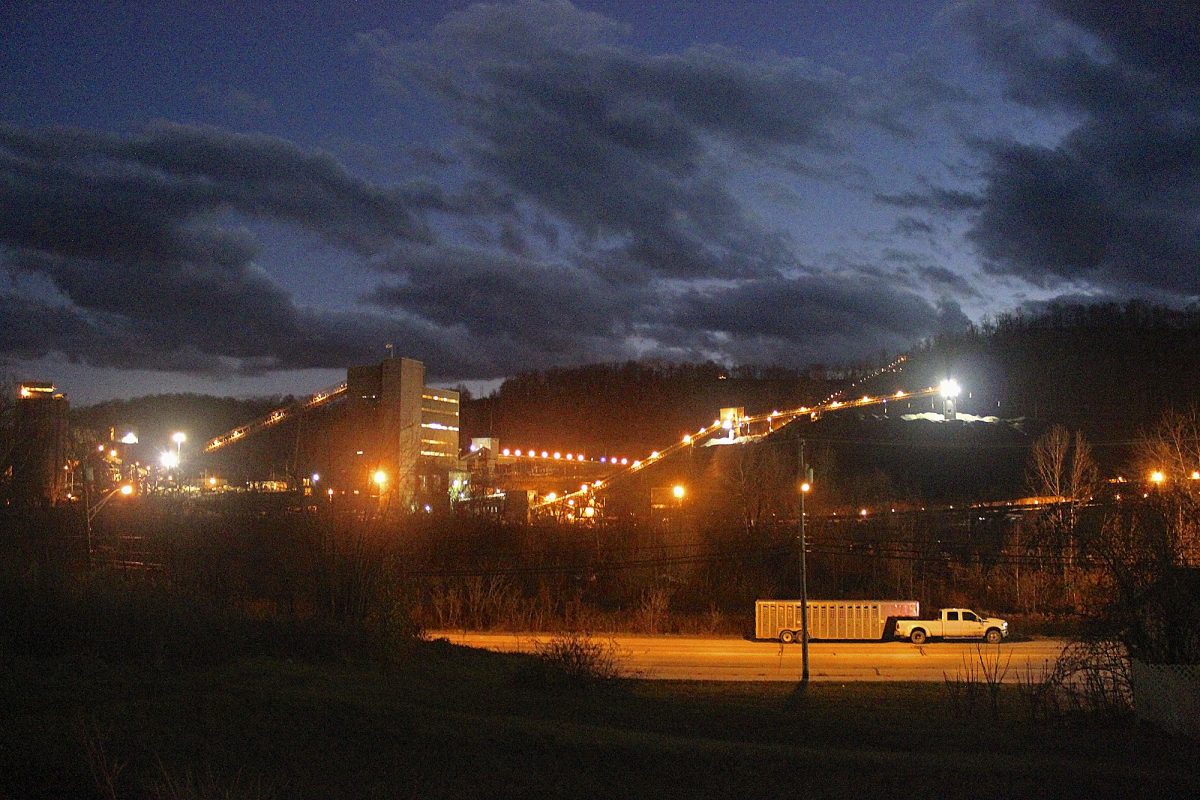
A view of Emerald Mine at dusk Thursday. Alpha Energy closed the mine earlier this month after operating it for nearly 40 years.
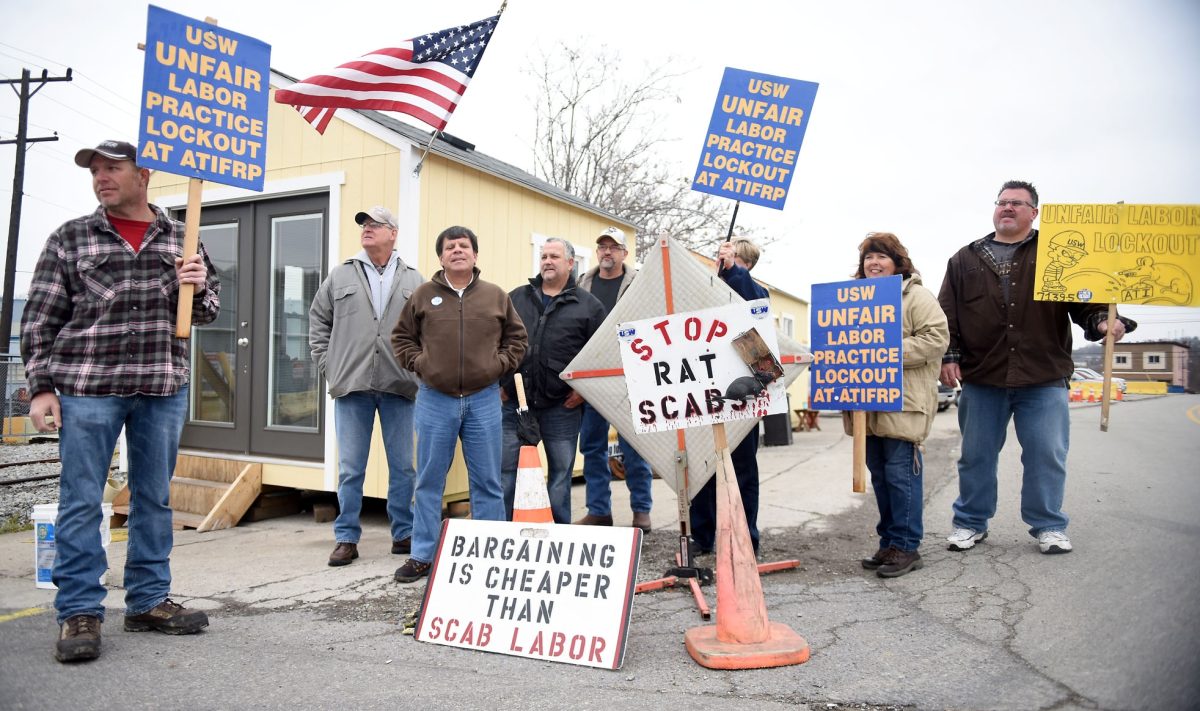
Katie Roupe/Observer-Reporter ATI workers picket Monday outside the company’s Canton Township plant. Benefits for union employeees ended Monday. They have been locked out for 3 1/2 months.
The absence of energy in the area’s economy was palpable well before the end of 2015.
By fall, the unemployment rates in Washington and Greene counties, which had reached historic lows earlier in the year, began to rise.
According to the Pennsylvania Department of Labor & Industry, the jobless rate in Washington County was 5.5 percent in October, up 0.6 percent from 4.9 percent in December 2014. In the same period, Greene’s was up a full two points, from 3.9 percent to 5.9 percent.
Coal mining was slammed by the advent of adverse regulatory changes, and natural gas suffered from a supply glut exacerbated by the lack of sufficient pipelines to carry it to markets.
Stated simply, after many years of running hot, fossil fuels went into a much slower burn here, and the chill was felt well beyond the mines and drilling pads.
The closing of Alpha Natural Resources’ Emerald Mine in mid-November impacted hundreds of coal miners in Greene County, and was emblematic of the many mine closures throughout Appalachia in 2015.
The closure of the mine near Waynesburg had been long rumored, but the finality of the shutdown was especially painful for those who were left without jobs.
Elsewhere in the industry, the news wasn’t any better. Consol Energy’s initial public offering of its thermal coal assets failed to bring what the company had originally estimated. Later in the summer, the company put its planned metallurgical coal IPO on hold because of continued degradation of met-coal prices.
Coal once employed thousands across the region. Its future, however, was further clouded in August by the final draft issued from the Environmental Protection Agency’s 2014 hearings on its proposed Clean Power Plan for coal-fired generating plants and the continued transition of utilities from coal to natural gas.
Don Chappel, executive director of Greene County Industrial Developments Inc., which markets EverGreene Technology Park and Paisley Industrial Park, said 2015 was the least productive year for business activity in a decade.
“I probably saw my slowest year in the past 10 to 12 years as a result of the slowdown in oil and gas,” Chappel said in mid-December. He added that the decline in coal in Southwestern Pennsylvania and West Virginia spells many more job losses beyond the mines themselves.
Chappel said two property sales agreements that had been in the works failed to materialize because of the downturn in energy.
“Each (client) cited energy prices” as a reason for backing out of deals, he said, adding that he sold a 13-acre plot in EverGreene Technology Park to Greene County Memorial Hospital Foundation to build a recreation center.
Construction also began by Royal Flush, a natural gas-related company, on a 5-acre pad in Paisley Industrial Park near Carmichaels.
“The coal mine problem is not just a Greene County problem,” Chappel said, adding that the entire energy supply chain in the region saw a loss of jobs with coal mine closures coupled with the downturn in natural gas extraction.
According to the state Department of Labor & Industry’s November preliminary jobs report, the mining and logging sector, which includes coal and natural gas, was down statewide by 8.4 percent in November, from 37,900 jobs in November 2014 to 34,700 last month. (The specific report for Washington, Greene and the Pittsburgh region won’t be released until the final days of December, but will reflect the losses of jobs from Emerald’s closure.)
The state report mirrors the job losses in the national energy industry, where the Associated Press reported the loss of 11,300 jobs in November’s U.S. jobs report.
As Chappel noted, the loss of direct jobs in the two fossil fuel industries spelled broader losses in the energy supply chain.
“The supply chain is enormous; the region supplies the coal mining industry with hydraulics, roof bolters,” he said, adding that railroads also felt the loss of coal shipments.
Where the natural gas supply chain could have absorbed some of the impact from coal’s woes in normal times, those working to supply oil and gas companies here felt the impact of the slowdown.
Natural gas produced from the Marcellus and Utica shales spent the year in a downturn primarily because of a supply glut exacerbated by a lack of pipeline infrastructure to carry product to external markets.
All the major producers announced drilling plans in late December and early January, only to downgrade them once and, in some cases, twice, within a month or two of their original estimates.
Paul Battista of Sunnyside Supply in Slovan, who saw his business expand over the years with the growth of natural gas drilling in the tri-state area, is now wondering when it will turn around.
“We’re probably down 30 to 35 percent,” Battista said in mid-December. “The scary part is we don’t know how long this bottom is going to last. What we’re asking ourselves is, ‘Can we wait another year, or do we have to change some things internally here?'”
Fairmont Supply, which was spun off in December 2014 from Consol Energy Inc. to Tenex Capital Management, spent the year transforming itself from a longtime supplier to the coal and natural gas industries into an across-the-board industrial supplier.
It also moved from its old headquarters in Southpointe II to space in its Jefferson Avenue warehouse site, where, at the same time, it incorporated a separate oil and gas product distribution center from Henderson Avenue.
“We’re now fully integrated,” said Fairmont’s new executive chairman, Rudi Strobl. “It’s now a true industrial distribution company.”
The decline has negatively impacted Model Cleaners, said John LaCarte, president of the Charleroi-based company.
“This has been a challenging year,” he said. “We deal with a lot of companies, particularly industrial companies, that require uniforms for their employees. When people are laid off, there are fewer pieces to clean, fewer people in garments.”
LaCarte, who also is president of the Middle Monongahela Industrial Development Association, is concerned about forecasts that suppressed natural gas prices will continue. He said that is troubling not only for his family operation, but for the region and nation.
Model Cleaners, however, has found a silver lining amid the energy clouds. “Our company has benefited by lower gas prices because we have so many delivery trucks,” LaCarte said. “That has mitigated some revenue changes.”
Sunnyside’s Battista saw a bright spot as well.
“We’re getting more requests for quotes,” he said. “The industry’s shopping, they’ve got the time.”
Sean Sullivan, general manager for The Meadows Racetrack & Casino, said he’d like to see the natural gas industry reignite, but added that the downturn in oil and gas didn’t have a big impact on the North Strabane Township gaming and entertainment venue.
“That hasn’t killed us,” said Sullivan, adding that he’s “more concerned about the families and the layoffs and their impact to them,” and what that means in terms of the area’s economy.
Meadows Marketing Director Kevin Brogan and Sullivan acknowledged that they see a decline of gas workers’ “white pickup trucks” in the parking lots of the hotels that line the mile-long stretch of Racetrack Road.
“On the hotel side, we have suffered some in terms of occupancy and average daily rates,” Sullivan said. A 150-room Hyatt Place hotel opened next to his facility earlier this year, the latest entry to Racetrack Road’s hospitality offerings. More than 1,000 rooms have been added there in recent years.
Brogan said The Meadows has been successful in diversifying itself for a number of different demographic groups that have helped to shield it from the impacts of the energy industry’s downturn. Sullivan noted that the casino saw strong revenues, especially in the second half of 2015.
At the deadline for this story, only EQT had released its 2016 spending plan, forecasting capital expenditures of $1 billion in 2016, which includes $820 million for well development. Last year, the company forecast $2.3 billion in capital expenditures that included $1.95 billion well development.
But indications are the shale gas industry will spend another year of dialed-back activity.
Range Resources, the area’s biggest exploration and production company for natural gas, isn’t expected to announce its 2016 plan until February. But according to information provided by the company, it will look to spend between $550 million and $890 million. Last year, after initially projecting a budget of $1.3 billion, Range revised its capital expenditures to $870 million.
While producers expect another year of slow production, many industry analysts see 2017 as a year when some pipeline projects will be completed and begin carrying the region’s abundant supply to other markets. Credit Suisse, for instance, is projecting that the U.S. will become a net exporter of natural gas in 2017.
But that would mean some major pipelines being completed by then – a tall, and critical, order.
Grant Ruckel, senior director of government affairs for Energy Partners, was blunt about the supply bottleneck when he addressed the Washington County Chamber of Commerce in the fall.
“There simply aren’t enough pipes” to move the volume of gas coming out of the region, said Ruckel, whose company is building the Rover Pipeline, which will connect locally produced gas to Midwest markets, as well as the Mariner East 2 and Mariner West pipelines across Pennsylvania that will carry product to the East Coast.