

National unemployment rate jumps to 5 percent
WASHINGTON – U.S. employers added a decent 156,000 jobs in September, even while an influx of job seekers lifted the unemployment rate slightly to 5 percent, the Labor Department reported Friday. The rise in people seeking work is an encouraging sign Americans are more optimistic about their prospects.
The jobs gain last month, though modest, suggested the U.S. economy remains steady if not particularly strong.
Wages also rose and are increasing at a healthier pace than they were earlier in the economic recovery – a trend that may be drawing more people into the job market to look for work.
For much of the recovery, the proportion of Americans who either had a job or were looking for one had been declining as an aging population led to many retirements. Many of the unemployed also grew discouraged about their prospects.
Others stayed in school or remained at home caring for relatives.
Yet in the past year, the proportion of adults either working or looking for work has risen from a 40-year low of 62.4 percent to 62.9 percent. That is still far below pre-recession levels. But the proportion has increased even while many people in the vast baby boom generation have been retiring.
Jobs growth has averaged 178,000 a month this year, down from last year’s pace of 229,000. Still, hiring even at this year’s level is enough to lower the unemployment rate over time. And economists have been expecting the pace of jobs growth to slow as the supply of unemployed workers declines.
The September hiring figures probably will keep the Federal Reserve on track to raise the short-term interest rate it controls by December, economists said. After seven years of pinning that rate at a record low near zero to try to spur more borrowing and spending, the Fed raised its rate modestly in December. It has not acted since.
“The September payroll report was a decent report that shows moderate job growth continues,” Scott Anderson, chief economist at Bank of the West, wrote in a note. “In many ways, it was a ‘Goldilocks’ number – not too hot or not too cold – for the market and the Fed.”
Friday’s report also comes a month before voters will decide a presidential election in which the two major nominees have sketched out wildly conflicting views of the economy’s health and what should be done to stimulate its growth.
Average hourly pay rose 6 cents to $25.79 in September, and is up 2.6 percent from a year ago. That’s better than the gains throughout most of the seven-year economic recovery, during which pay has increased about 2 percent a year. The pay increases, modest as they are, suggest that many employers are being forced to pay more to attract workers.
Yet, wage gains are still lagging behind the roughly 3.5 percent pace that has long been consistent with a healthy economy.
Nearly all of the net job gains last month occurred in the services industries, including such higher-paying services as management and technical consulting, accounting and computer networking.
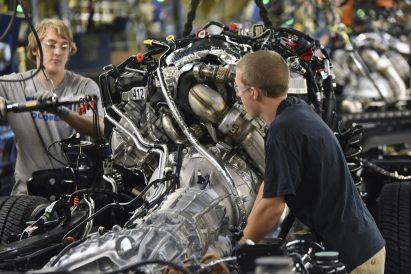
Manufacturers shed jobs for a second month in a row, cutting 13,000. Manufacturers have struggled for the past 18 months as businesses have reduced their spending on machinery and other equipment. Donald Trump, the Republican presidential nominee, has focused his economic proposals on restoring manufacturing jobs.
Last month, construction added 23,000 positions and retail 22,000. Employers added 15,000 jobs in a category that includes restaurants, hotels and casinos, its slowest gain since May. Hiring also slowed in the education and health sectors.
Recent data suggest the economy is picking up after a weak start to the year, though growth is unlikely to accelerate very much.
Consumer spending was flat in August, the weakest showing in five months. And factories have struggled as businesses have put off investing in new machinery, computers and other equipment.
Still, a recent private survey found that manufacturing expanded in September after shrinking in August. Orders for factory goods jumped, suggesting that output may rise further.
Consumers also appear increasingly confident about the economy, which could stimulate a rebound in spending. Consumer confidence reached a nine-year high last month.
Retailers are expecting robust spending for the holiday shopping season. The National Retail Federation projects that holiday spending will rise 3.6 percent this year from last year. That’s better than last year’s gain and slightly above the 3.4 percent average since the Great Recession officially ended in 2009.
The economy expanded at just a 1.1 percent annual pace in the first six months of the year. Still, economists have forecast that growth accelerated to a 2.5 to 3 percent annualized pace in the July-September quarter.
The slower growth hasn’t led employers to cut back on staffing. Applications for unemployment benefits, a proxy for layoffs, fell on average last month to a 43-year low.