

A riveting performance BalTec’s machines do duty in thousands of applications daily
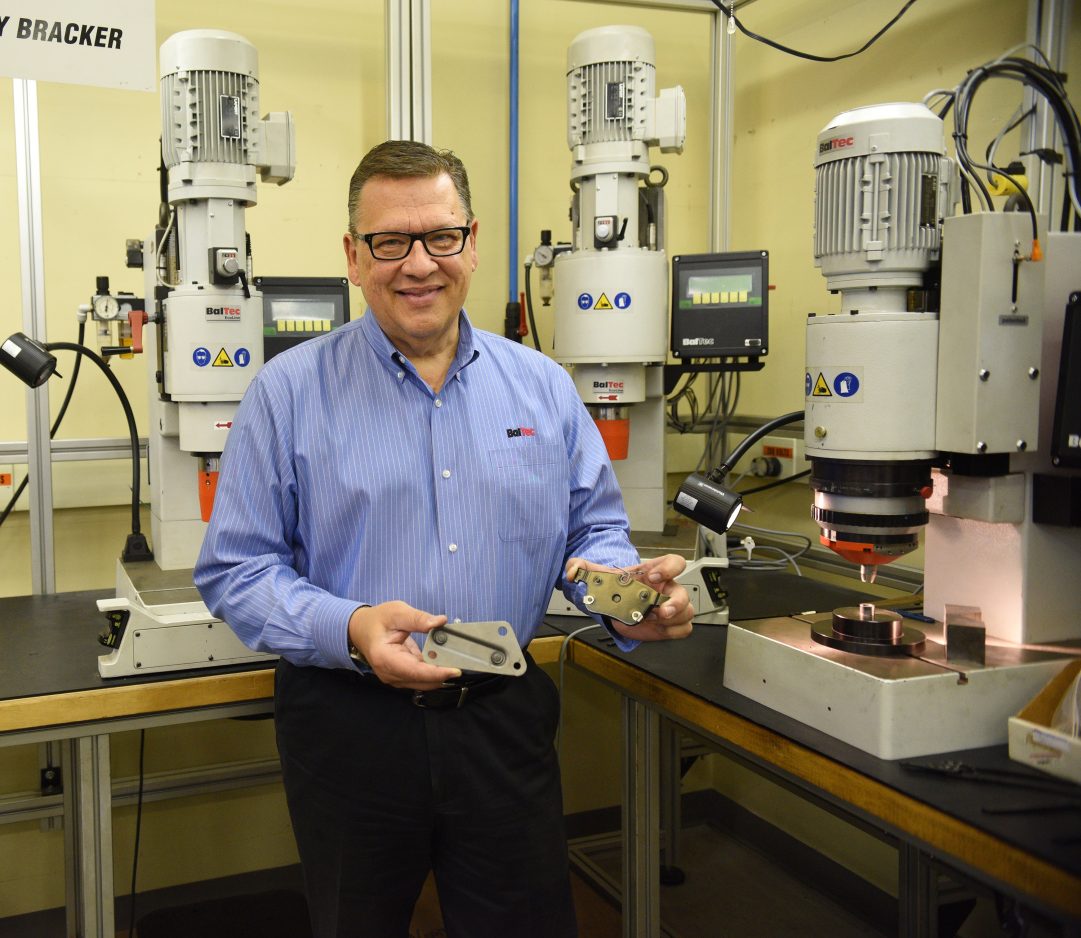
Chuck Rupprecht, general manager at BalTec Corp.’s North American headquarters, holds a striker assembly for a Ford F-150 and a brake pad for a Tesla in the company’s lab on Hillpointe Drive.
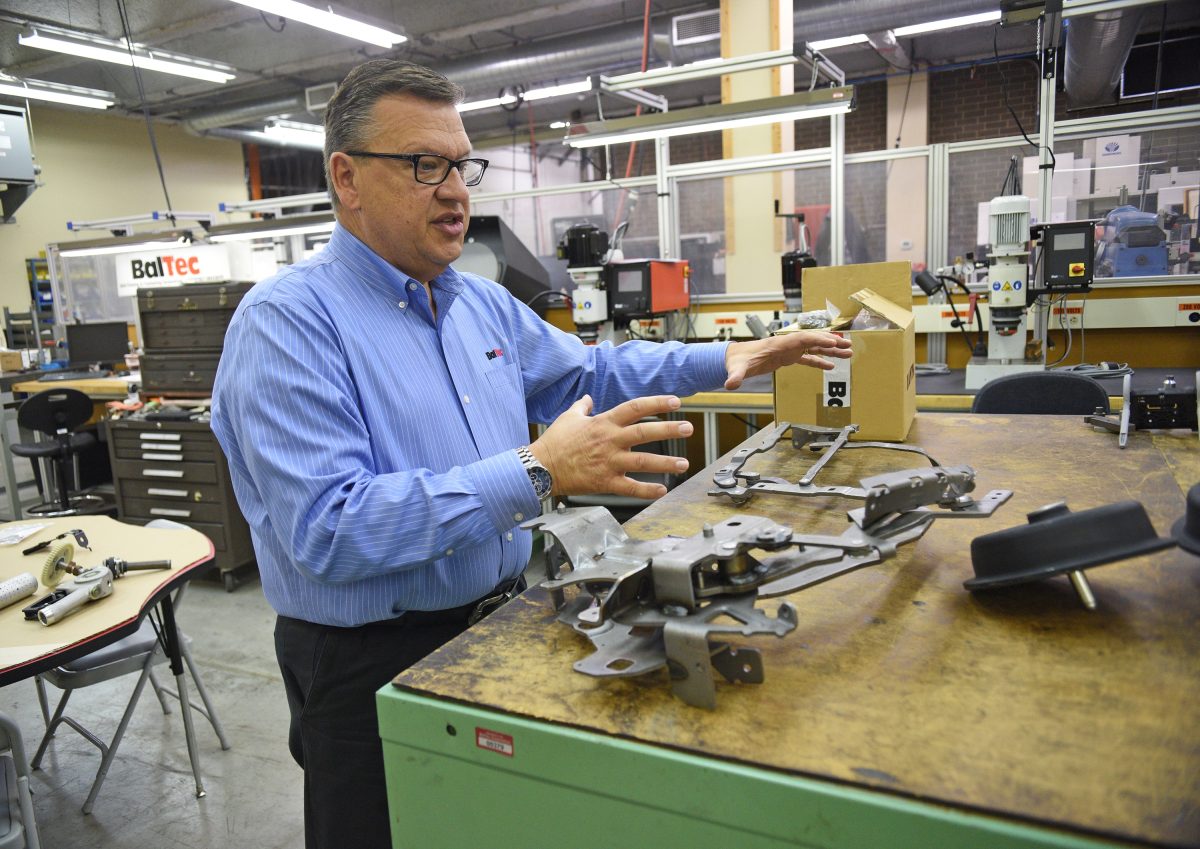
Chuck Rupprecht describes the frame BalTec built for the supplier of the convertible top for Ford’s Mustang convertible. The frame contains includes 24 hinges, each of which has a rivet that makes operating the roof possible.
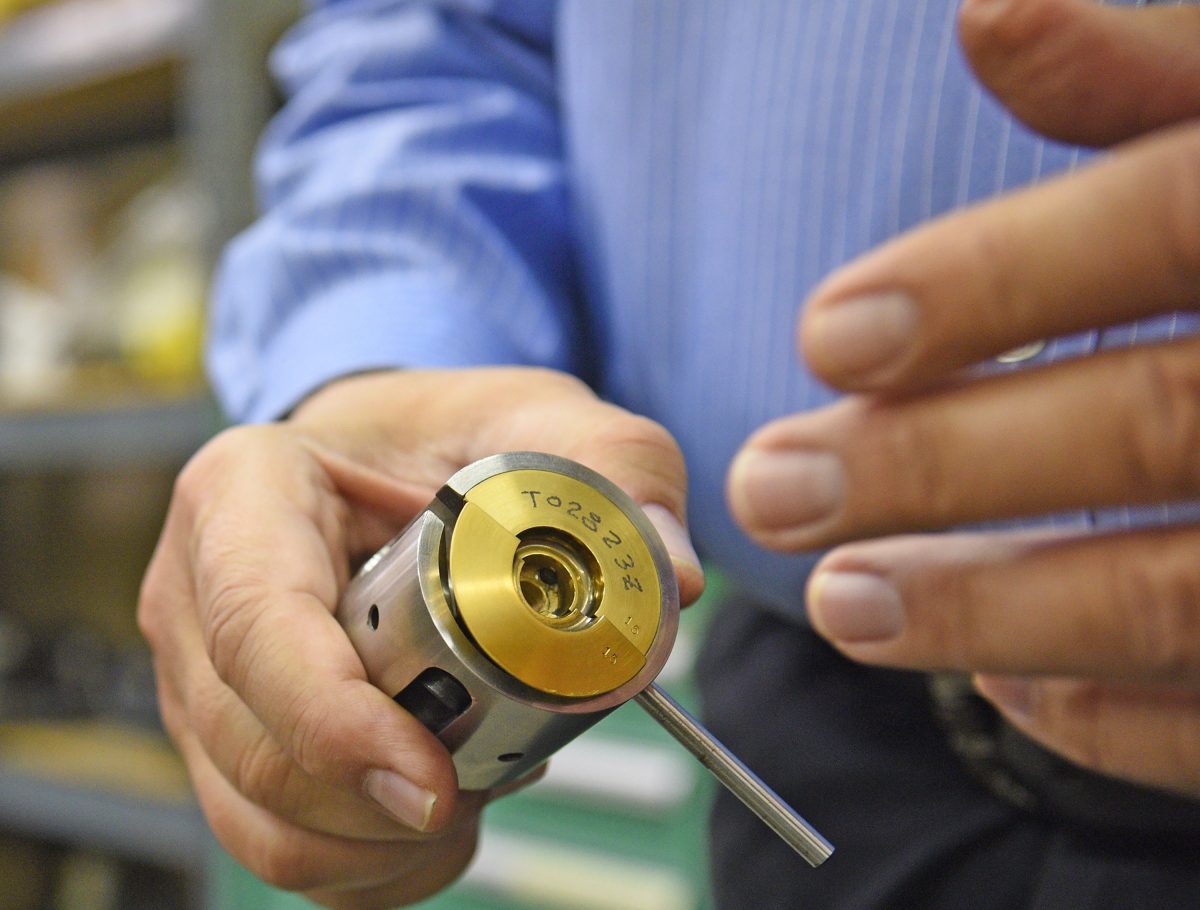
This tool is used to place rivets in car airbags.
It’s a small but indispensable piece of hardware that makes everything – from a pair of pliers to a convertible roof – do what it’s supposed to do every time.
It’s a rivet, and it does its job so well that it’s taken for granted, if it’s ever considered at all.
From a small workshop inside BalTec on Hillpointe Drive in Southpointe, a team of 15 people, including machinists, mechanical engineers and an application engineer, help manufacturers in all types of industries put function to form, solving the challenge of parts they’re designing and where rivets will need to be strategically placed to do the job they need to do.
“We’re a pretty cool company,” said Chuck Rupprecht, general manager of BalTec’s North American headquarters at 121 Hillpointe Drive. “We could be considered more of a niche company.”
But it’s an impressive, critical niche. BalTec, based in Switzerland, has about 45,000 of its riveting machines in operation worldwide, with about 25,000 of them in the U.S. Those machines are responsible for placing rivets that make tens of thousands of parts work.
“About 65 percent of our business is automotive-related,” Rupprecht said, showing examples of door holders, locking system devices, brake pad pistons, striker assemblies and seat belt buckles. Regardless of which make or model someone drives, Rupprecht said it’s a safe bet that it contains numerous BalTec rivets. The company works with Tier one and Tier two suppliers to the automotive industry.
But standing in front of a table in the shop’s sample room, Rupprecht also showed an array of non-automotive products, including a wire-stripper, pliers, a penknife, an assembly that enables the seat to tilt in a high-end office chair as well as an incredibly tiny rivet at the end of a heart catheter. Each of the products started out with Rupprecht’s group building a prototype for the customer that incorporates a rivet into the manufacturer’s part that will provide the movement needed for a particular function.
Once approved, the part goes into production at the manufacturer.
BalTec’s Switzerland headquarters manufactures three different styles of riveting machines that employ the company’s radial riveting process that creates a rosette pattern that enables the flowing, gentle deformation of the forming material with the least possible force. Riveting material is typically tool steel that is formed using different pressures from either pneumatic or hydraulic sources. Depending upon the application, rivets are either raised or flat.
While BalTec’s machine models are available “off the shelf,” Rupprecht said each can be modified to meet individual customers’ specifications.
“Think of it as a high-end drill press,” he said.
For the staff at BalTec, the challenge is to determine the optimum way to place a rivet so that it performs flawlessly every time it’s used over the life of a product. Sometimes that requires finding a way to place a rivet in a crevice of a part.
But the task isn’t always as daunting as it may seem. Rupprecht pulled open a drawer containing scores of forming tools that have been used on thousands of other prototypes that can usually provide a solution to similar challenges.
What Rupprecht likes most about BalTec’s machines is their integrity on the shop floor. Like the proverbial Swiss watch, the company’s machines have a durability that’s built for the long haul.
“We have machines out there that have been running for decades,” he said, noting one customer who has been using the same machine since 1969.
Many of the machines are operated by a machinist, while some companies incorporate the units into their automation for certain tasks.
In the case of the Ford Mustang convertible top, BalTec created a 24-hinged frame with each hinge receiving a rivet. It then created a machine that enabled the supplying company to make about 200 of the units per day, turning them out at a rate of every 4.5 minutes.
And despite the automotive industry’s need to retool assembly lines annually, Rupprecht noted that companies keep the machines used in the production of parts for older models to service the aftermarket. Depending upon the type of operation, some factories have as many as 250 of BalTec’s machines at work.
Despite the critical role rivets play in tool and assemblies, Rupprecht said it’s difficult to hire qualified people who can help industry solve the daily challenges of creating a riveting performance in its products.
“They’re hard to find,” he said, noting that BalTec has operated a mini-apprentice program with a graduate from Western Area Career and Technology Center, and also has an intern from WACTC’s mechatronics group.
BalTec became a corporate resident of Southpointe in 1998, when it was looking for a new home after running out of space at its former site in Carnegie.
“The company was looking for a place that promoted high-tech companies,” Rupprecht said, adding that the Southpointe address has always fulfilled that requirement.
And with the more recent addition of restaurants and shops in Southpointe’s Town Center, the park makes it easy to entertain customers when they come to visit.
“It shows well,” Rupprecht said.